Featured Photo: A Pacific Marten (Martes caurina) in a 2×2 lope abruptly turns to go a different direction. October 28, 2025, near Cinnamon Butte, Oregon.
Snowfall brings a special kind of tracking opportunity. When hills, forests, meadows and roads–whole landscapes–are blanketed with snow, tracks can go on for many yards or miles. In addition, the relative abundance of tracks in a snowy landscape gives many opportunities to see how tracks from one animal can change in different types of snow and with exposure over time. This post synthesizes observations, experiences and lessons from snow tracking excursions in the Cascades of eastern Douglas County, Oregon, 2019-2025. Not all species that could leave tracks or sign in snow in the Cascades or Umpqua Basin were observed during these outings, but most common species were observed. Let’s take a look at this region, habitat, and its inhabitants together.
The area considered here is in eastern Douglas County in southwest Oregon, from the Cascades summit to about 20 miles west near Toketee Lake. The vast majority of this area is managed by the Umpqua National Forest, and ranges from about 2,500 ft to 7000 ft elevation, with a few higher peaks. I sometimes refer to the High Cascades, which are areas usually 4,000 ft elevation and higher and mostly within about 10 miles of the summit, though some ridges extend farther west. Prominent areas with access include Toketee Lake (2,431 ft), Lemolo Lake (4,150 ft), Cinnamon Butte Road (4,850 to 6,300 ft), and Diamond Lake (5,183 ft). The highest peak is Mount Thielsen on the east side of Diamond Lake at 9,184 ft.
The entire area is dominated by conifer forest with many rivers and streams, scattered lakes and meadows, large burned areas and open areas above timberline. Dominant forest types include Douglas-fir at the lowest elevation, then some patches of true-fir (Abies sp.), large swaths of lodgepole pine, and mountain hemlock at the highest forested elevations.
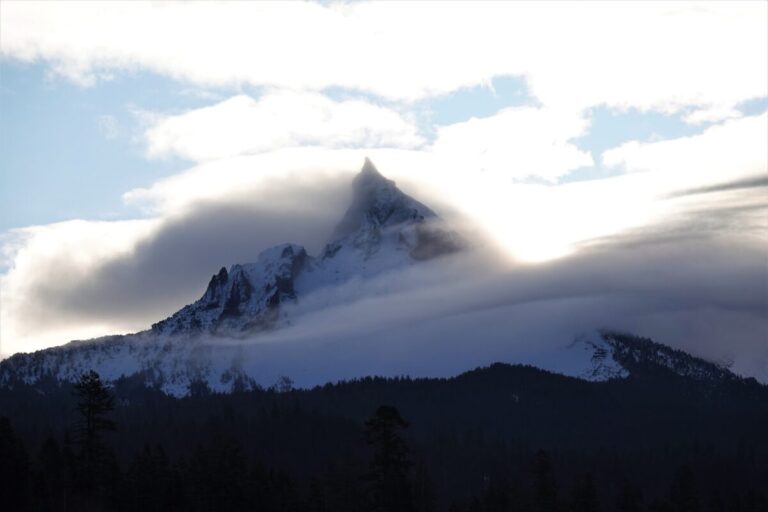
Mount Thielsen at sunrise, after some of the first fall snows, with a river of moist air moving through. HIgh Cascades weather can be unpredictable. Always be prepared for unexpected changes.
THE SNOW SEASON
Snow can occur any month of the year in the High Cascades of Oregon, but lasting snows usually become more regular in mid- to late October when cooler temperatures and cloudier days hold snow on the ground longer. Early on, shallow snow depths make for relatively easy access by vehicle and foot for many areas. As temperatures cool to near or below freezing, successive snow events begin to layer snow upon snow. In the higher forested areas of eastern Douglas County, peak snow depths in February to March are typically in the range of 4-8 feet. Snow depths can increase and decrease at any time with fluctuations in temperature, precipitation, sunshine and wind. As spring approaches, temperatures and daylight duration slowly increase bringing warmer rains and more sunshine. By April and May the snow begins losing its grip, but some off-highway roads remain closed through May and even June or July at the highest elevations.
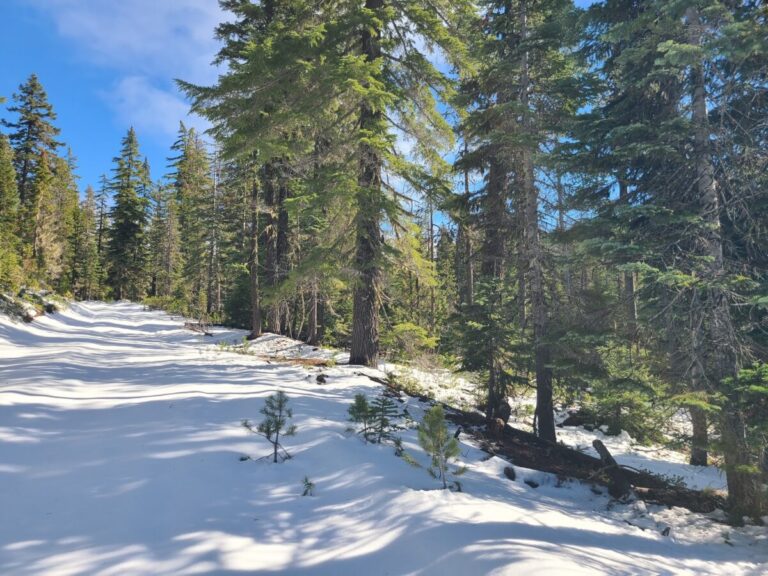
The gated road up to Cinnamon Butte. This area experienced a fire and some thinning so the forest adjacent to this part of the road is somewhat open.
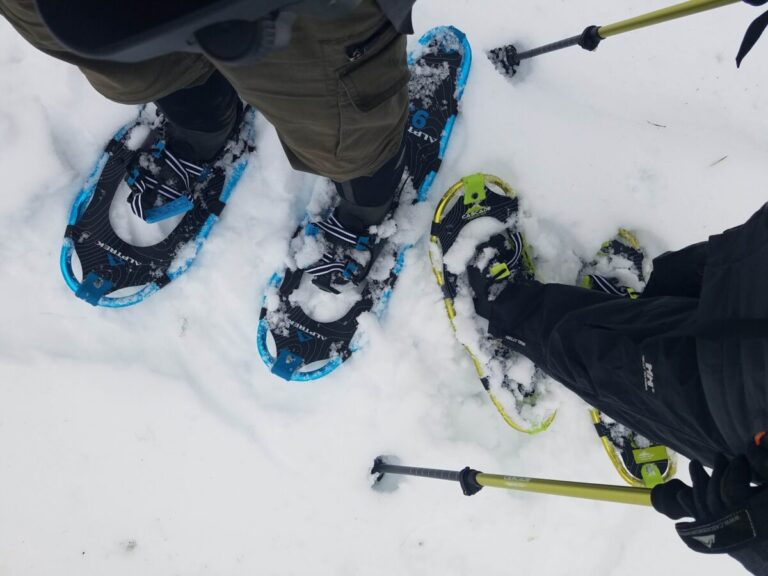
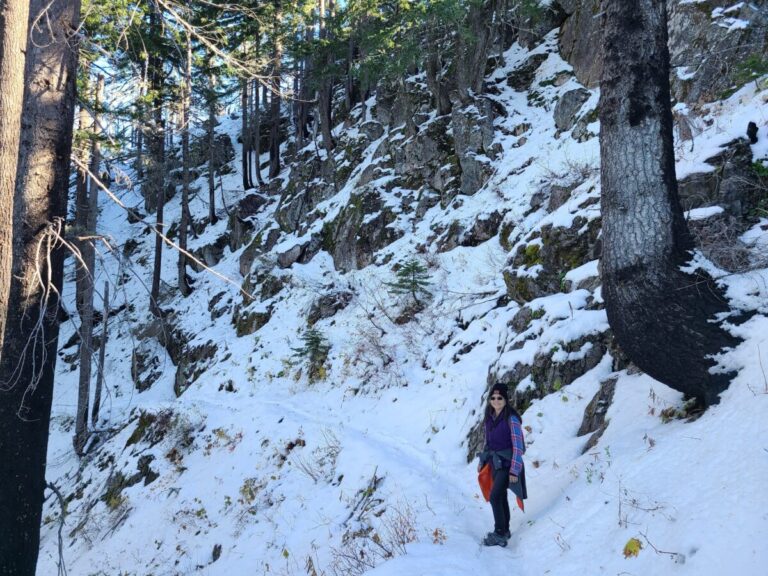
Snowshoes are my favorite mode of transportation when tracking in snow deeper than about 1 ft, though occasionally I wish I was more proficient with cross-country skis! In shallow snow, say less than 6 inches, only boots are required.
SNOW CONDITIONS
Myriad weather conditions and sequences during snow season create many different types of snow substrates. In general, colder clearer weather results in lighter, fluffier snow, while relatively warmer and cloudy weather produces heavier, wetter snowfall. Snow melt (or rain) or solar warming and then freezing can produce hard ice crusts on top of the snow. Repeated snowfall during very cold conditions can produce deep powdery snow. Many combinations of these conditions over time can produce a wide variety of conditions and layers of snow that respond differently to animals traveling across the surface or trying to burrow. For example, a warm spell can melt snow of any type and re-freeze. Soft powdery snow can fall on top of crusty ice. In addition, things like forest canopy and topographic aspect can affect snow conditions. Forest canopies capture snow, reducing the amount that reaches the ground, whereas nearby open areas receive the full amount of snowfall. Snow out in the open can be more affected by wind and sun but be relatively clean and smooth, uncluttered to the eye, whereas snow under the forest canopy is more protected from sun and wind and experiences debris fall in the form of snow clumps, needles, twigs, and branches, cluttering the snow surface. In powdery snow, wind can reduce snow depths in one area and increase it in another. The variations are endless. Digging down through the snow can give some insight into the sequence of layers.
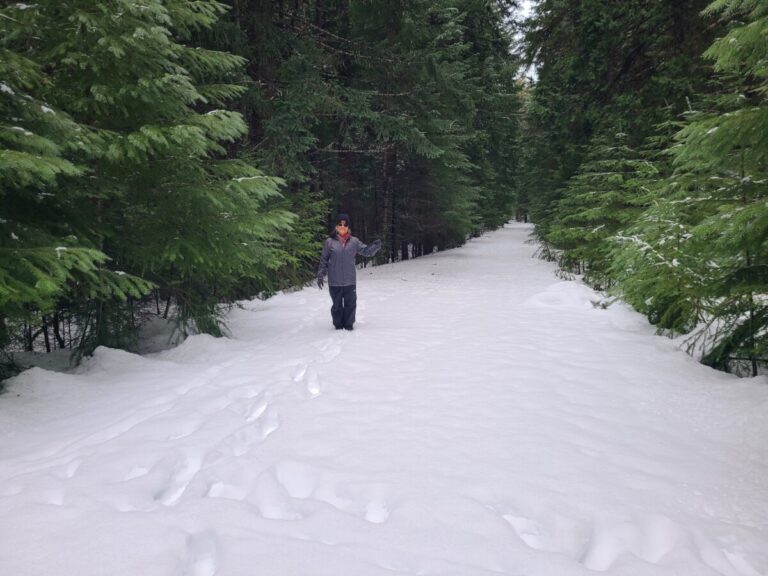
On this gated road near Toketee Lake, the open canopy over the road has allowed there to be deeper and relatively unblemished snow accumulation, making it easy to see most disturbances in the snow.
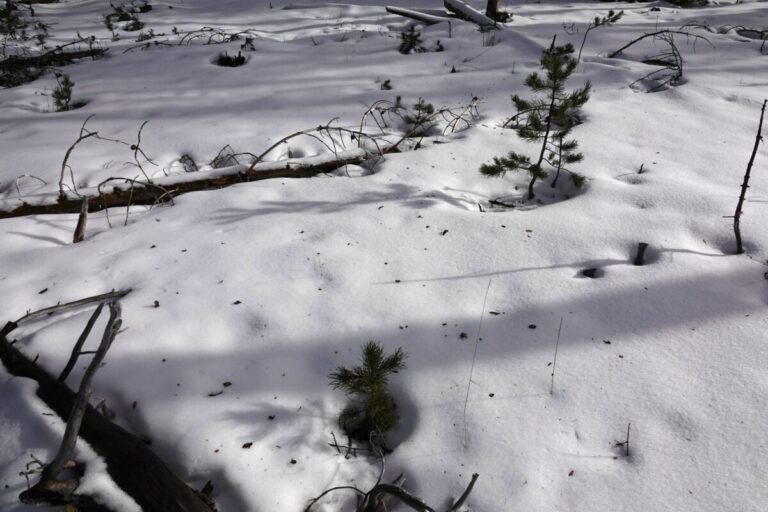
In somewhat open forest, there will be patches of relatively smooth snow and some debris-covered snow.
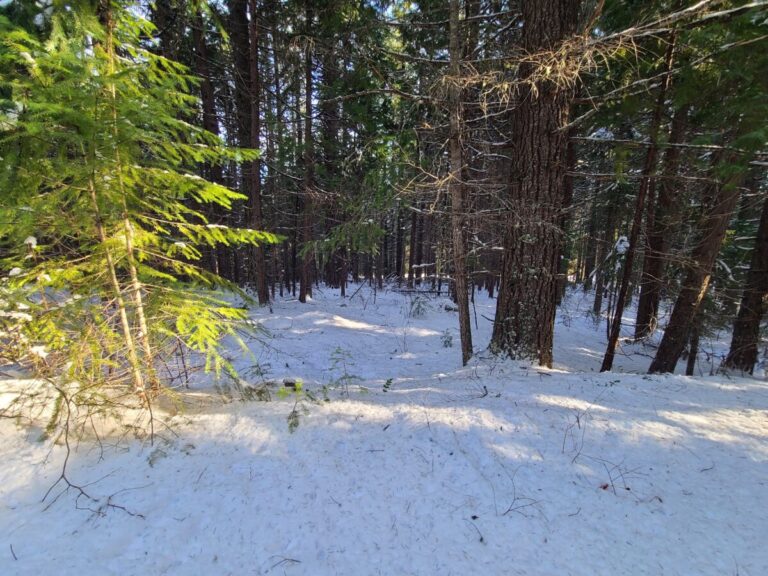
In a more closed-canopy forest, much of the snowfall is intercepted by the massive conifer canopy. Less snow reaches the ground and snow on the ground is often covered with messy snowfall and tree debris. Small snow precipitation events are less likely to cover up tracks in closed-canopy forest.
HOW SNOW CONDITIONS AFFECT ANIMAL TRAVEL AND TRACKS
An infinite variety of snow conditions and animal behavior results in infinite variability in tracks, as in all substrates. Here I just give a taste for this variation with a few examples. Animals travel differently and use different gaits in different snow conditions. For example, on a hard crust or packed snow their mode of travel may be very similar to that on solid ground, such as a coyote using a side trot or a marten using a 3×4 lope. However, in somewhat deeper, softer snow, the coyote may resort to a direct register walk and the marten to a 2×2 lope, putting the rear feet in the holes made by the front feet. And both may resort to a bound or even plowing in the deepest, fluffiest snow. Similarly, animals that often travel in an overstep walk such as bear or mountain lion, will resort to direct register in typical snow conditions to save energy, again putting hind feet in the holes made by the front feet. The list could go on forever, but I think you get the idea. When you observe tracks in the snow, see if you can determine how the animal is moving and how the snow conditions affect its travel!
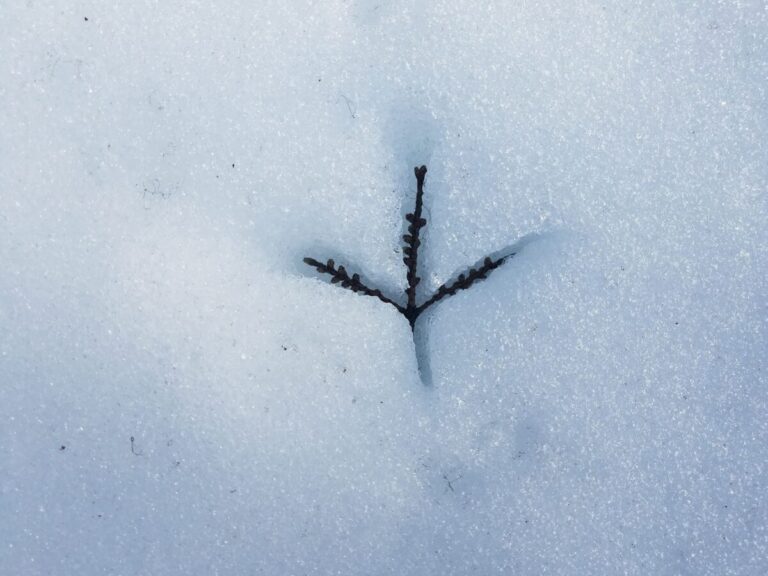
Grouse? Turkey? Oh, just a twig. When there are periods of sunshine, these small twigs of all shapes and sizes absorb heat and subsequently melt surrounding snow.
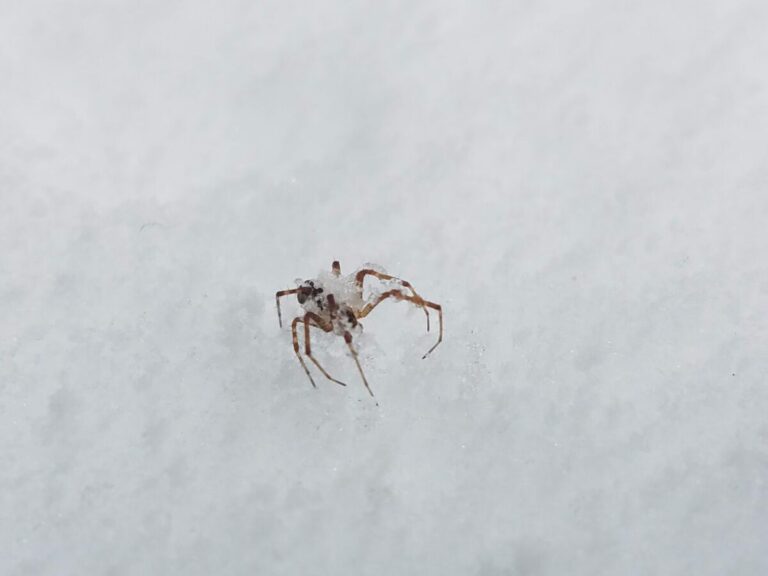
A spider in the genus Pityohyphantes makes its way across the snow. These are cold-hardy spiders and I have seen them several times during snow excursions. I have yet, however, to see them make tracks, haha!
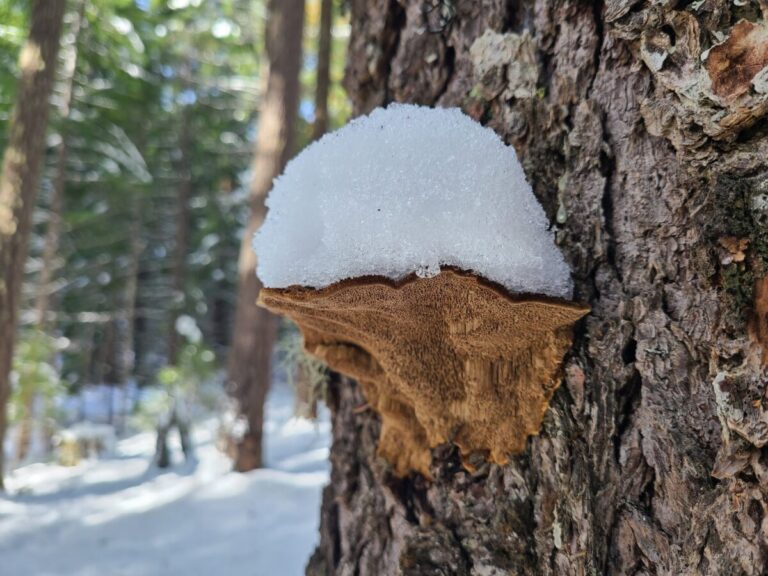
A pine bracket conk doing its part to hold some snow off the ground in a conifer forest.
TRACKS IN THE SNOW FROM LITTLE TO BIG
Following are short narratives and photos of most wildlife species tracks and sign I’ve encountered while snow tracking in the Cascades of eastern Douglas County from 2019 to 2025. These are all from easily accessible areas on public land and either right next to a road or at most two miles of snowshoeing from my pickup. I do not have a snowmobile, which would considerably extend my reach. I have ordered these notes and accompanying photos roughly from the smallest to the largest animals. While I do mention certain features that identify some of the tracks to species, I do not go into comprehensive detail in the narratives or image captions. I recommend obtaining one or more good tracking books or apps to help you learn how to recognize tracks of different species and use compilations such as this as good ground for practice! And if you find something you think I got wrong, please share your thoughts in the comments so we can all learn!
Shrews, Voles, and Mice
I decided to group these smallest of terrestrial mammals together because, while each group has certain tracks and/or sign that are distinctive, there are also many tracks/sign that are currently ambiguous as to species for me and for many trackers. More local work needs to be done to understand tracks and sign of these species. In this section I treat known or possible tracks/sign of each group separately and end with some that I am uncertain about. If you have some insight into the creators of these tracks, please make a note in the comments.
Shrews
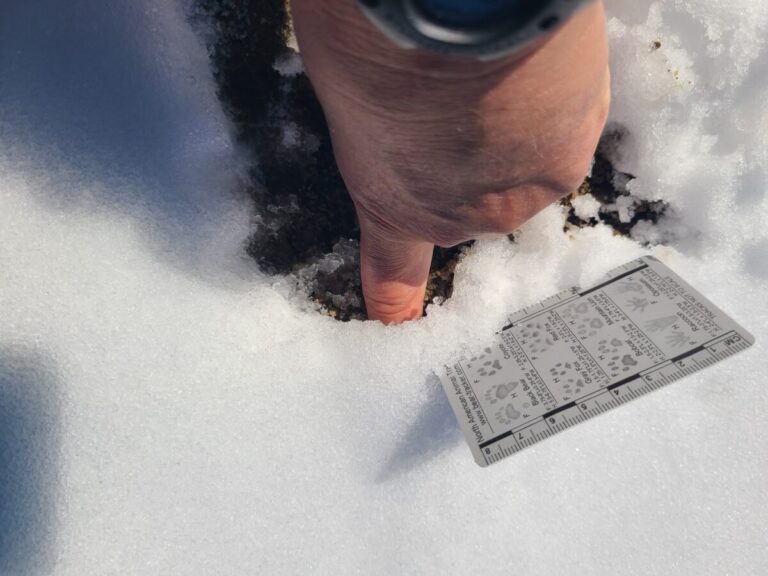
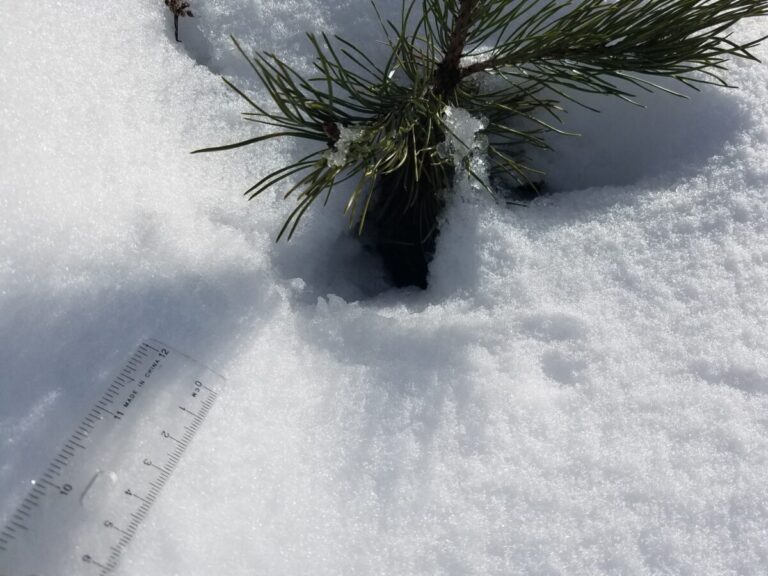
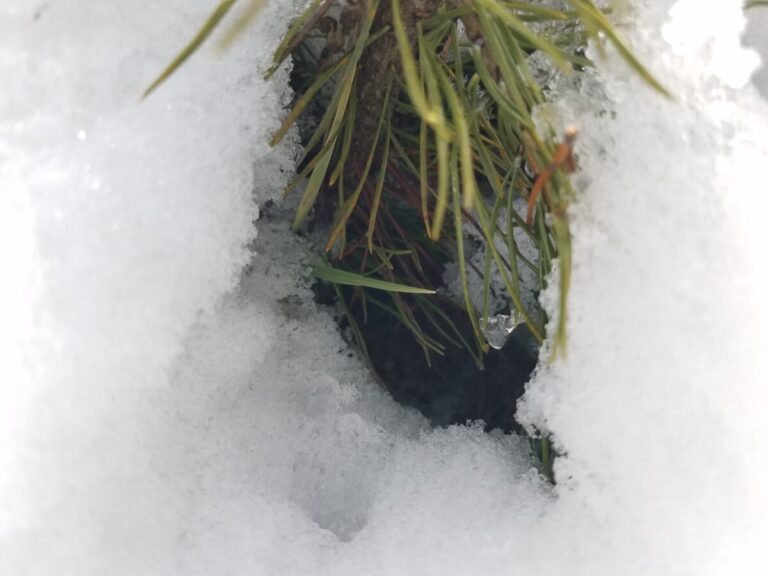
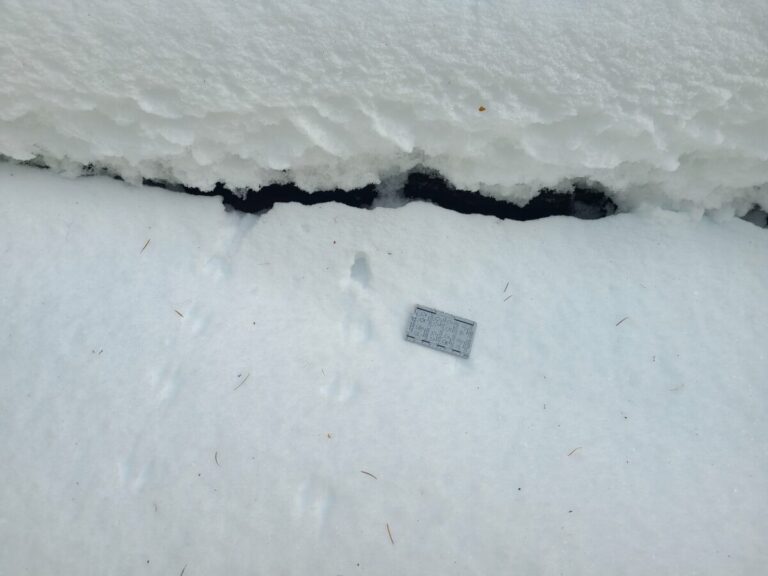
Shrews are the smallest terrestrial mammals in the Pacific Northwest. They are tiny and active all year as they hunt day and night for arthropods, gastropods, and even small vertebrates. When I have seen shrews on the forest floor outside of snow season, they were either traveling rather rapidly across the surface in a fast trot with occasional bounds and leaps, or more often making their way under surface debris such as leaves, needles, bark and small twigs as they searched for food. I have not yet, to my knowledge, found shrew tracks in the snow. I did find what I initially interpreted as a possible snow tunnel of a shrew based on the diameter of the tunnel being a max of 3/4 of an inch. I could fit my index finger only up to the second knuckle. Shrews seem quite at home pushing their way underneath things, so a tunnel such as this does not surprise me. However, I later wondered if this could be just a very small vole, perhaps a Red-backed Vole (Clethrionomys sp.). Let me know what you think.
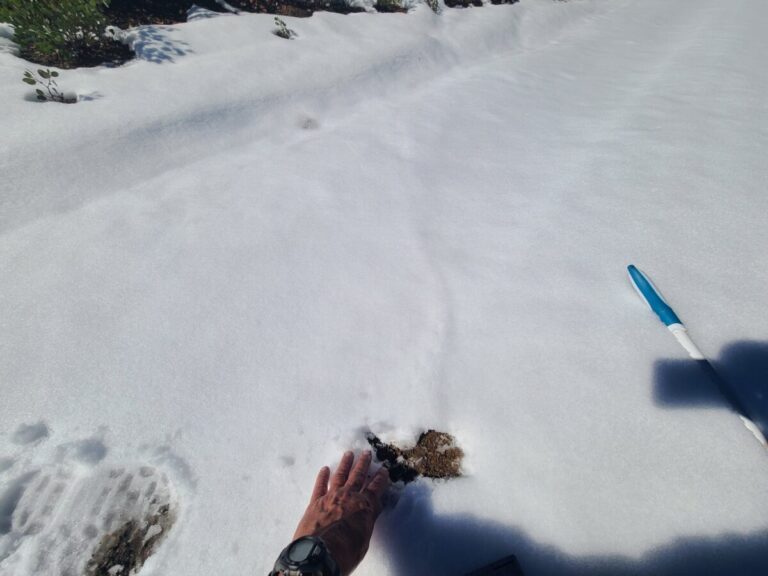
Possible shrew tunnel barely visible on snow surface. Much less apparent than a nearby pocket gopher tunnel.
Exposing the tunnel.
Possible shrew tunnel in snow, approximately 3/4 inch diameter. Snow depth less than two inches.
My index finger fit only about halfway into the tunnel.
Deer Mouse
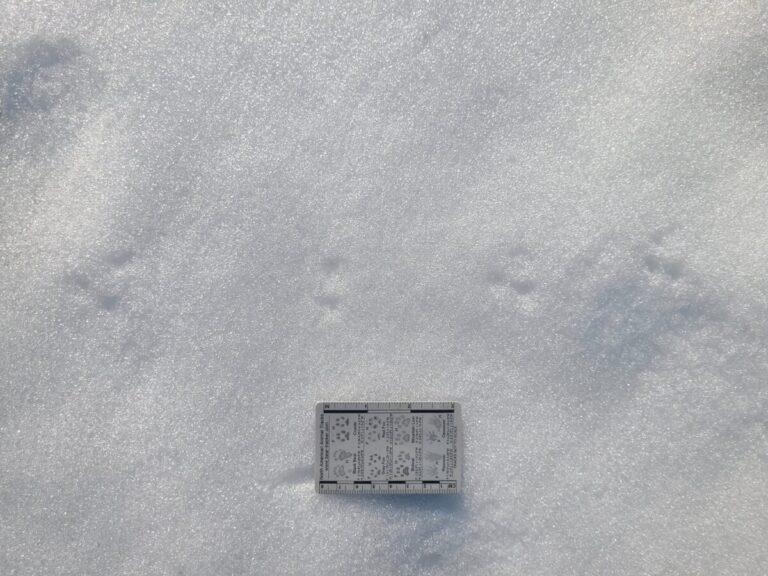
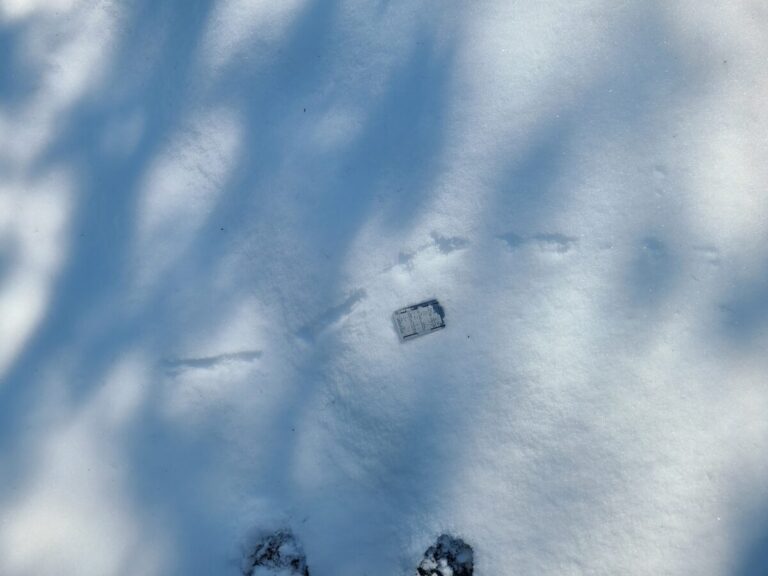
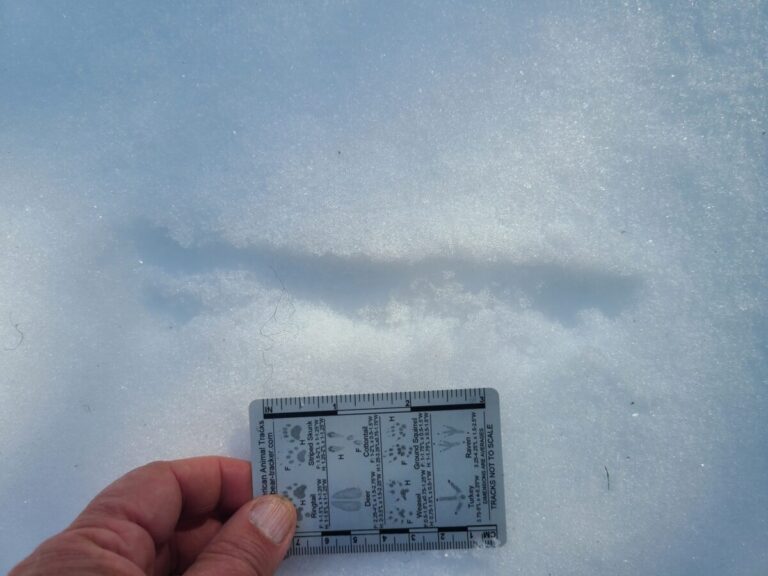
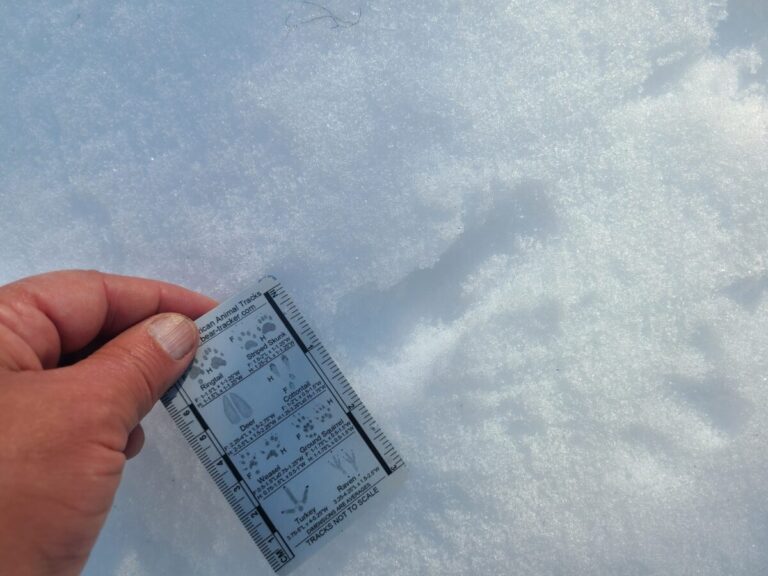
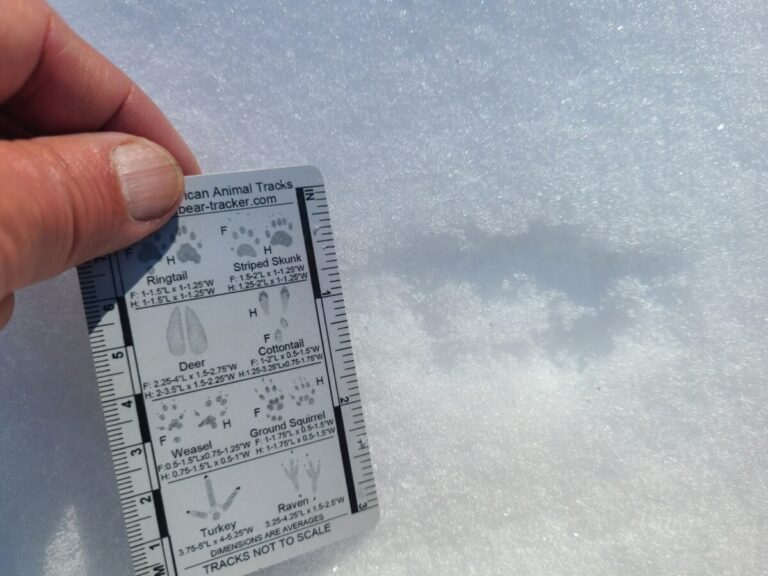
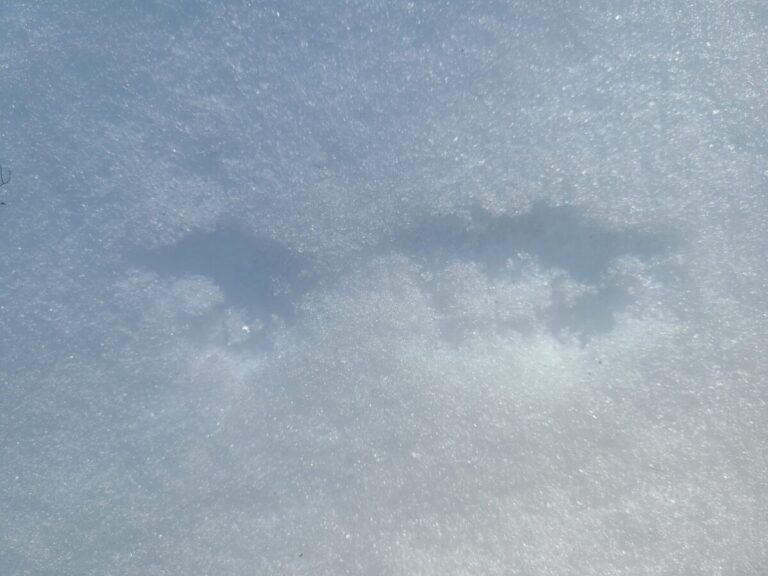
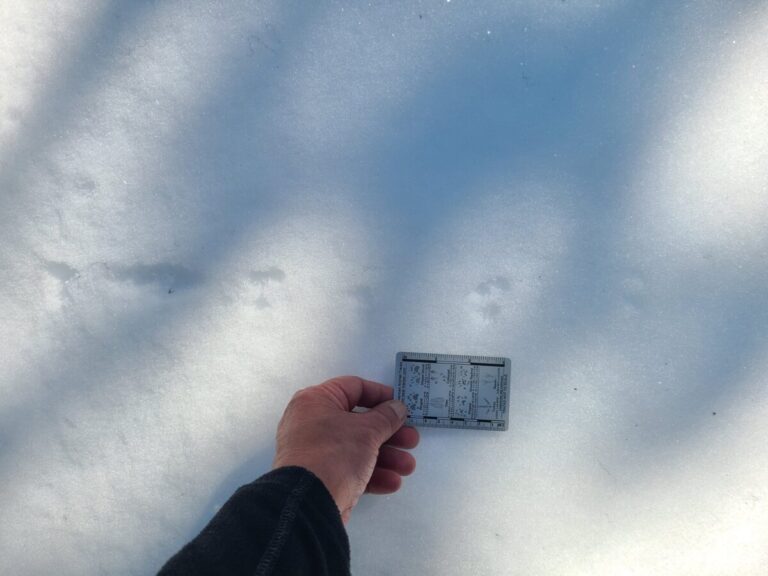
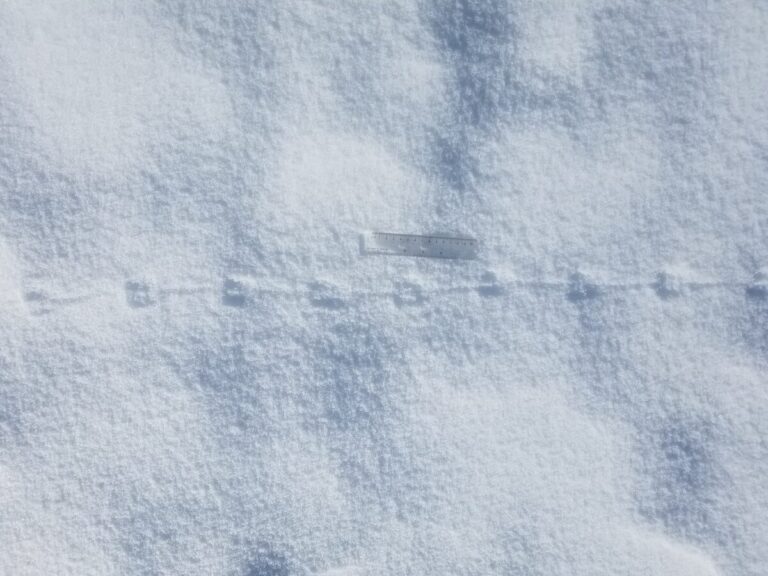
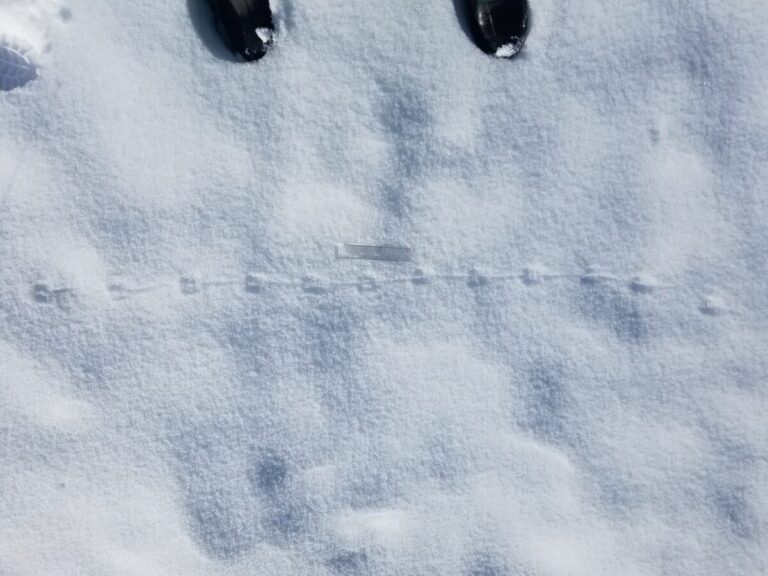
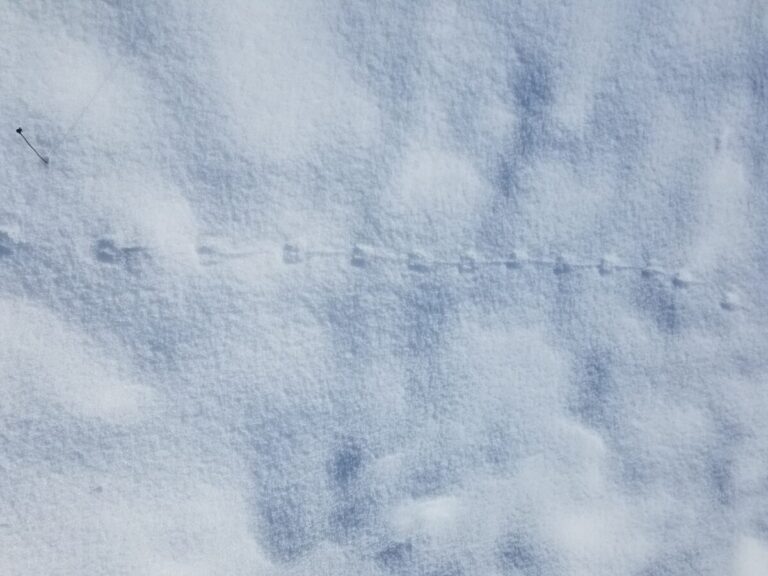
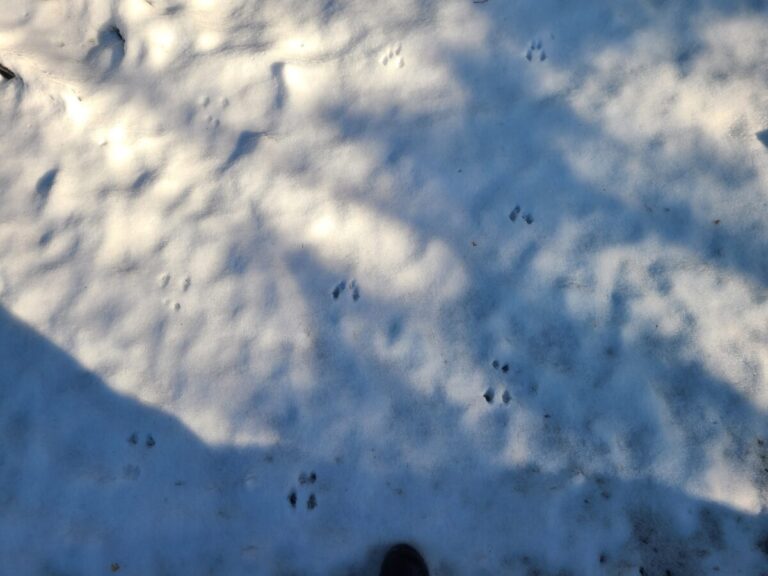
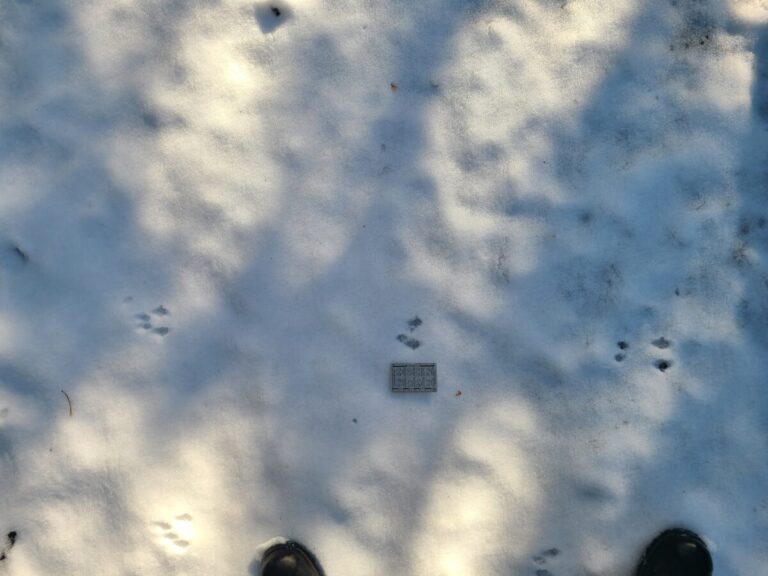
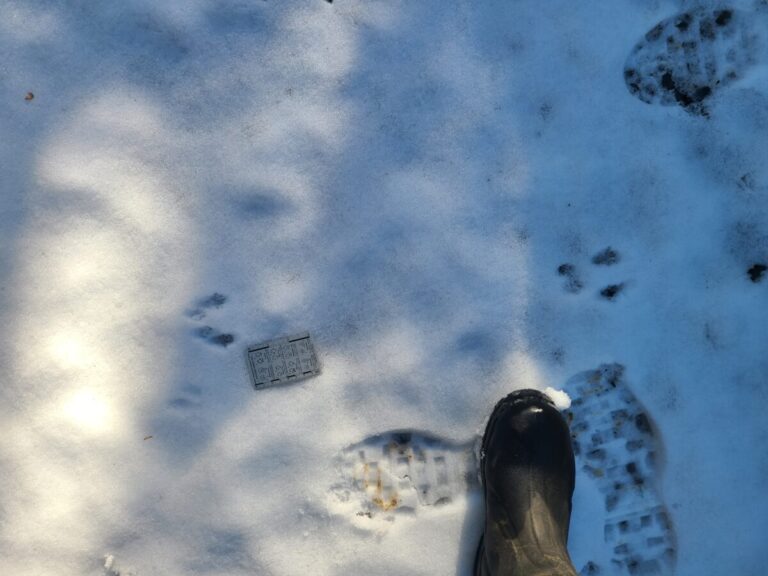
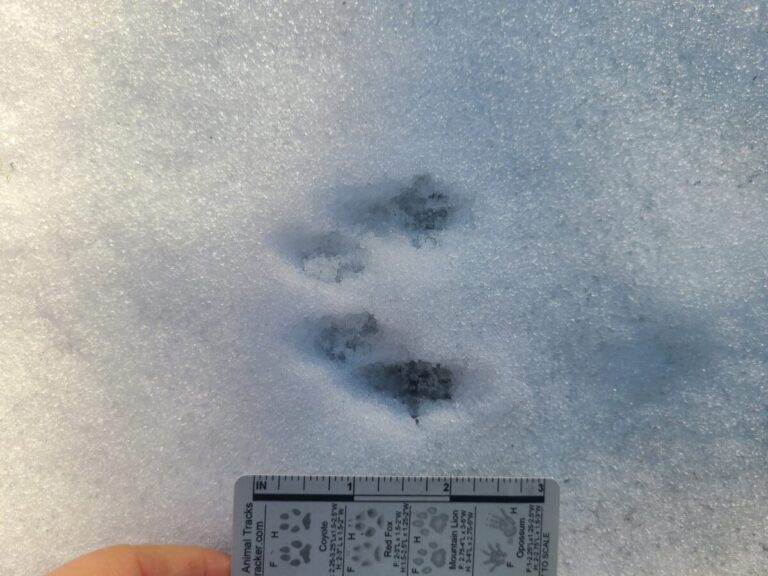
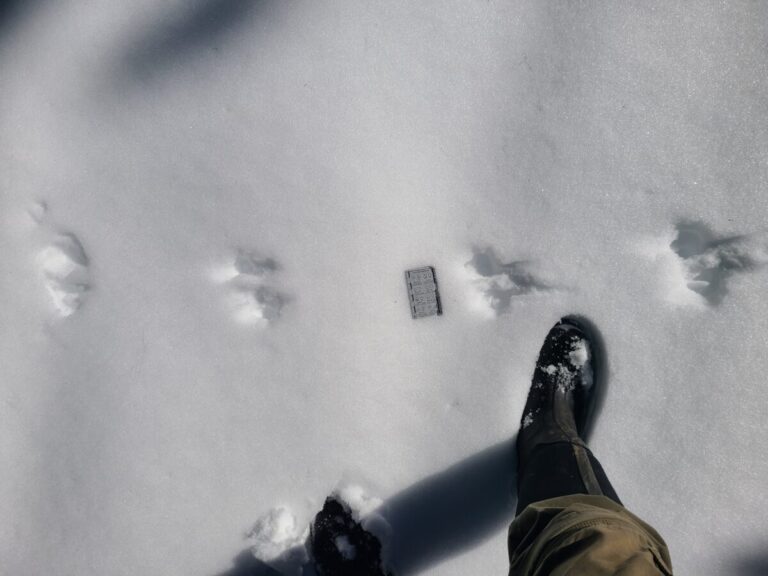
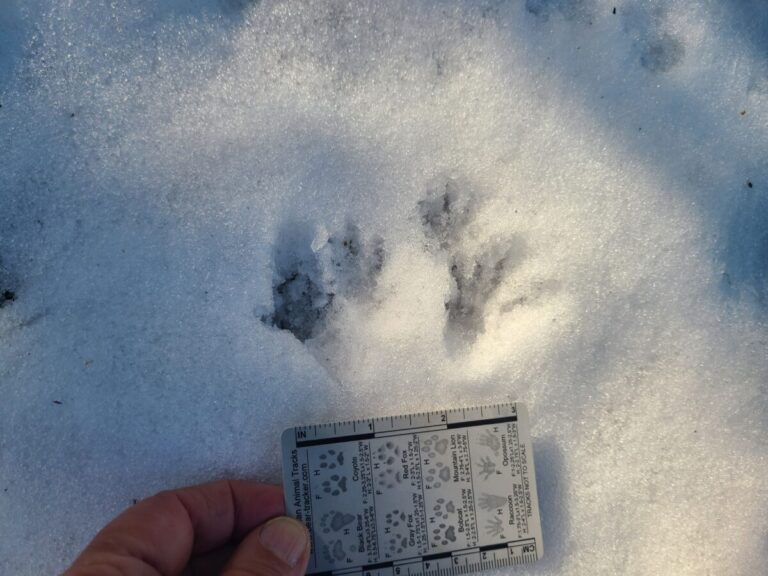
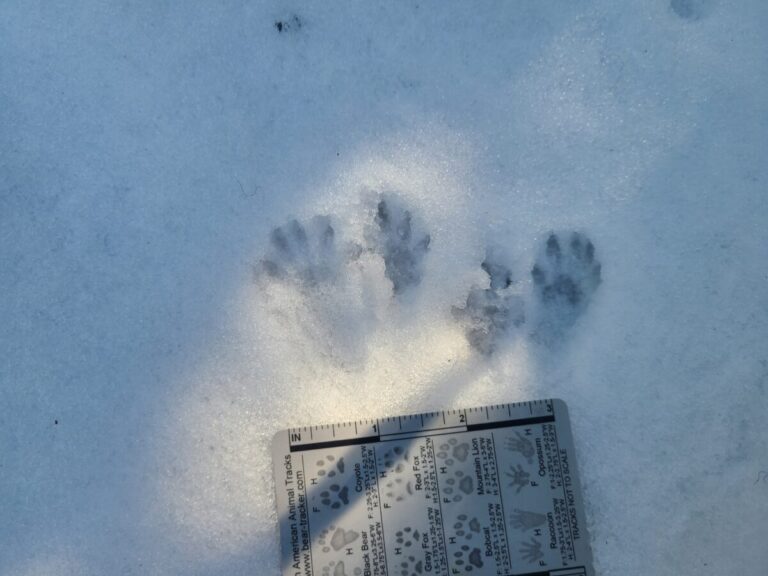
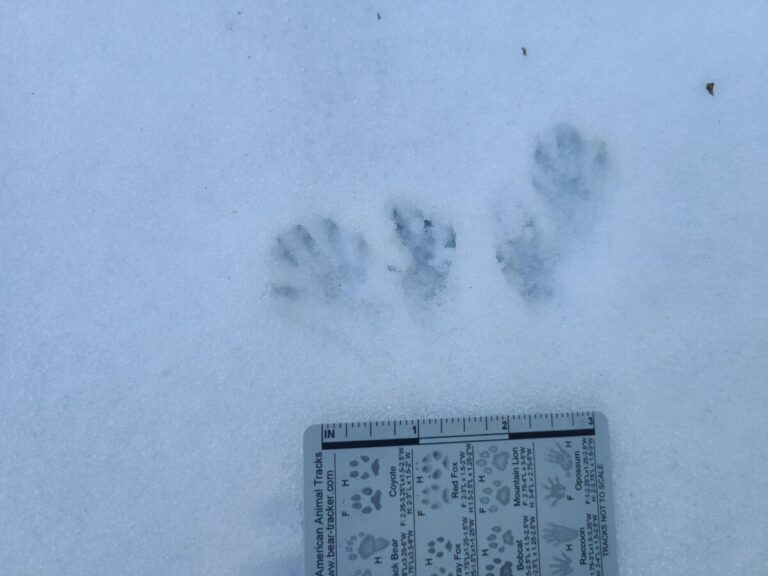
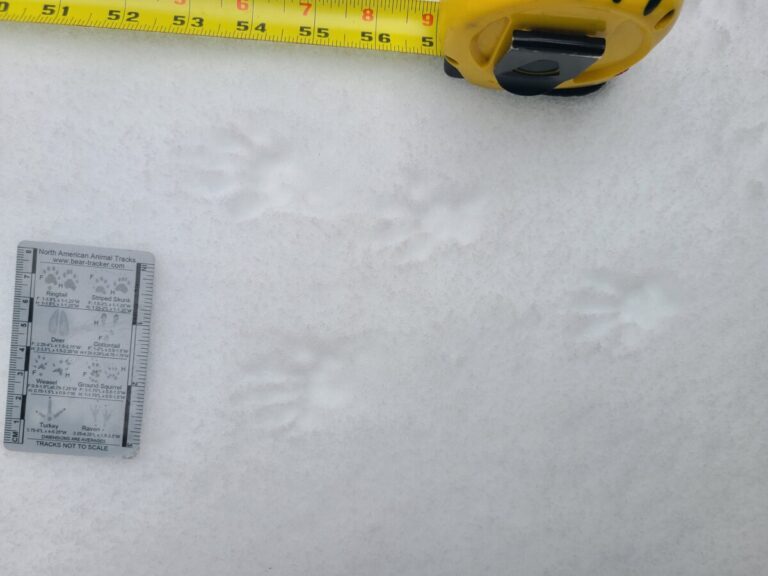
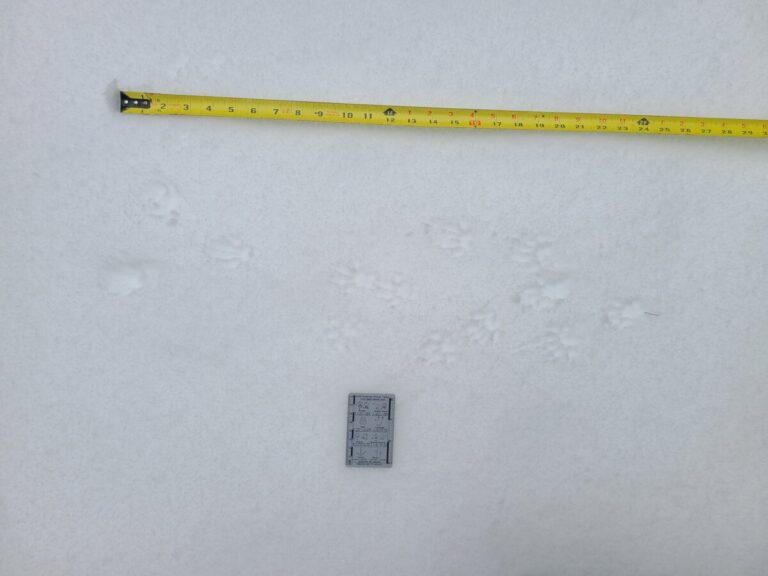
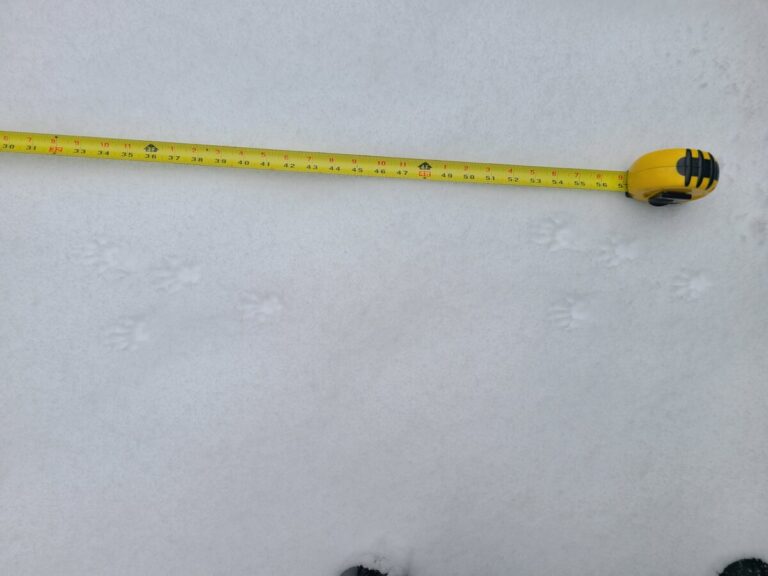
The Deer Mouse is one of the most widespread and familiar of our mice. Like voles, Deer Mice spend plenty of time under cover, but commonly travel and forage on the surface, typically by jumping (bounding) from one location to another, then slow walking to look for food. When escaping a perceived threat, they can bound quite far. Deer Mouse and vole tracks in snow can show a variety of presentations, some of which are quite distinct and some of which are quite similar. For example, in the photo set below, I have included some tracks that I’m pretty sure are Deer Mouse, due to the fairly long bounding distances.
Bounding tracks of a Deer Mouse. As with rabbits and hares, in this gait the mice push off with their rear feet, land first with their front feet, and let their rear feet straddle their fronts and land farther than the fronts. Thus, in bounding tracks such as these, the direction of travel is towards the back feet. Often time the front feet land in nearly the same location so you may see only three dots in the snow instead of four.
Bounding tracks of a Deer Mouse. As with rabbits and hares, in this gait the mice push off with their rear feet, land first with their front feet, and let their rear feet straddle their fronts and land farther than the fronts. Thus, in bounding tracks such as these, the direction of travel is towards the back feet. Often time the front feet land in nearly the same location so you may see only three dots in the snow instead of four.
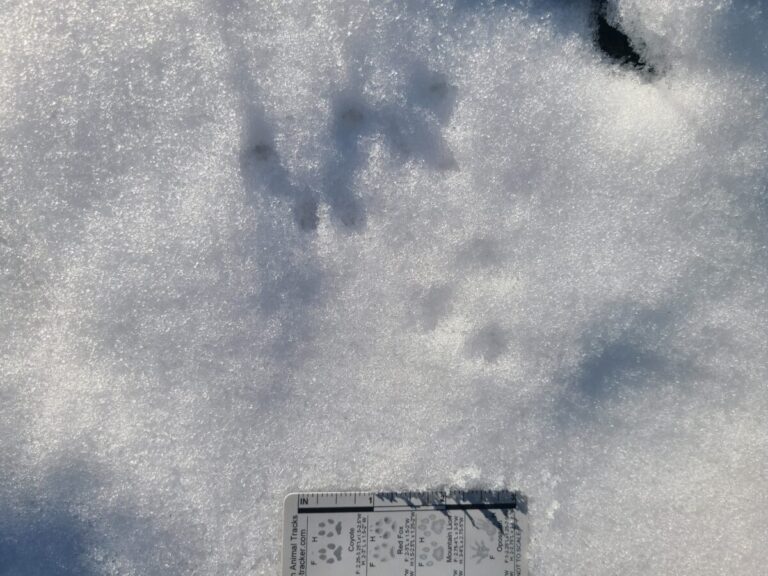
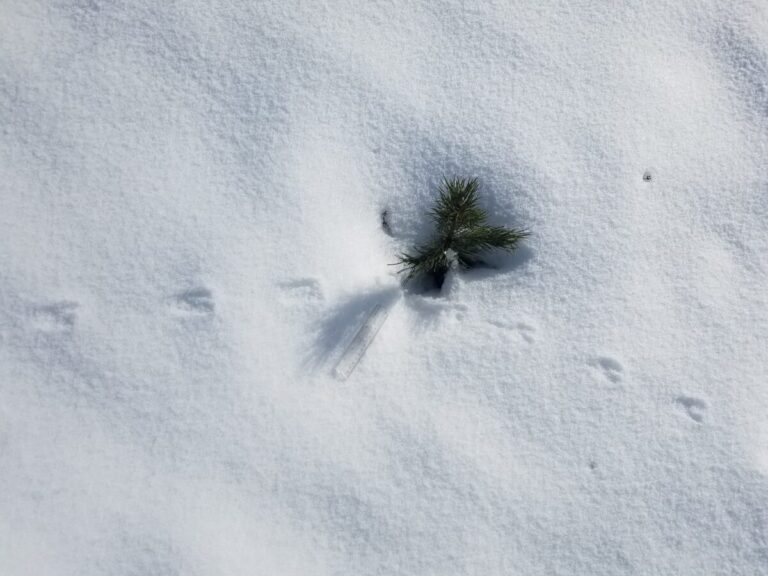
Bounding tracks of a Deer Mouse. Two different directions are represented here. The more shaded track sets show the paired front feet below and the rear feet above, meaning the mouse was moving toward the top of this image. The single set of tracks in more sunlight was moving what direction?
Voles
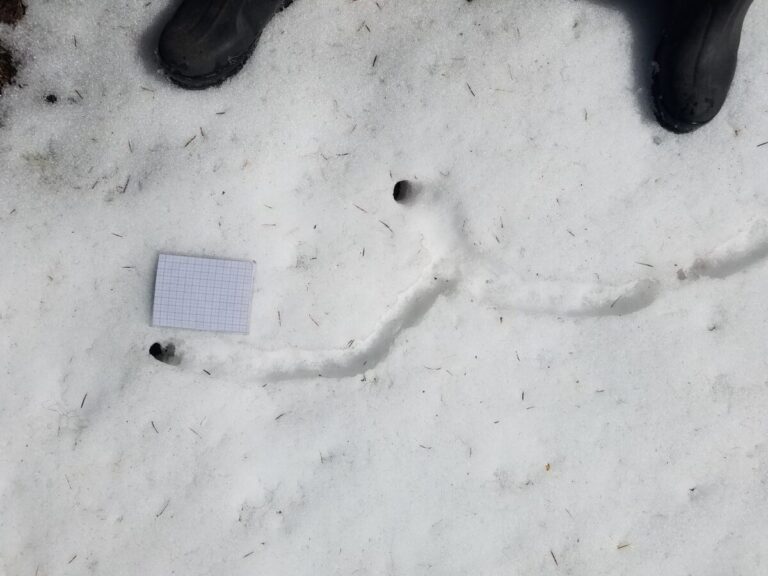
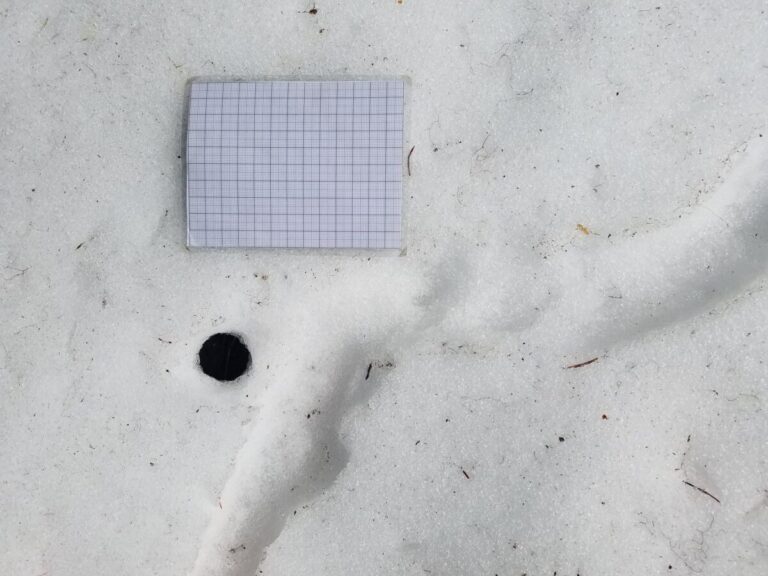
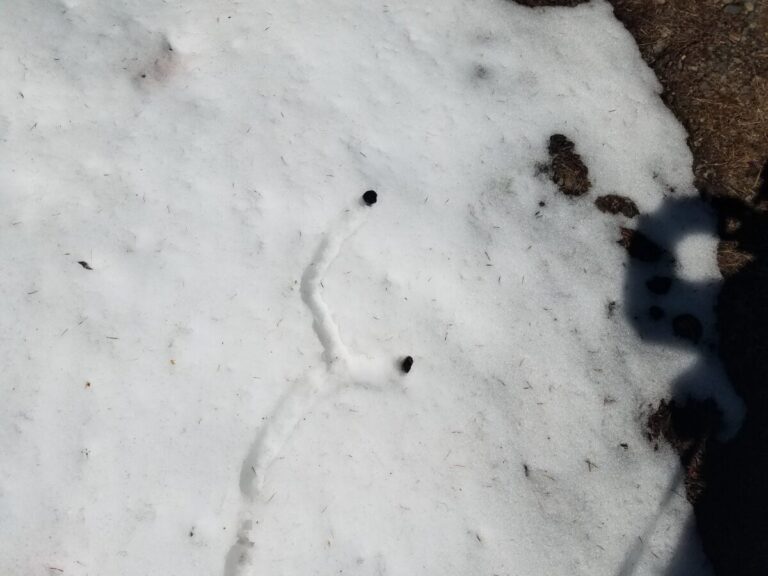
In the eastern Douglas County Cascades there are potentially three genera of voles comprising 3 or more species: Microtus, Arborimus, and Clethrionomys. Ground-dwelling voles commonly make tunnels, canals, and pathways in soil and vegetation, under bark and logs and do the same in snow. Therefore, when I see snow plowed and pushed out of the way to make holes or grooves in the snow, I’m pretty certain these are from a vole.
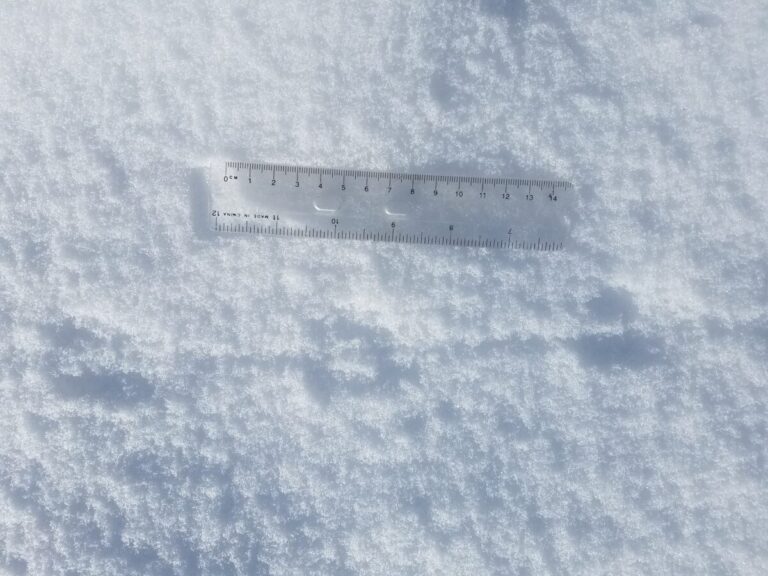
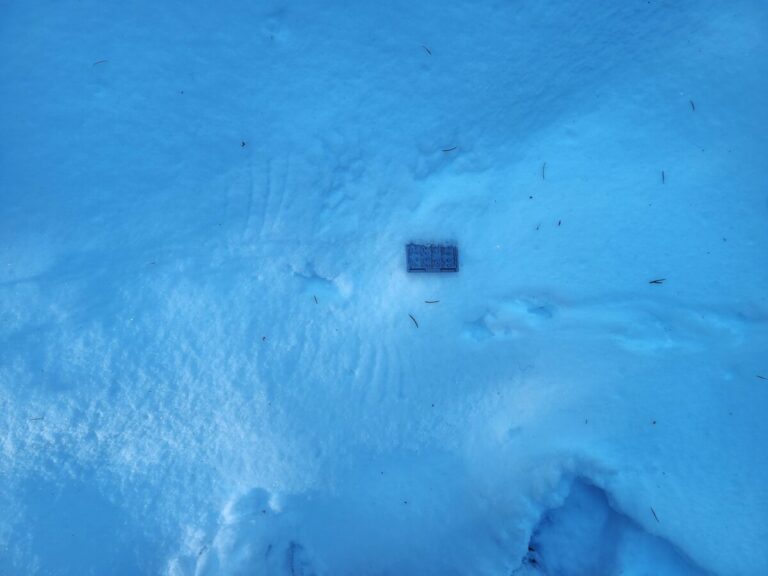
A very crisp example of a channel in the snow leading to two holes. These seem typical of voles. Grid is cm and mm.
A closer look at a snow channel and hole in snow. Grid is cm and mm.
This appears to represent some alternating snowplowing and jumping.
A close-up of some snowplowing and jumping.
A close-up of some snowplowing and jumping.
A close-up of some snowplowing and jumping.
A close-up of some snowplowing and jumping.
Some bounding tracks associated with some snowplowing and jumping.
A very crisp example of a channel in the snow leading to two holes. These seem typical of voles. Grid is cm and mm.
Mouse or Vole or Shrew?
The following track/trail images are ones that I am uncertain about. I think I will need to set up some trail cameras to be more certain of the maker of these tracks. I have some specific questions related to these mystery tracks and trails. In bounding track sets, is the pattern of having front feet closer to each other than the back feet specific to Deer Mice, or do voles and/or shrews do this as well? Do Deer Mice always have differently spaced front and hind tracks or are they sometimes evenly spaced? Do shrews, voles, and Deer Mice all show tail drag in different situations? What are those situations? If you have some knowledge that would help me and others learn about the makers of these tracks, please put a note in the comments!
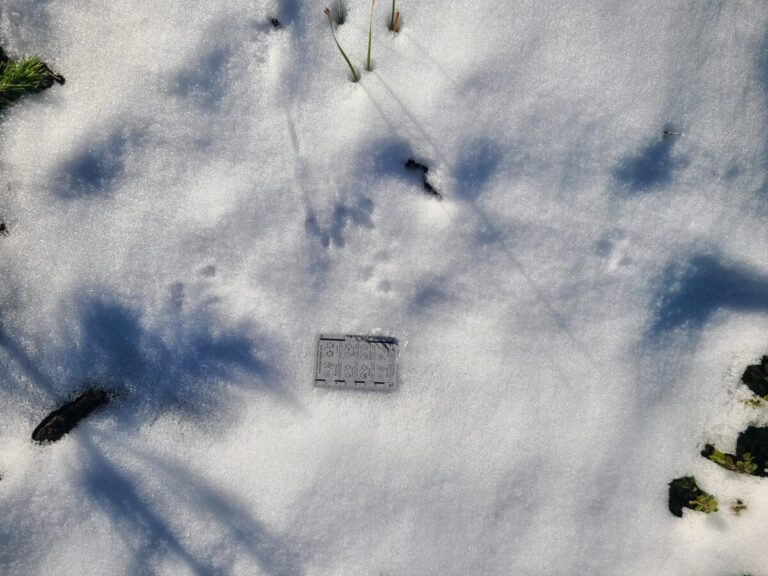
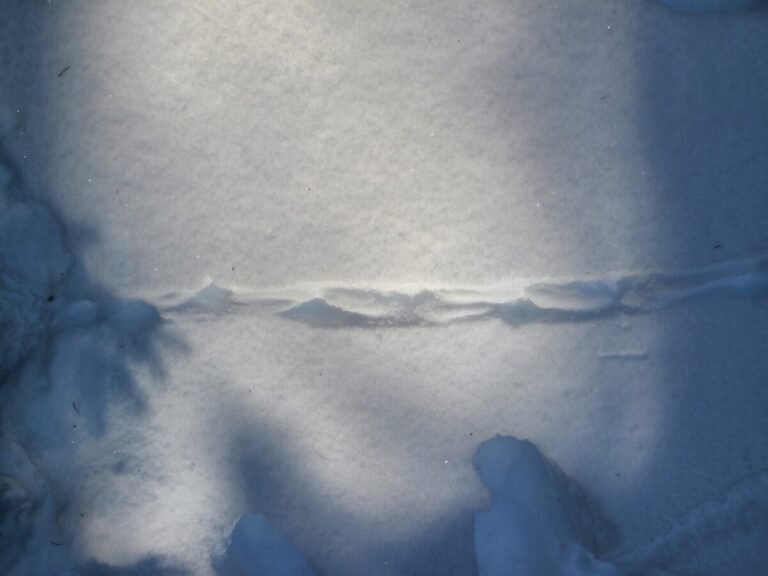
These show parallel placement of feet and tail drag or impressions. I would guess Deer Mouse, but I'm not sure.
These show parallel placement of feet and tail drag or impressions. I would guess Deer Mouse, but I'm not sure.
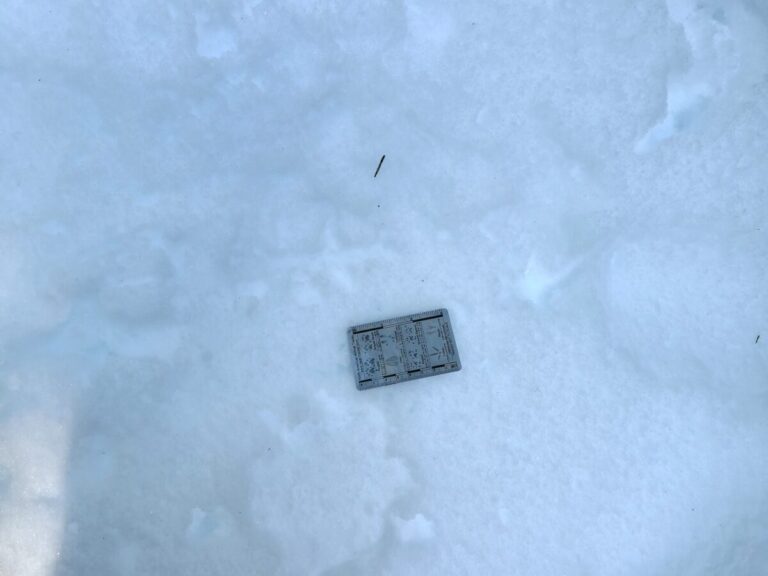
These show parallel placement of feet but no tail drag or impressions. I would guess Deer Mouse because I feel like the Deer Mouse needs an access provided by some vegetation whereas a vole would just make a hole.
These show parallel placement of feet but no tail drag or impressions. I would guess Deer Mouse because I feel like the Deer Mouse needs an access provided by some vegetation whereas a vole would just make a hole.
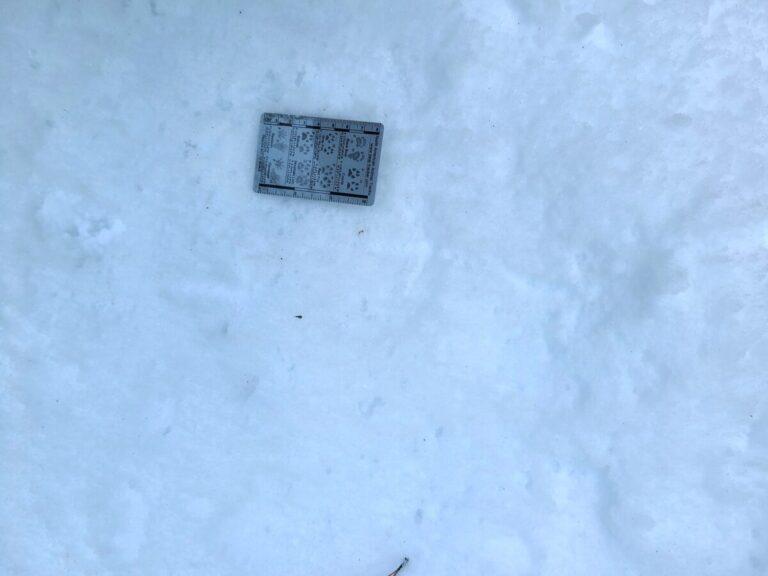
I would guess Deer Mouse because I feel like the Deer Mouse needs an access provided by some vegetation whereas a vole would just make a hole.
These show parallel placement of feet and tail drag or impressions. I would guess Deer Mouse, but I'm not sure.
These show parallel placement of feet and tail drag or impressions. I would guess Deer Mouse, but I'm not sure.
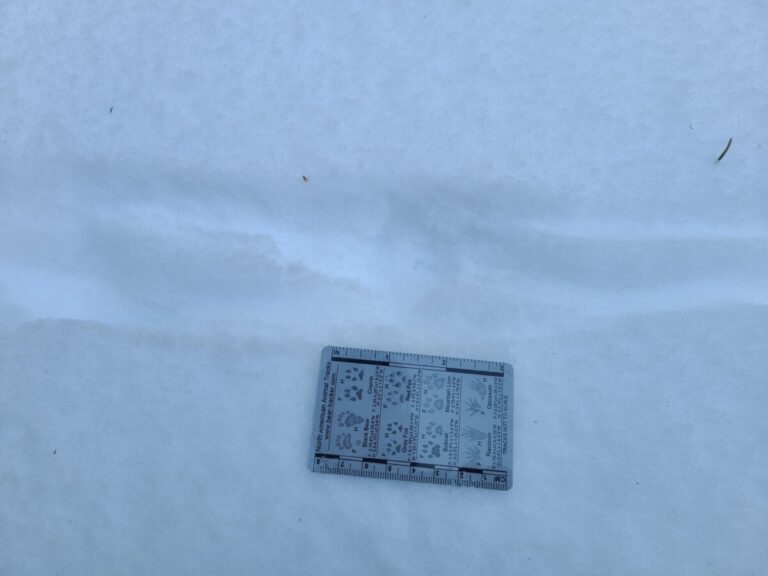
These show parallel feet placement and what looks like a small tunnel, though maybe it is just a footfall area (on the right set of tracks). I'm not sure whether this is Deer Mouse or vole.
Dark-eyed Junco
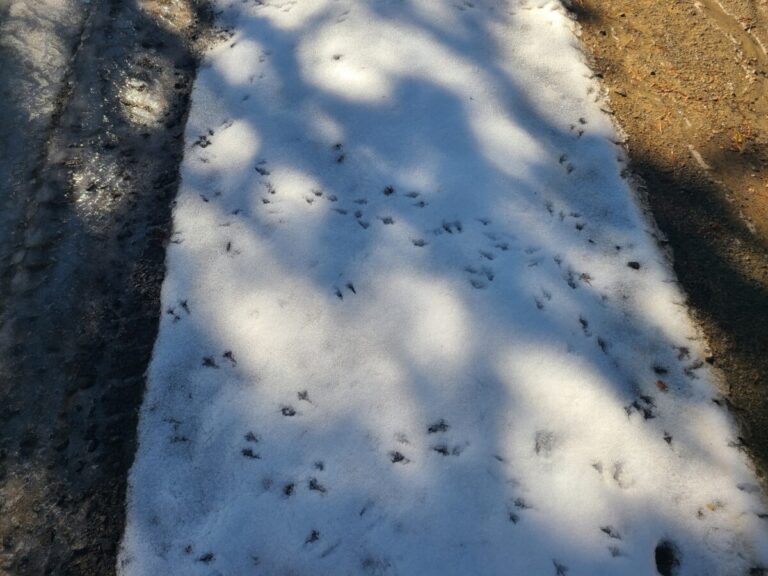
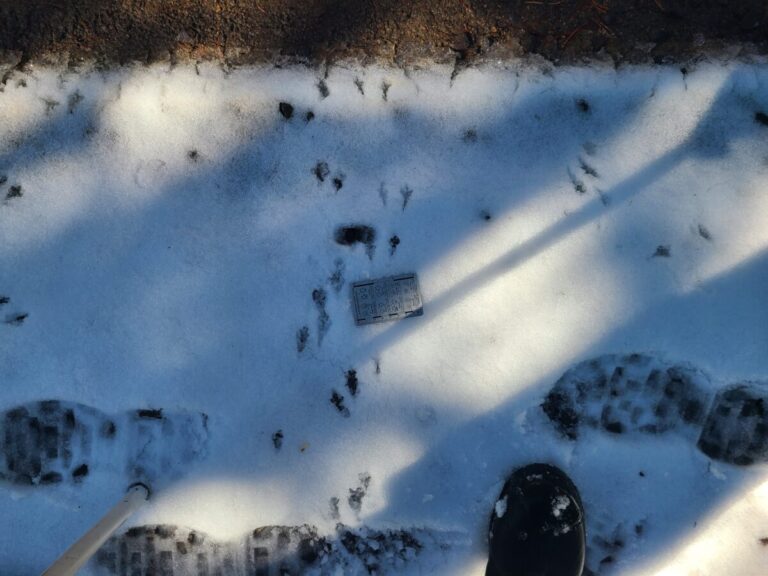
Juncos are one of the few ground-foraging birds that linger in fall at high elevations here as the snows begin to settle in and sometimes a tiny few remain throughout winter in areas where they can access open ground. They are small birds and their feet are small. They typically hop while they are foraging or moving casually across the snow so their tracks are usually in pairs, but they can also skip and run quickly on occasion. Sometimes long hops can resemble Deer Mouse tracks, but closer inspection will reveal the bird foot shape including the rear toe. Varied Thrushes (not pictured) are also often in forests with some or a lot of snow. Their tracks are substantially larger. Steller’s Jays, Canada Jays, and Clark’s Nutcracker (not pictured) are present all winter in snow areas and show the characteristic Corvid offset of the front middle tow (toe 3), similar to a raven (pictured later) but smaller.
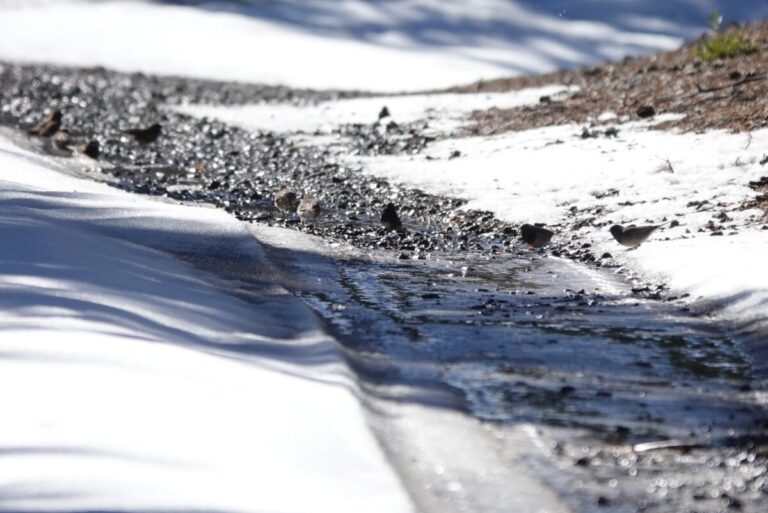
Dark-eyed Juncos drinking from snow melt and foraging in the open ground.
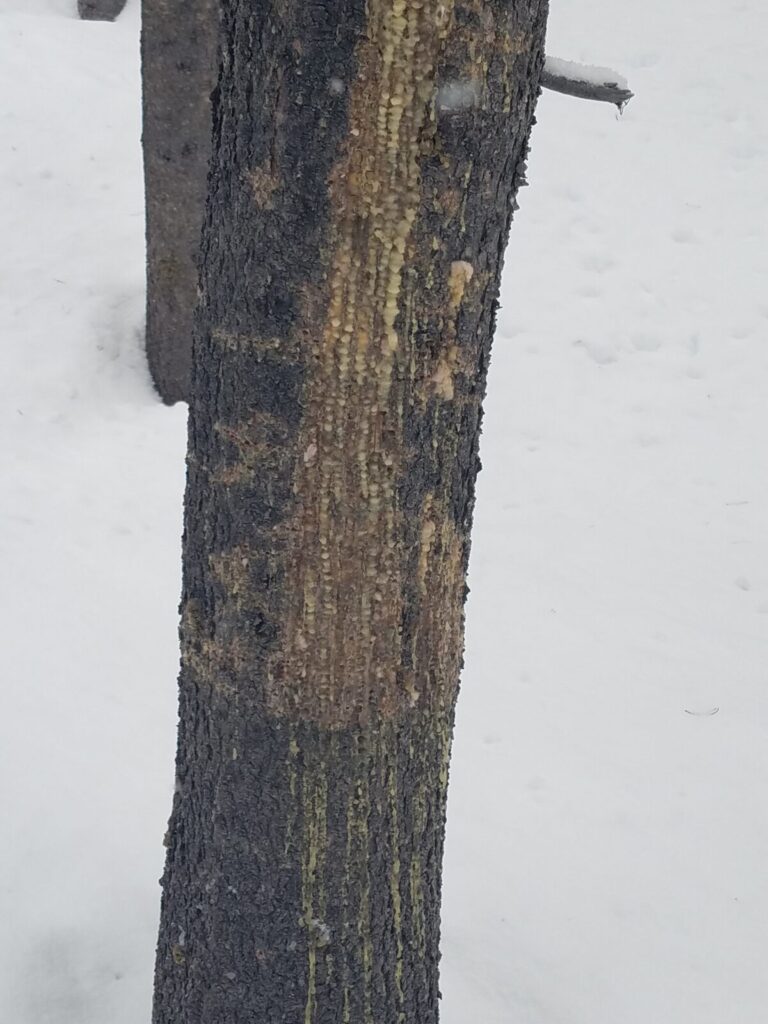
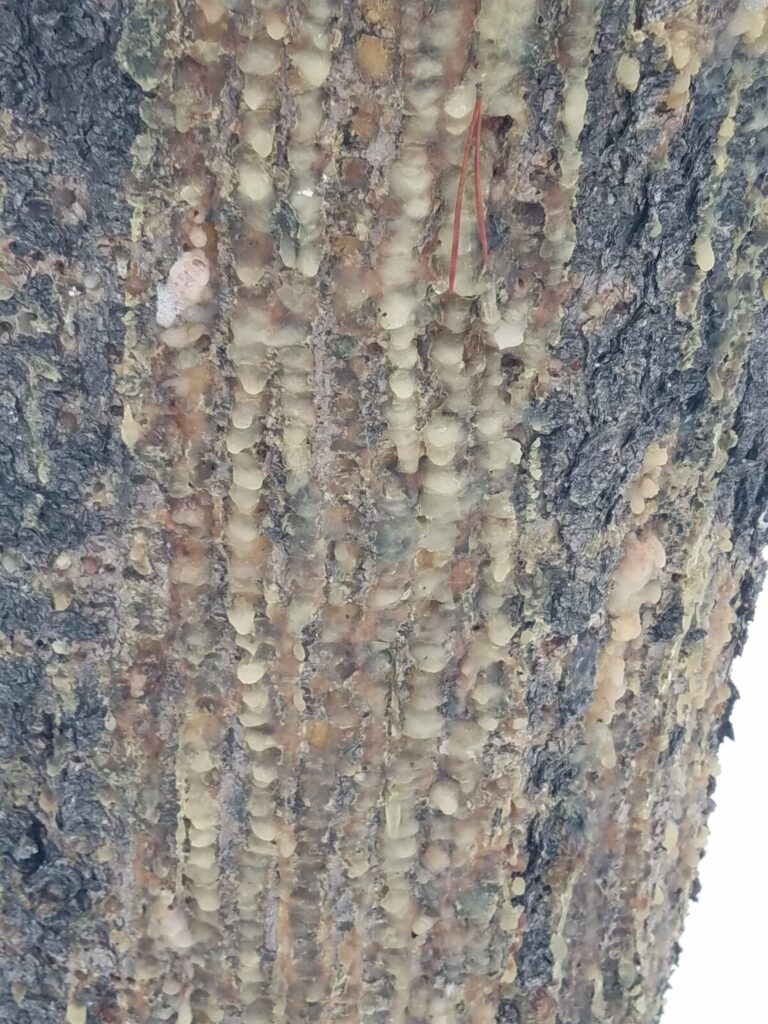
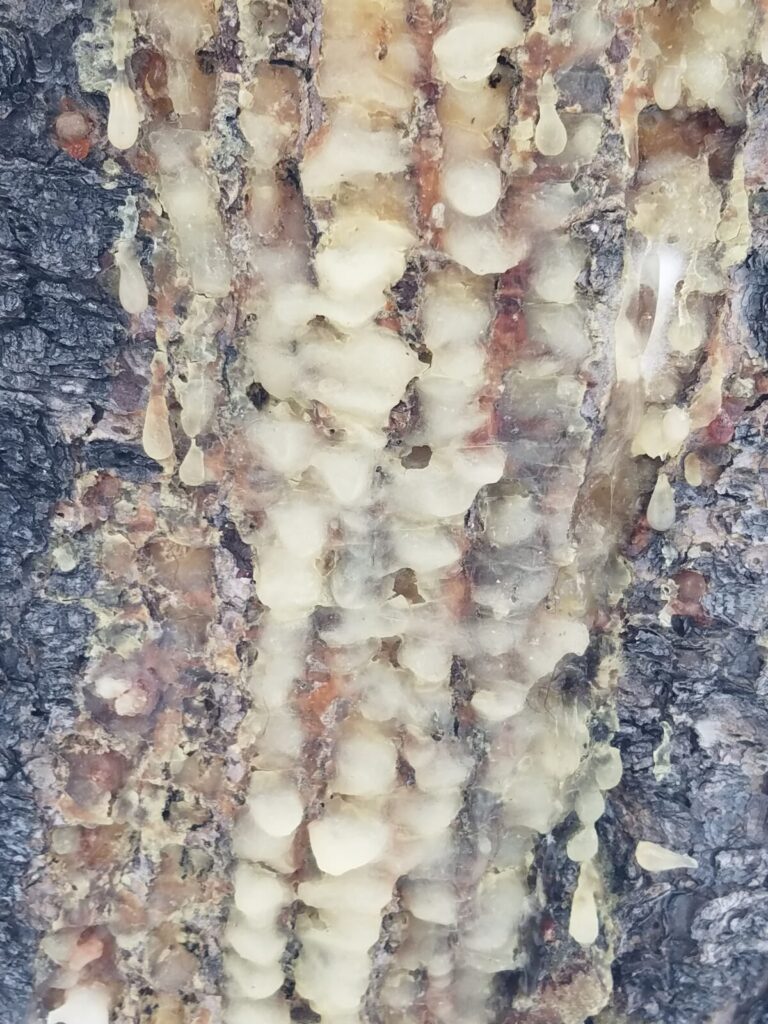
Sap flow and sapsuckers become rare to nonexistent in winter in the High Cascades of Oregon. Most sapsuckers move south or lower in elevation during the cold months. Nevertheless, one may still encounter their sap wells created and used during warmer months of the year, and a sapsucker may be encountered in person early or late in the season.
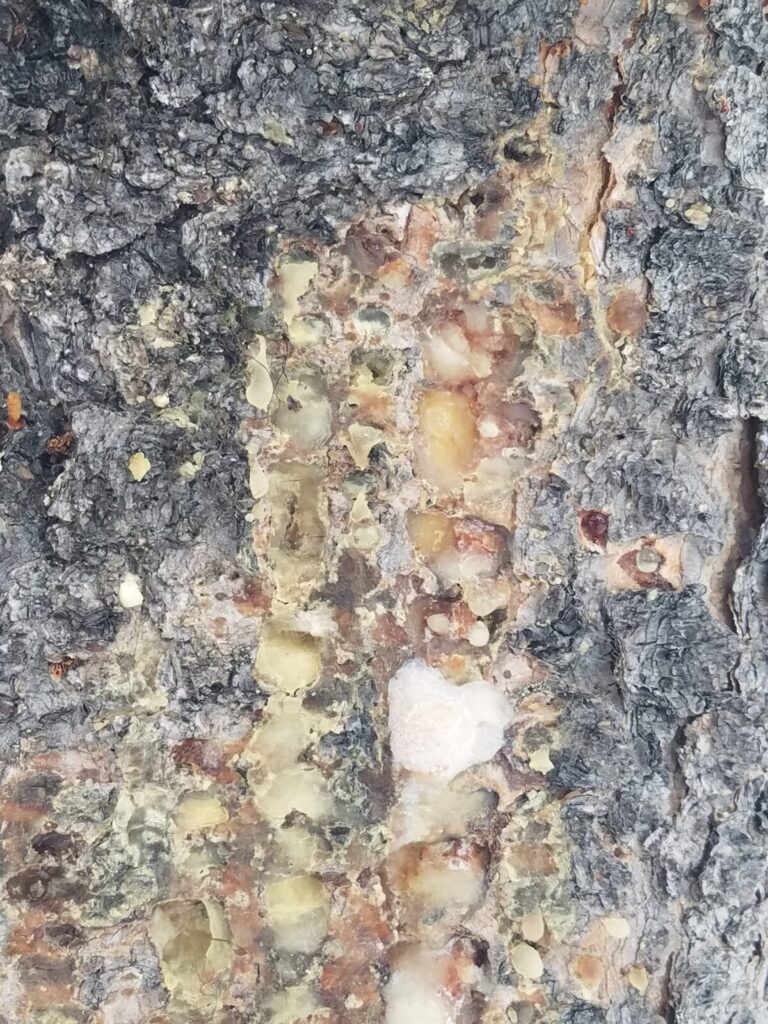
Old sap wells from the previous spring/summer/fall.
Old sap wells from the previous spring/summer/fall.
Old sap wells from the previous spring/summer/fall.
Old sap wells from the previous spring/summer/fall.
Black-backed Woodpecker
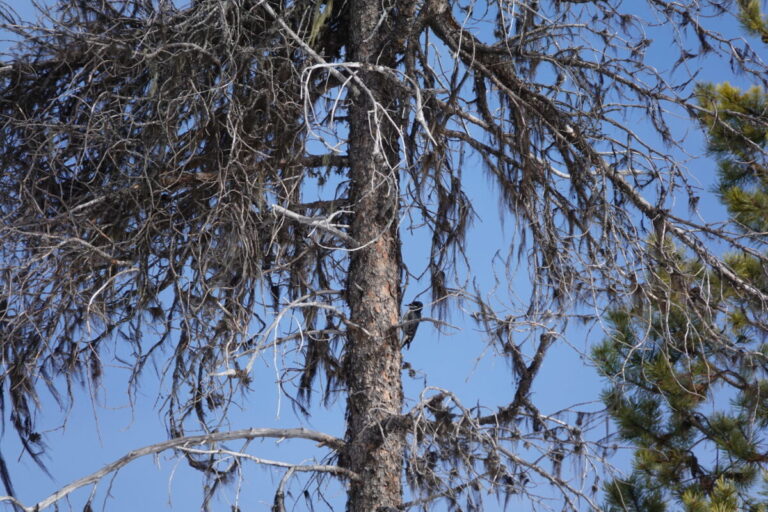
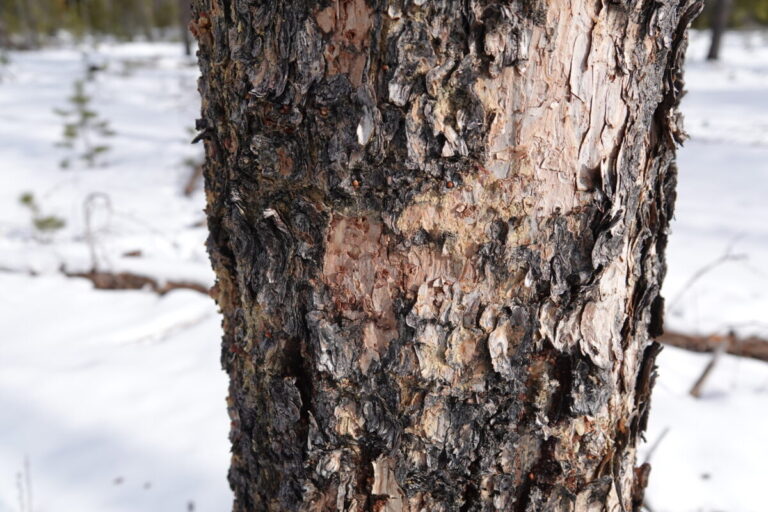
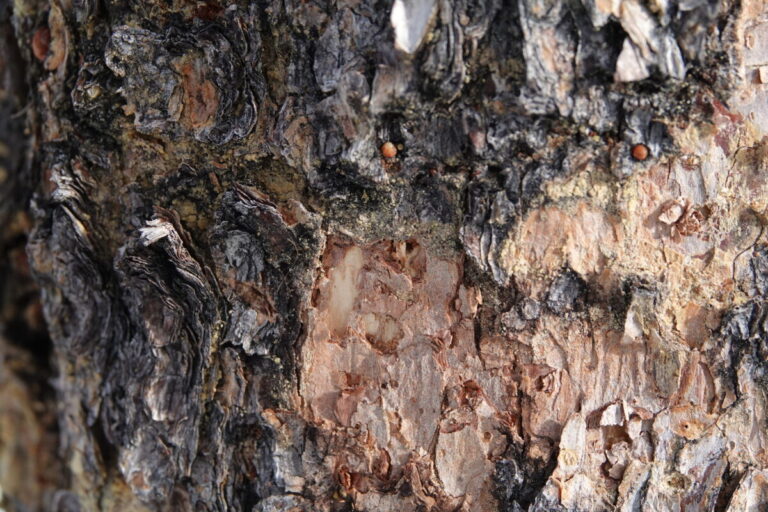
This species, and the less common American Three-toed Woodpecker, are present and active all winter in the High Cascades. They rarely make substantial holes in wood while feeding like the Hairy Woodpecker and especially the Pileated Woodpecker. Rather, they typically flake off the outer bark until they pinpoint their final small access hole from which they pull out a small beetle larva. This is most commonly seen on lodgepole pine, but they can feed on any tree species. Hairy Woodpeckers also flake bark but usually end up making a few small pits into the wood. Timing of the last snow and presence of wood chips on the snow can indicate how recent the activity occurred.
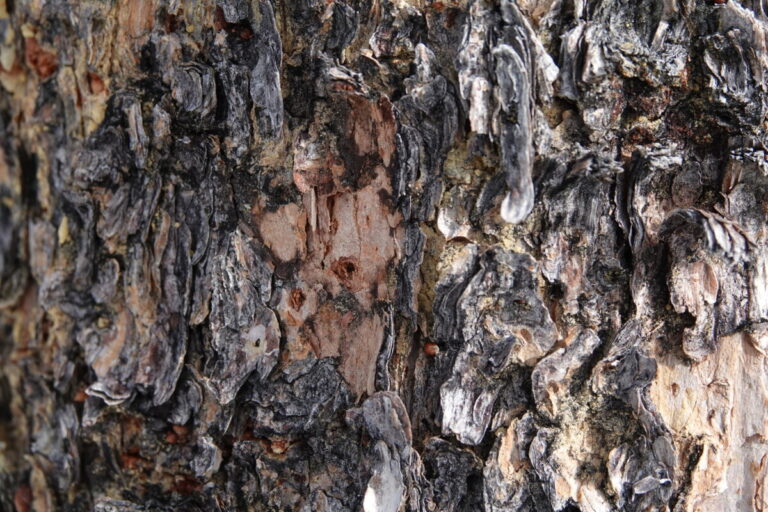
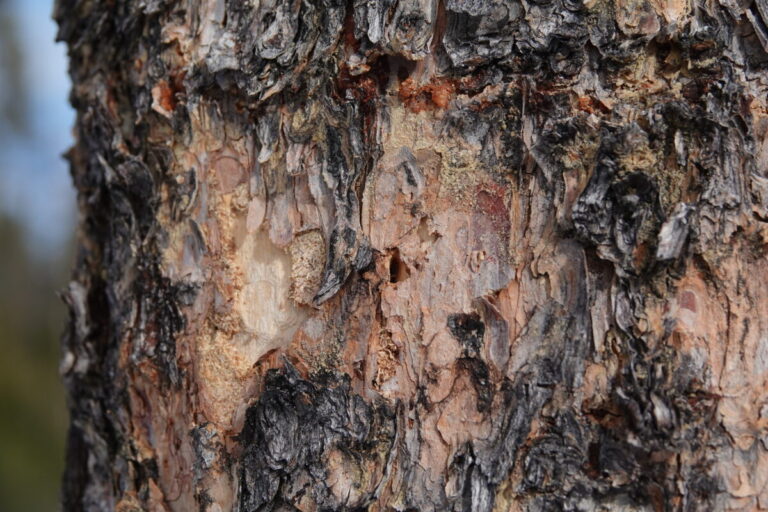
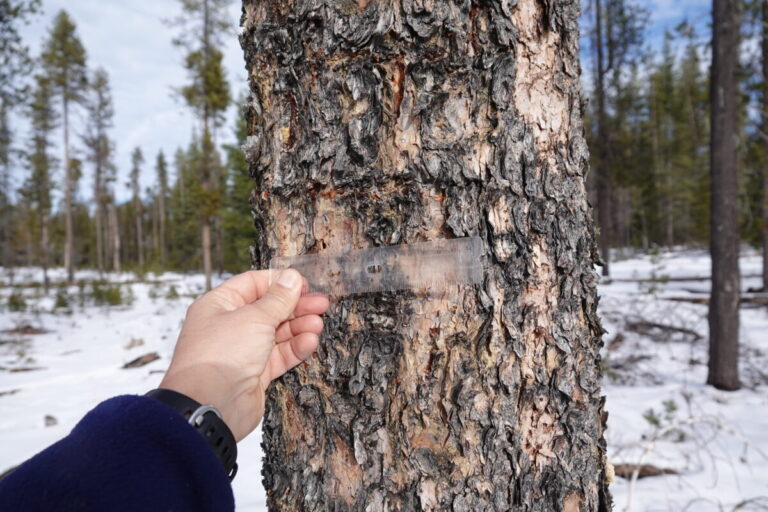
Flaked bark by a Black-backed Woodpecker on a lodgepole pine. Very small access holes are visible.
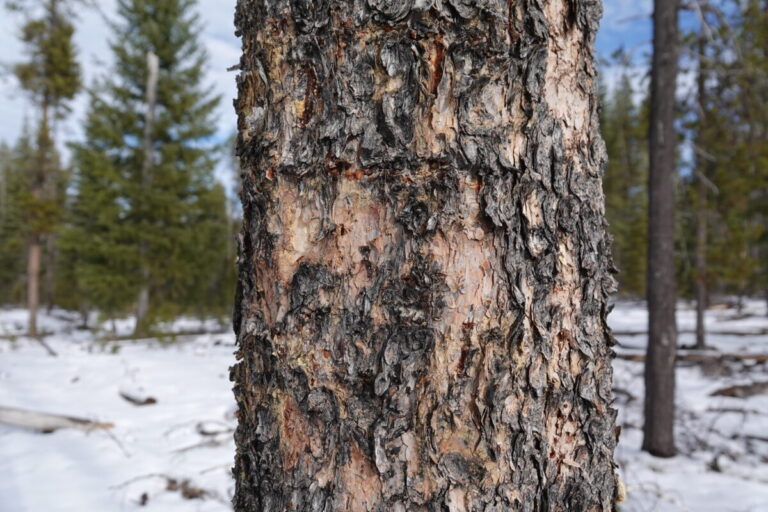
Close-up of flaked bark by a Black-backed Woodpecker on a lodgepole pine. Here the flaking has reached the cambium in one small area. Very small access holes are visible.
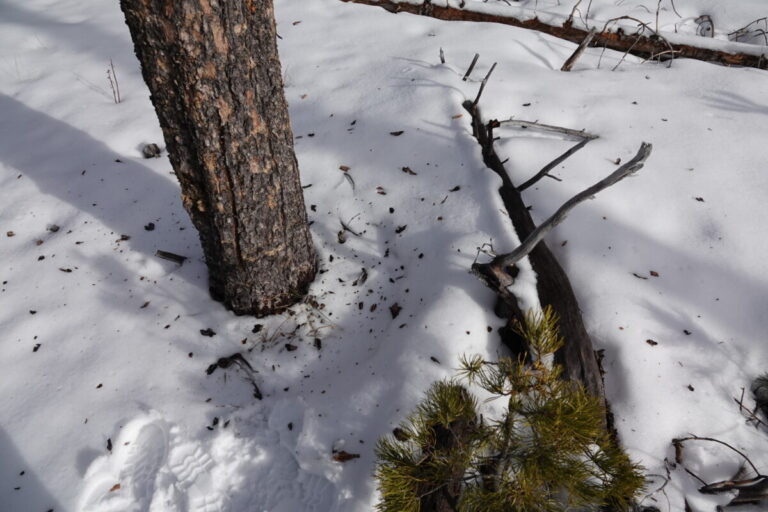
Lodgepole pine bark flakes on top of the snow from a foraging Black-backed Woodpecker.
Lodgepole pine bark flakes on top of the snow from a foraging Black-backed Woodpecker.
Flaked bark by a Black-backed Woodpecker on a lodgepole pine. Very small access holes are visible.
Flaked bark by a Black-backed Woodpecker on a lodgepole pine. Very small access holes are visible.
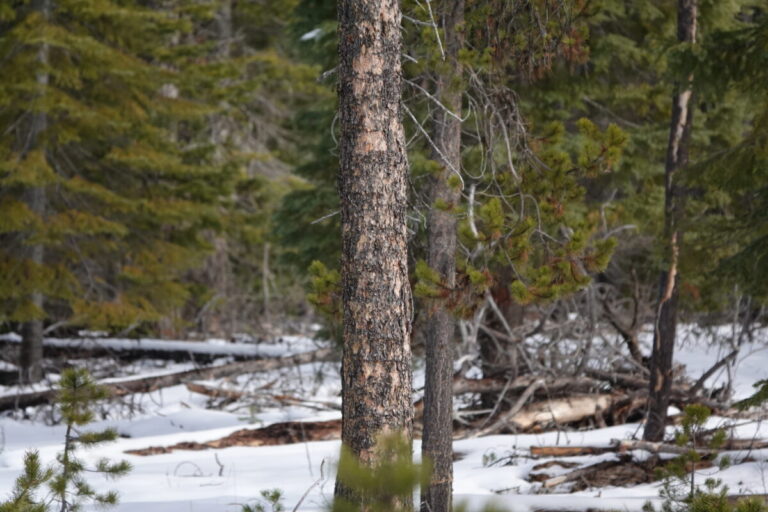
Broader view of a lodgepole pine foraged upon by a Black-backed Woodpecker.
Black-backed Woodpecker on right side of the bole of a lodgepole pine where it had been feeding.
Flaked bark by a Black-backed Woodpecker on a lodgepole pine. Very small access holes are visible.
Close-up of flaked bark by a Black-backed Woodpecker on a lodgepole pine. Here the flaking has reached the cambium in one small area. Very small access holes are visible.
Chipmunk
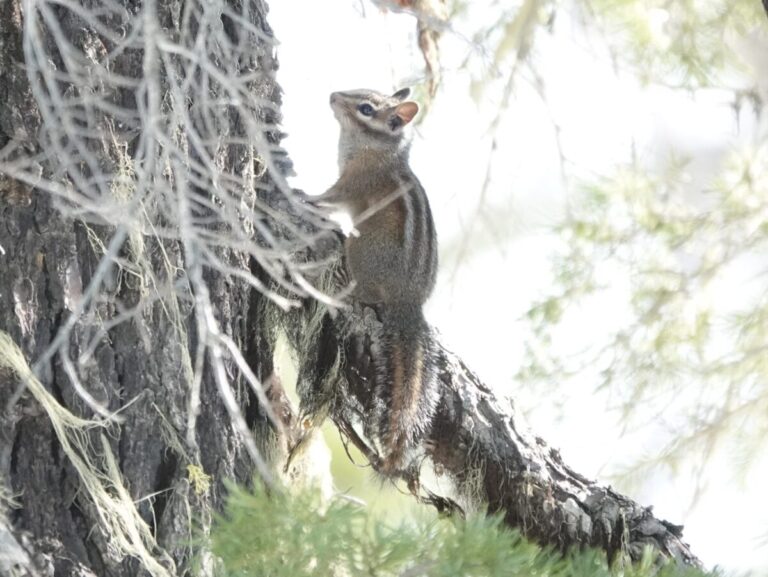
At high elevations, chipmunks spend the coldest part of winter (about four months most winters in this area) in and out of torpor, foraging now and then on stored food, and thus are not running around on the snow most of the winter. However, you can find their tracks, and the chipmunks themselves, when early season snows begin and again in early spring as things begin to warm up. At least four species of chipmunk have been recorded in the high elevations of eastern Douglas County and they are very difficult to identify so I will just treat them as “chipmunks.” I think I will also mention here that the Golden-mantled Ground Squirrel is also present in these areas but tends to go underground in fall even before the chipmunks and emerge later in spring, but it would be possible to find ground squirrel tracks in very early winter or early spring snows. I wouldn’t expect them in the middle of winter.
This chipmunk was still "awake" on October 28, 2025. At least four species of chipmunk have been recorded at high elevations of eastern Douglas County and I won't pretend to be able to tell them apart.
Several bounding trails of a chipmunk.
Chipmunk bounding trail.
A chipmunk bound, moving left to right.
Small dimensions of a chipmunk bound.
Close-up of chipmunk bounding track set.
Close-up of chipmunk bounding track set, with greater than average distance between the fronts and hinds, perhaps due to a thinner snow surface.
A chipmunk track set with the fronts very close to the hinds.
Chipmunk track set with some drag lines from the rear feet as it bounded left.
A bounding trail of a chipmunk.
Long-tailed and Short-tailed Weasels
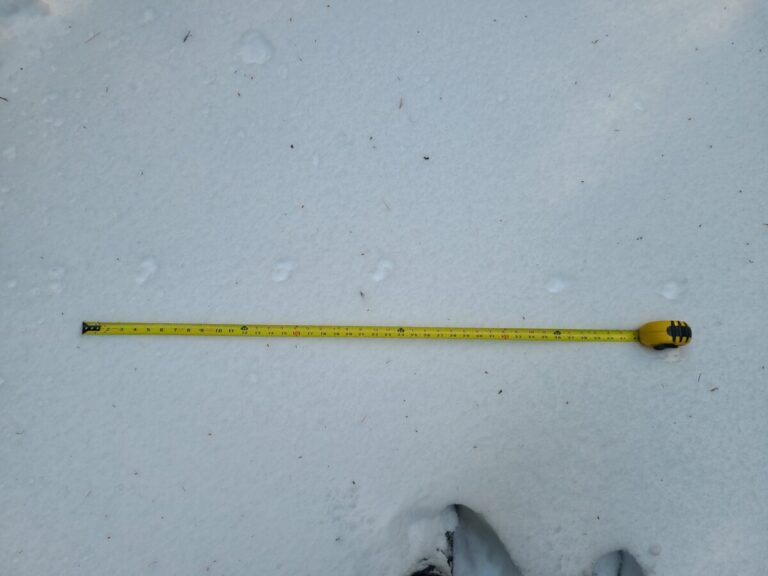
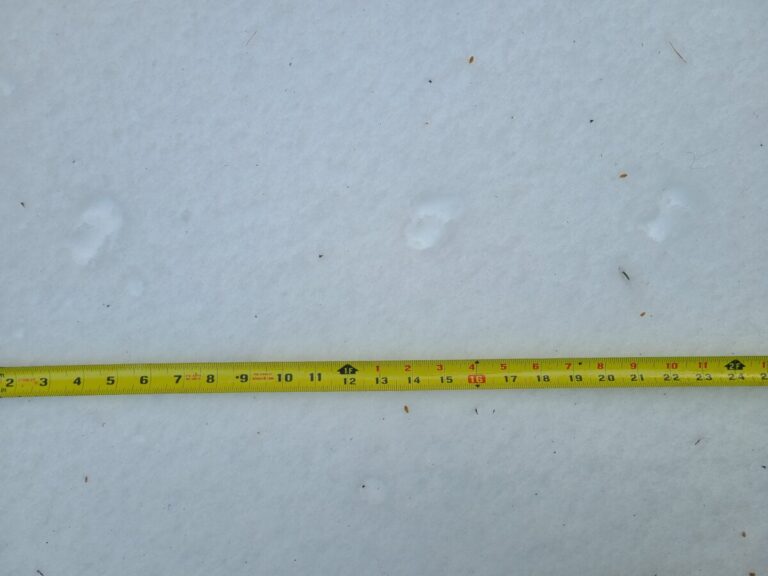
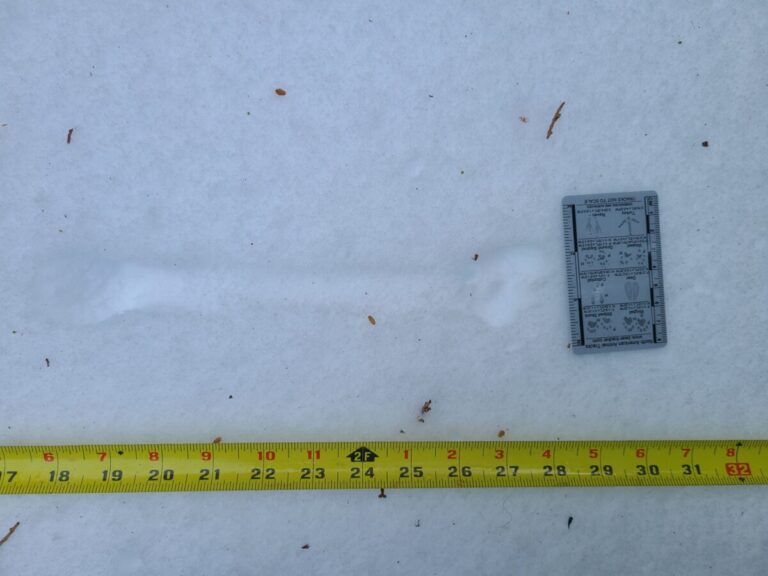
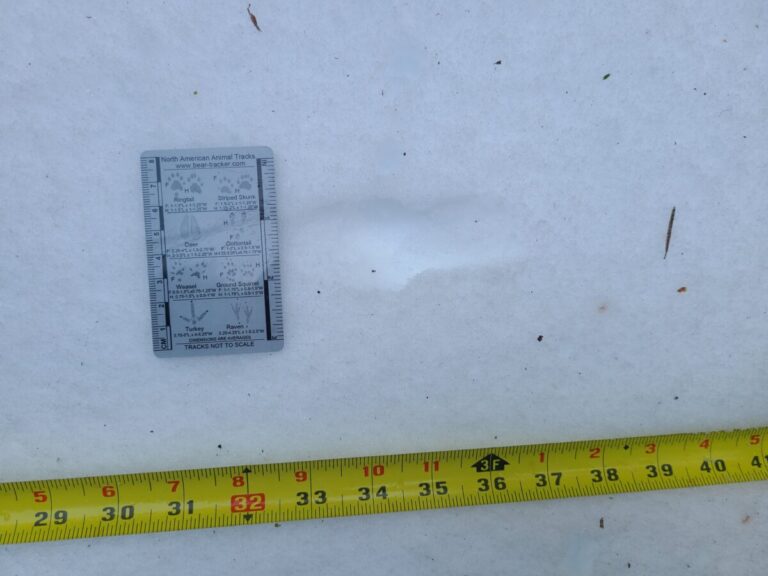
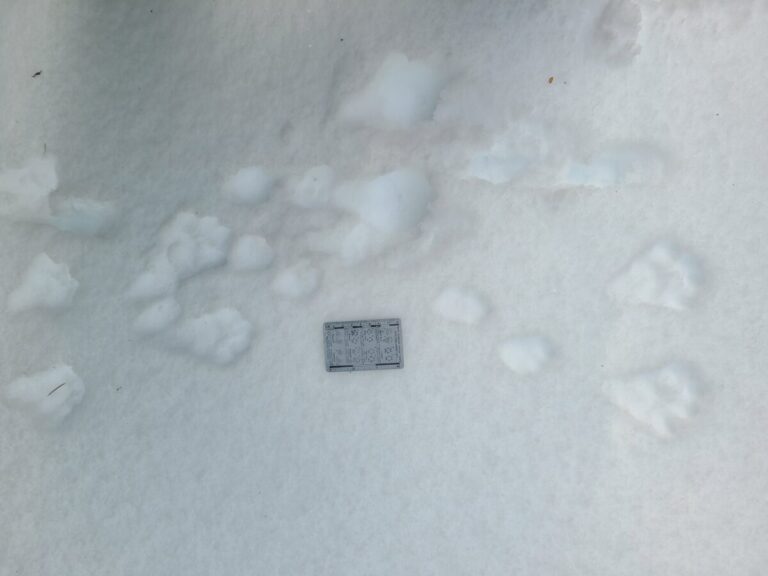
Thus far I have only twice found the tracks/trail of one of these small weasels in the snow. Both times they appeared quite small so I am guessing they are the Short-tailed Weasel (aka American Ermine). The foot impressions are roughly the size of a chipmunk, quite small, but their lope/bound pattern is distinct with only two diagonally oriented impressions being left for each leap. And in a bit softer/deeper snow there is often a drag mark between two sets, looking somewhat like a “dog bone.” Some people call these a lope and some call them a bound. What do you call them and why?
A weasel bound trail showing the alternating long and short distances between track sets.
A weasel bound trail showing the alternating long and short distances between track sets.
A weasel bound trail in soft snow, making it difficult to discern left and right side footfalls.
A weasel bound trail. Note the diagonal orientation of the track impressions compared to the line of the trail.
Notice the two somewhat offset impressions (one more forward than the other) in each track set.
The "dog bone" within a weasel bound trail.
One rather obscure impression due to deeper softer snow along a weasel bound trail.
Weasel bound trail including the "dog bone" pattern connecting two of the closer track sets.
Weasel bound trail including the "dog bone" pattern connecting two of the closer track sets.
A "dog bone" impression within a weasel 2x2 lope trail.
Douglas’s Squirrel
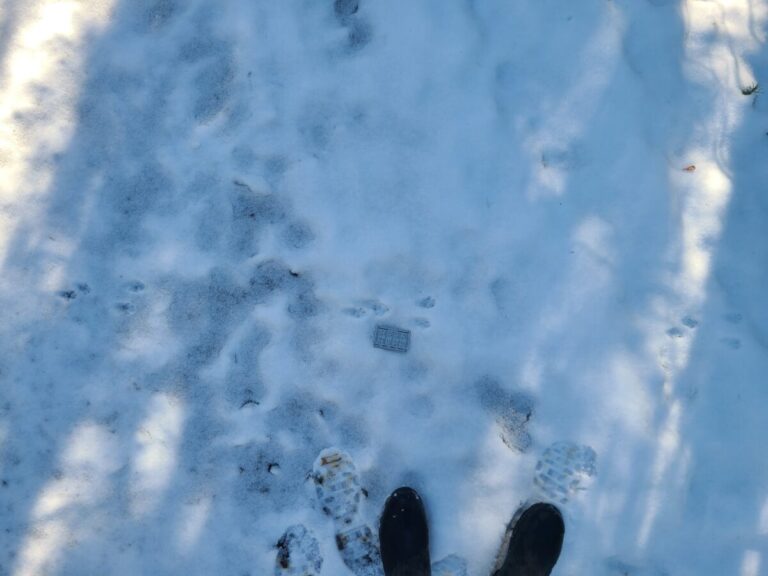
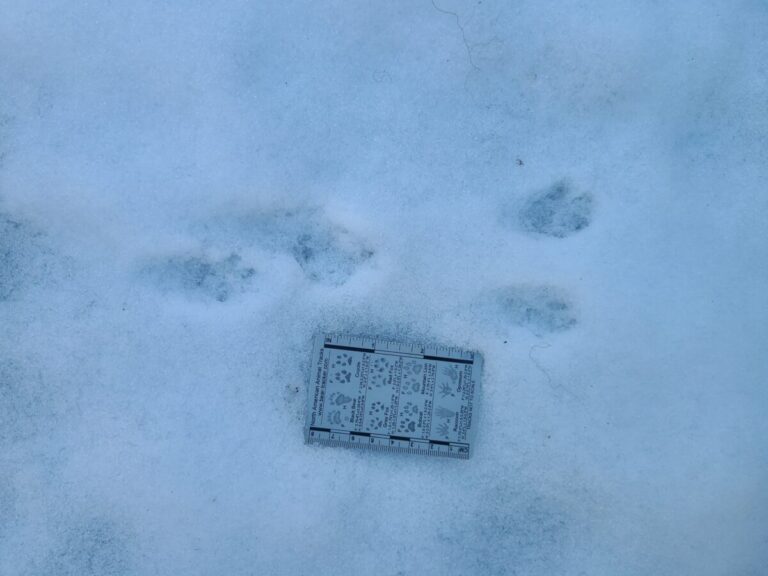
This species is one of the most common mammals active in winter in the High Cascades in this area and thus their tracks are some of the most common ones encountered. They mostly travel in a bound like the mice and chipmunks, but with impressions and trail widths being larger. As with the other rodents and rabbits/hares, in a bounding trail it is the wider-spaced and larger impressions of the rear feet that are in the direction of travel. This can switch if the animal is staying stationary for a moment rather than bounding, or even just moving much more slowly. You will notice this in some of the images below. Douglas’s Squirrels, also called Chickarees, make a variety of sounds, some of which are thought by many hearing them to be some type of bird.
Douglas's Squirrel bound and drag marks. Moving left to right.
Douglas's Squirrel bound and drag marks. Moving left to right.
Douglas's Squirrel bound and drag marks. Moving left to right. These are older tracks as indicated by the lack of thrown snow crumbs and very smooth (melted out) appearance.
Douglas's Squirrel bound and drag marks. Moving left to right.
Douglas's Squirrel bound and drag marks. Moving left to right.
Douglas's Squirrel bound and drag marks. Moving right to left.
Unusually detailed foot prints of a Douglas's Squirrel.
Unusually detailed foot prints of a Douglas's Squirrel.
Unusually detailed foot prints of a Douglas's Squirrel.
Unusually detailed foot prints of a Douglas's Squirrel that has paused briefly. Four toes can be seen on the smaller front tracks and five on the rears.
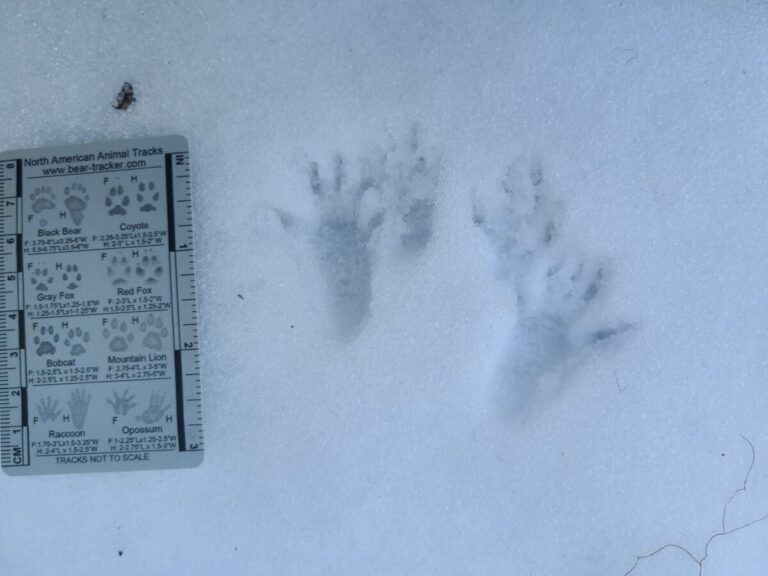
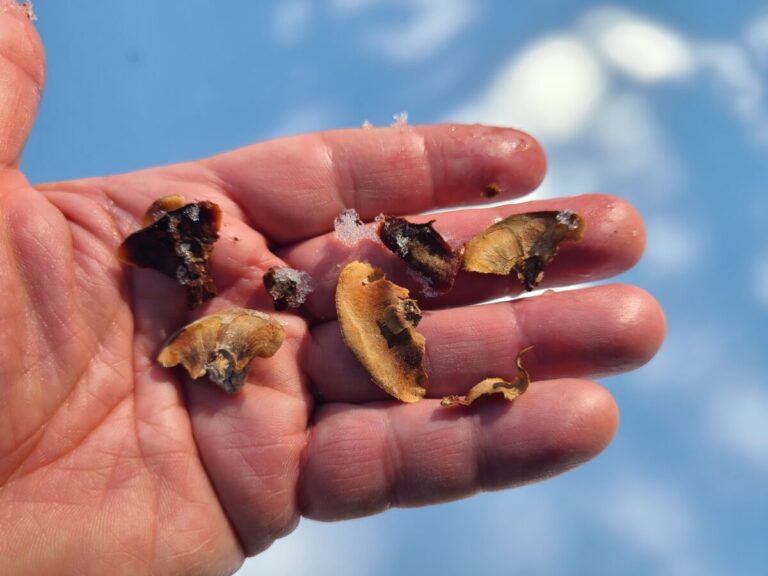
True fir (Abies sp.) cone scales stripped by a Douglas's Squirrel.
The track set below initially recalled a cottontail to me, with the paired hinds and offset fronts. However, upon closer examination, I could see 4 toes (1-2-1 pattern) and the proximal pads on the front feet, and 5 toes (1-3-1 pattern) on the hind feet. Therefore, I’ve concluded that these show a “rabbit-like” bound of the Douglas’s Squirrel. I have heard of this pattern but this is the first time I have seen it.
A very lagomorph-like bounding trail of a Douglas's Squirrel. Zooming in the the tracks I could see 4 toes on the front feed and 5 toes on the hinds.
An unusual lagomorph-like track set of a Douglas's Squirrel. Look closely for 4 toes on the front feet (left) and 5 toes on the hind feet (right).
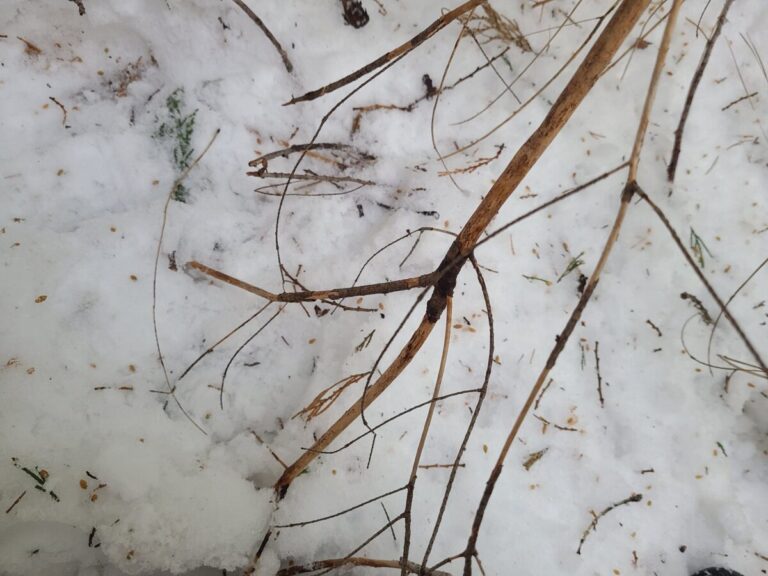
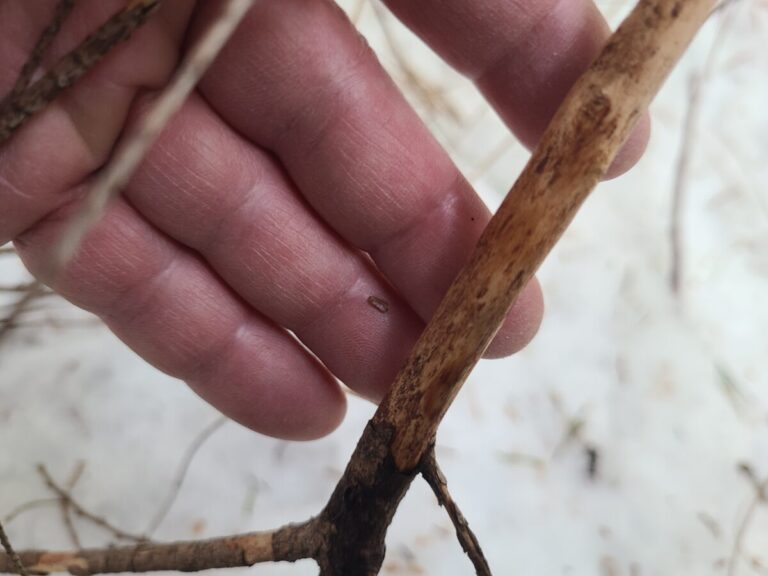
The following set of photos shows some small diameter down conifer trees or limbs that have been stripped of flaky bark by a squirrel. Both Douglas’s Squirrel and Western Gray Squirrel do this, but the diameters on many of these stripped twigs are smaller than I am used to with Western Gray Squirrels so I am putting it here in the Douglas’s Squirrel section, but I could be wrong. Note that this sign is different than that of foraging sign by rabbits or hares because only the thin flaky bark has been collected, the cambium and surface of adjacent wood has not been scraped (no incisor marks).
Bark removed from this conifer limb, but no incisor marks.
Bark removed from this conifer limb, but no incisor marks.
Bark removed from this conifer limb, but no incisor marks.
Bark removed from this conifer limb, but no incisor marks.
Bark removed from this conifer limb, but no incisor marks.
Bark removed from this conifer limb, but no incisor marks.
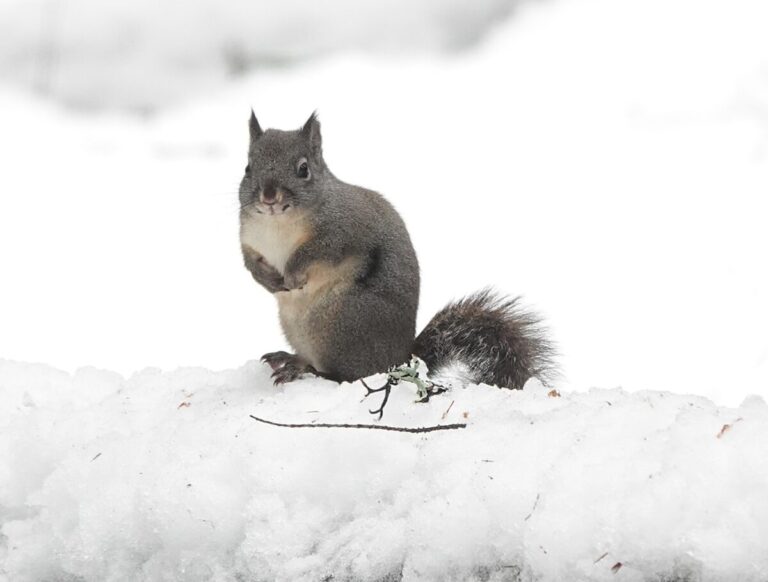
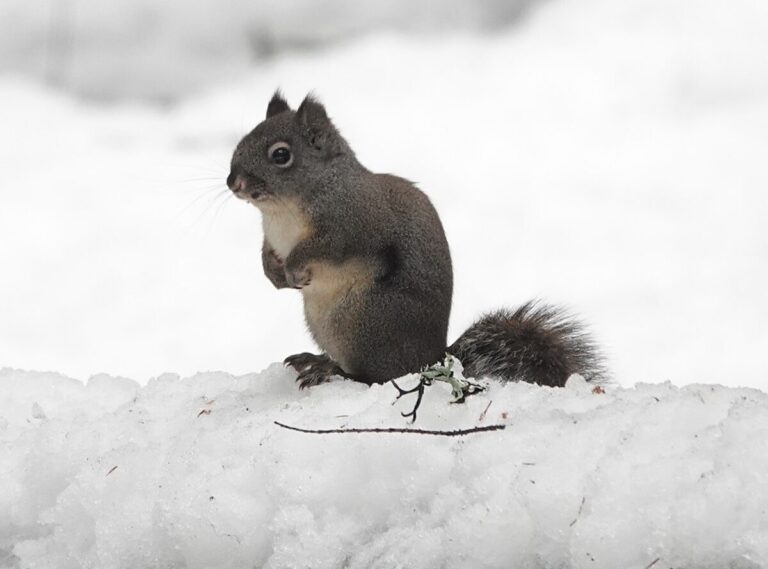
A Douglas's Squirrel checking me out from the top of a log. This one is quite pale underneath which might indicate it is a young one, but they also tend to be less colorful underneath here than in the Coast Range.
A Douglas's Squirrel checking me out from the top of a log. This one is quite pale underneath which might indicate it is a young one, but they also tend to be less colorful underneath here than in the Coast Range.
Pocket Gopher
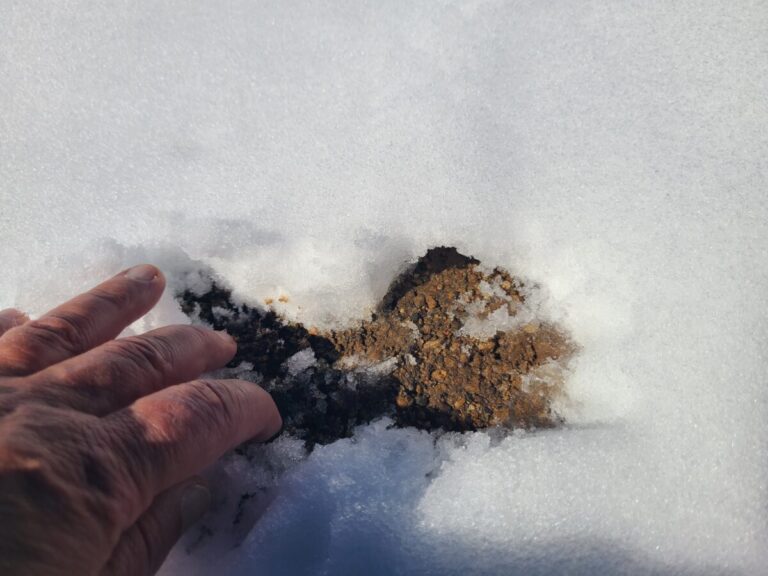
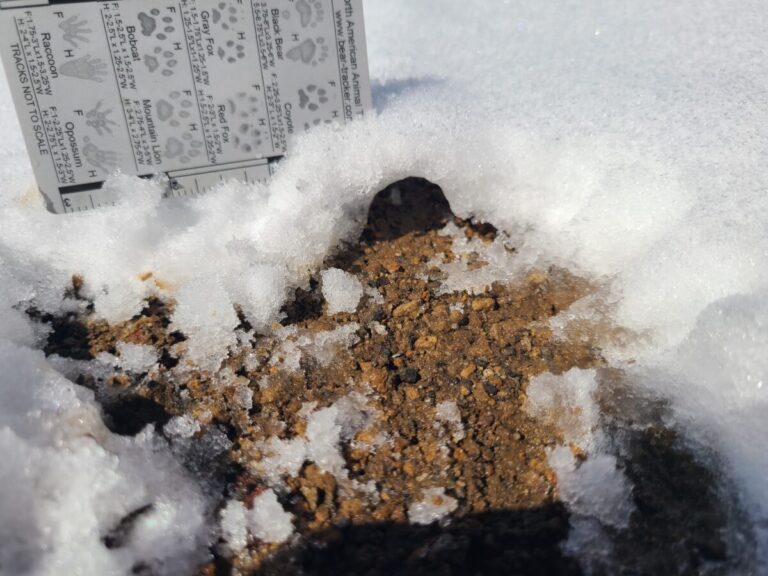
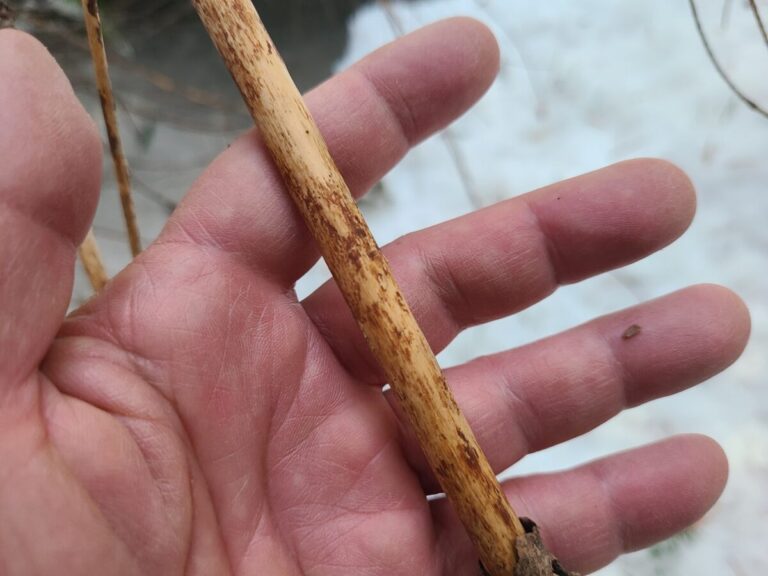
I suspect most pocket gophers in this area are the Western Pocket Gopher, but it is possible that Northern Pocket Gophers are present as well. During winter, pocket gophers are active under the snow and rarely make an appearance at the surface. Their “eskers” (soil-filled tunnels under and through the snow) are revealed upon snow melt. Following are a couple photos of the only evidence I have encountered that I thought was pocket gopher during the winter. It is a collapsed (melted) tunnel that seems much too large for a vole, or even a mole. This was visible because at this time and place the snow was only about 2 inches deep. Later in winter when the snow is deeper, such a tunnel would not be visible.
A collapsed pocket gopher tunnel. It appeared to me that since the snow layer was relatively shallow the sunshine and dark soil underneath served to weaken the formerly domed tunnel so it slowly sunk into itself.
Closer view of the collapsed pocket gopher tunnel.
Pileated Woodpecker
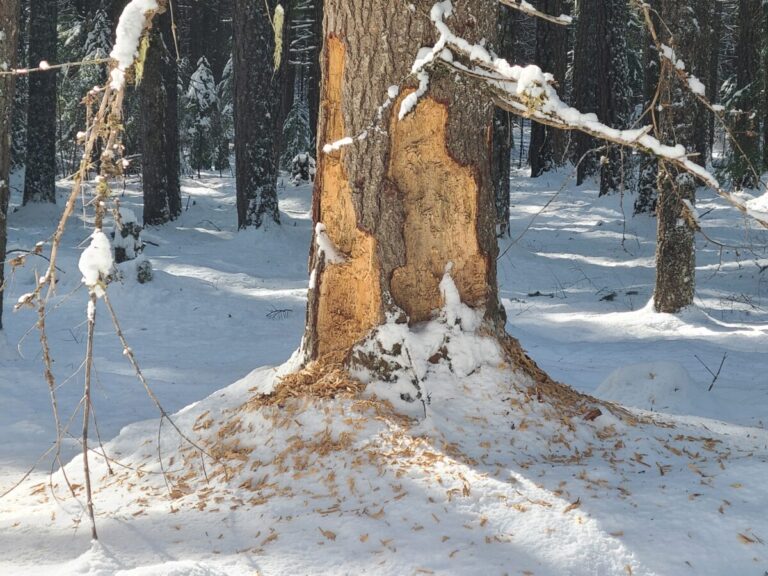
This, the largest extant woodpecker in North America, forages all year round including all winter in the High Cascades. Some of their foraging efforts can be small and be similar to that of the Hairy Woodpecker, but their most distinctive foraging sign are large rectangular oval excavations on standing and down trees. Sometimes these excavations end up converging and covering many square feet of a dead or partly dead tree. As with other woodpeckers, timing of the last snow and presence of wood chips on the snow can indicate how recent the activity was.
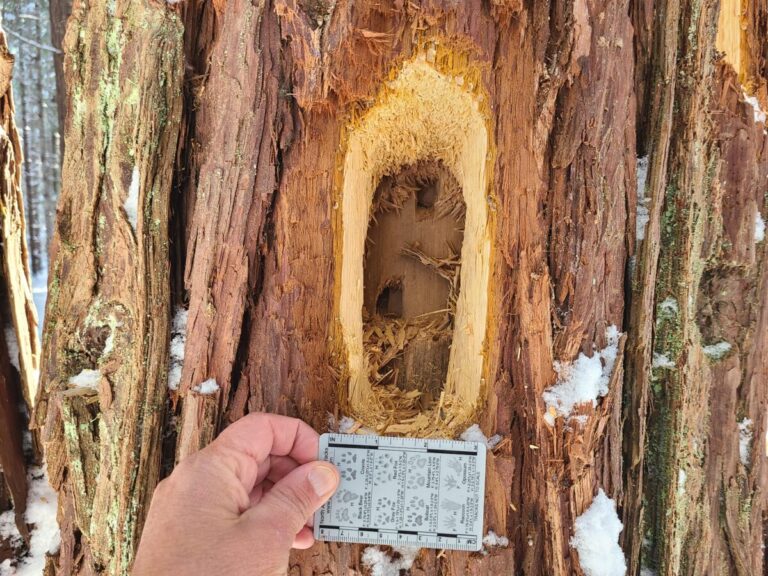
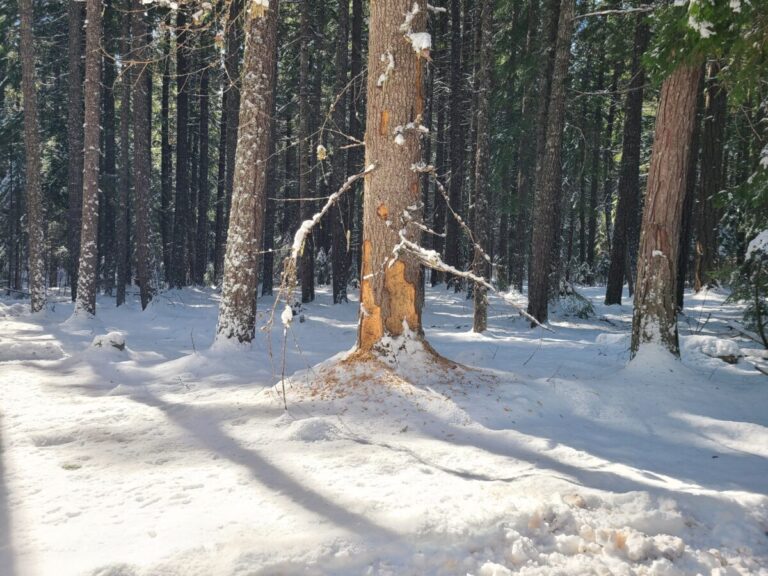
A classic rectangular oval excavation by a Pileated Woodpecker in this Incense Cedar.
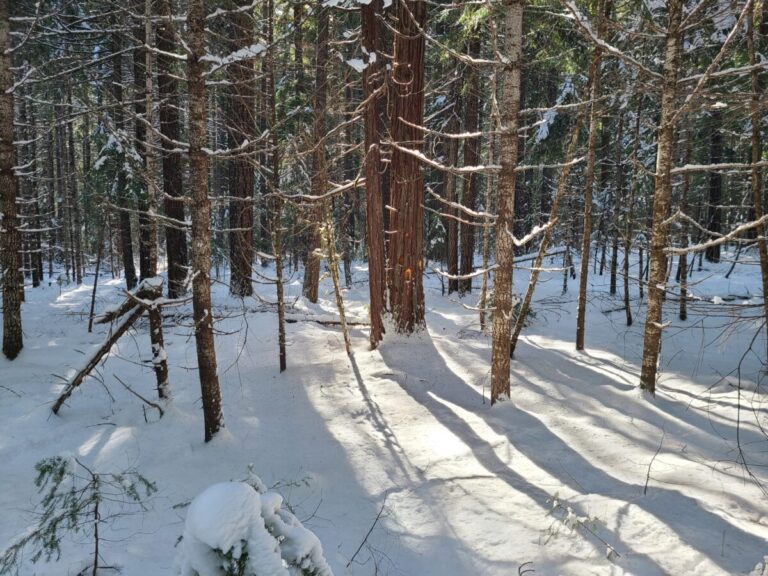
A broad view of the cedar containing the rectangular oval excavation by the Pileated Woodpecker.
Broad and extensive excavation by a Pileated Woodpecker in a dead fir tree. Wood chips cover the snow nearby.
A broader view of the dead fir tree with the extensive excavation by a Pileated Woodpecker.
Ruffed and Sooty Grouse
Both of these species of grouse occur in the High Cascades and I have not yet watched either species make tracks in the snow. Nor do I have a reference for foot or track measurements for Sooty Grouse. I assume Sooty Grouse tracks are larger than Ruffed Grouse tracks because the birds themselves are larger. But let me know if you have some actual data or can ID these tracks with certainty.
Grouse trail. Footfalls are visible but details of the feet are not.
Grouse trail. Footfalls are visible but details of the feet are not.
Grouse trail. Footfalls are visible but details of the feet are not.
Grouse trail. The actual footprint is barely visible and not very clean.
Grouse tracks where the snow was not as soft, under a bit of conifer canopy.
Grouse tracks where the snow was not as soft, under a bit of conifer canopy.
Grouse tracks where the snow was not as soft, under a bit of conifer canopy.
The grouse tracks came out from this sheltered area of brush. The grouse may have been feeding in there.
One grouse track showing all toes.
Grouse trail walking right to left, then wing marks at takeoff.
Closer look at grouse trail walking right to left, then wing marks at takeoff.
Western Gray Squirrel
This is our largest species of tree squirrel in the Pacific Northwest, where it primarily occurs at moderate and low elevations. Very small numbers enter high elevation mountains via river corridors and occupy nearby slopes as well. Tracks and trails of this large squirrel are similar to the Douglas’s Squirrel but larger. Track and trail photos are below, but you might also review the photos of bark stripping sign that I put under Douglas’s Squirrel, which are basically identical to those of the Western Gray Squirrel, but I speculate on average might less often include the thinner twigs.
Western Gray Squirrel trail bounding towards the observer.
Western Gray Squirrel bounding trail, traveling right.
Western Gray Squirrel bounding trail, traveling right.
Western Gray Squirrel set of four feet, fronts close together on the left and rears farther apart on the right. Travel direction to the right.
Nice detail on a Western Gray Squirrel slow bound track set.
Western Gray Squirrel tracks.
Western Gray Squirrel tracks.
Western Gray Squirrel tracks at the base of a tree which it climbed.
Western Gray Squirrel tracks at the base of a tree which it climbed.
Common Raven
Ravens are present throughout the High Cascades. They commonly loiter around or patrol human concentration areas such as roads, sno-parks, resorts and such to scavenge road-killed animals or dropped food items, but presumably forage on scraps from predator kills as well. The vocalizations of this wise landscape monitor can read like a newspaper or Facebook feed for anyone who knows what they are saying. Crows, which are smaller, do not occur in the High Cascades, especially in winter.
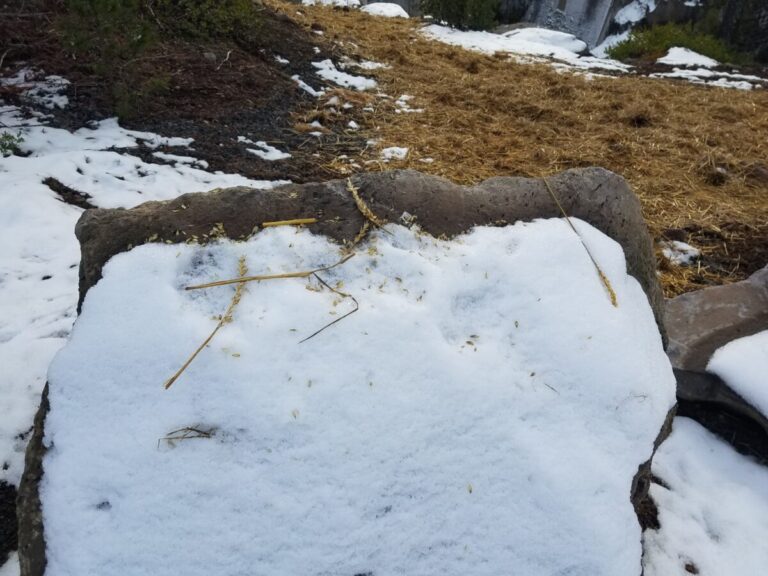
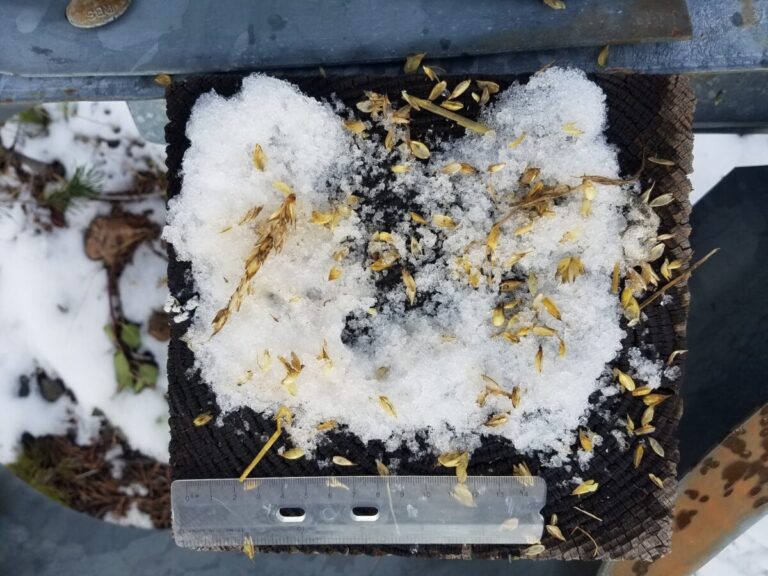
Ravens perched on this rock to process seed heads harvested from the erosion control "hay" seen in the background.
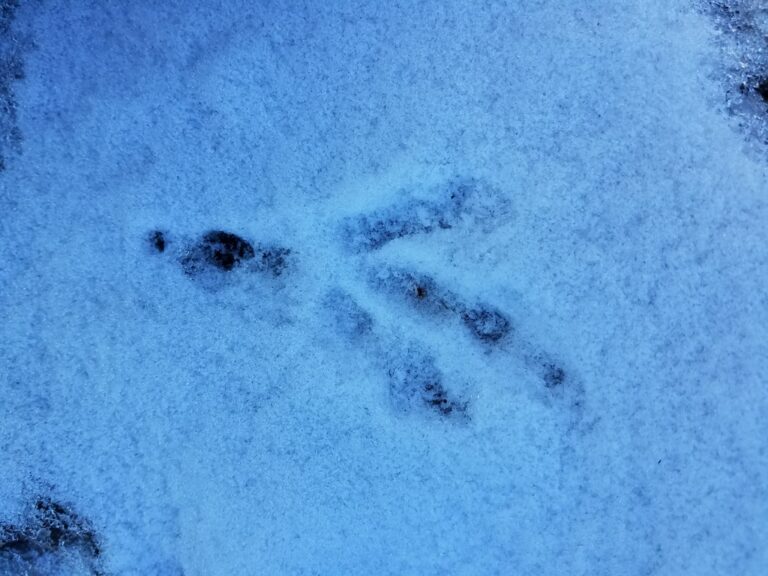
Common Raven track, left. The center toe (toe 3) leans towards the inside.
Common Raven track, left. The center toe (toe 3) leans towards the inside.
Common Raven track, left. The center toe (toe 3) leans towards the inside.
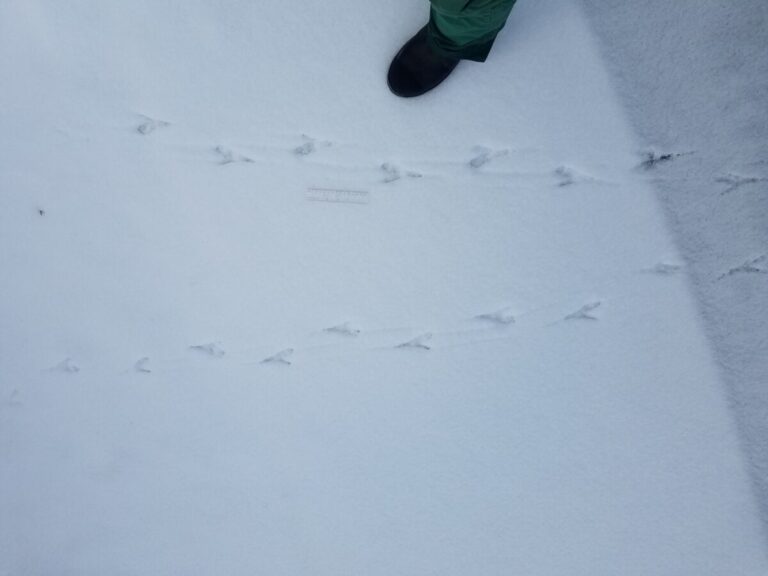
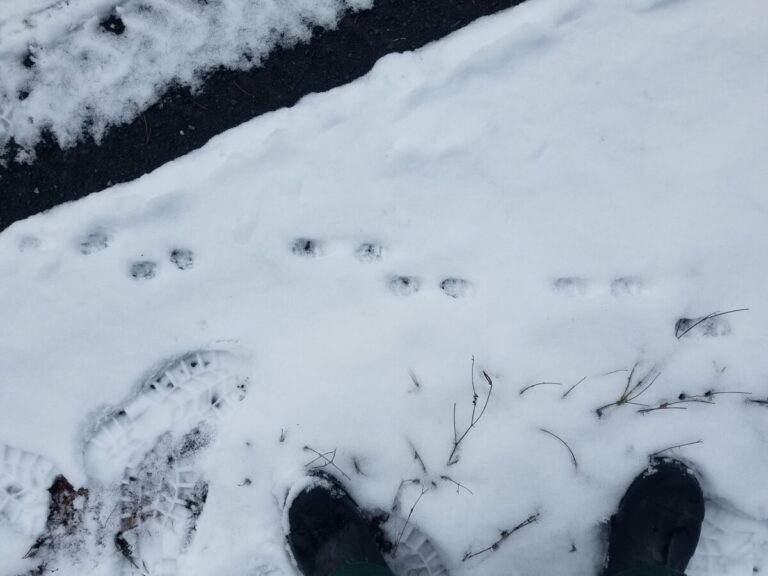
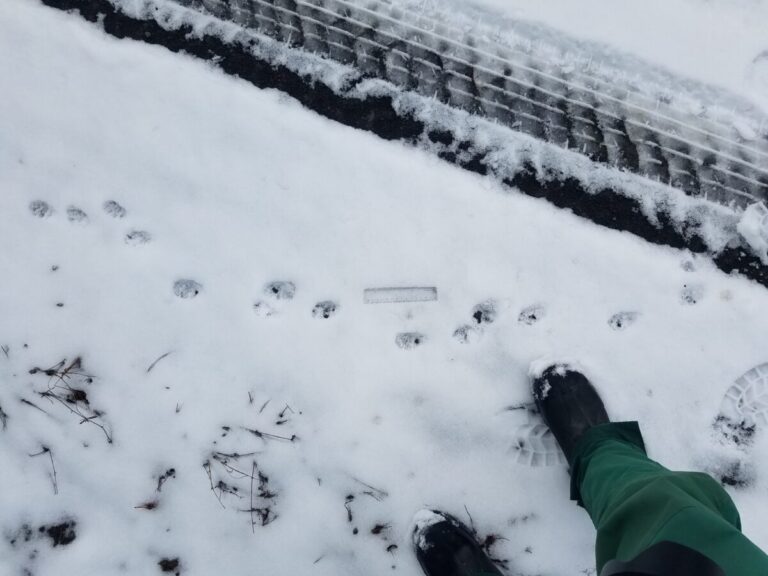
Raven tracks showing traveling left.
Raven tracks, traveling left. The two toes that are close to each other (toes 2 and 3), in this case look like one fat toe or mitten.
Raven tracks traveling left (top) and right (bottom).
A raven perched hear while it processed seedheads from a composition of grass spread nearby for erosion control.
Striped Skunk
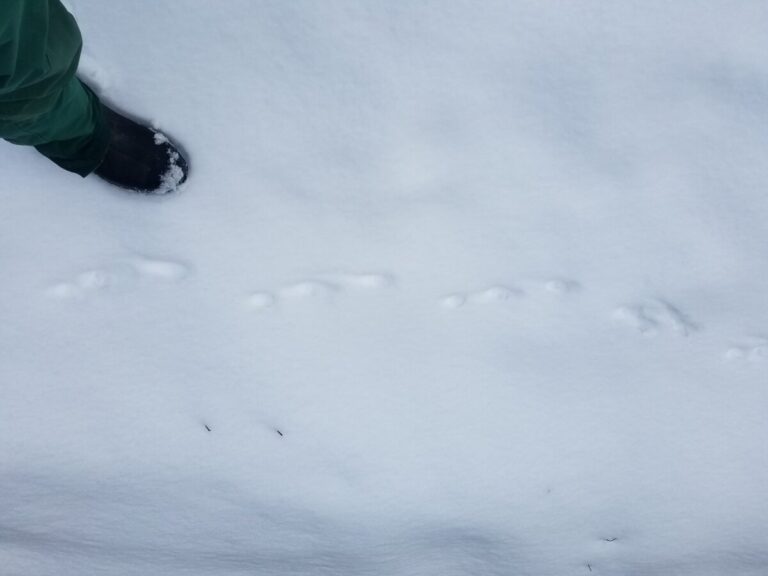
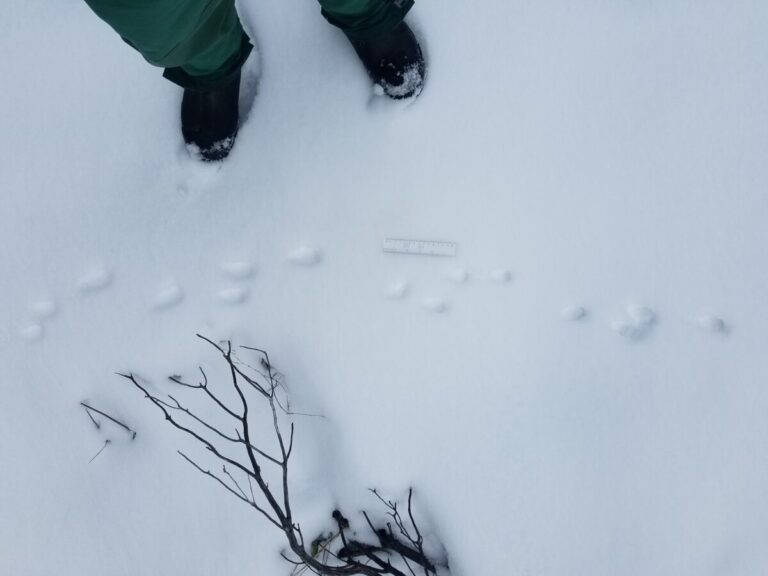
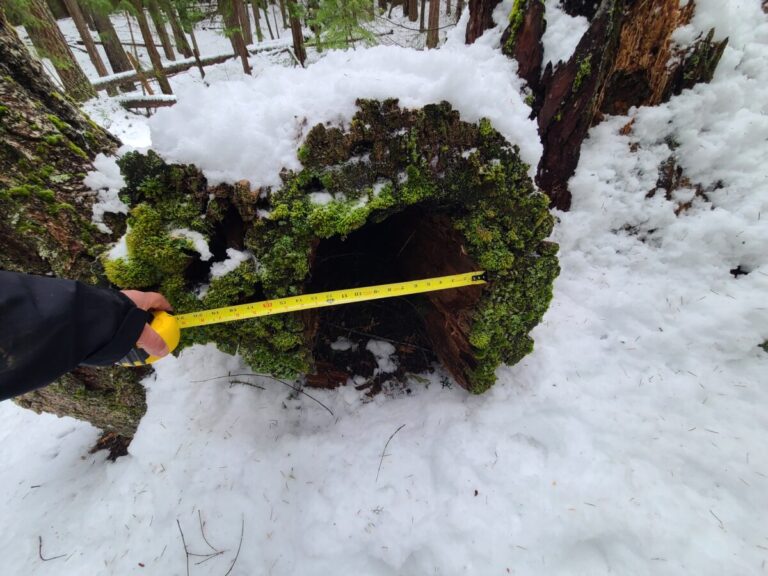
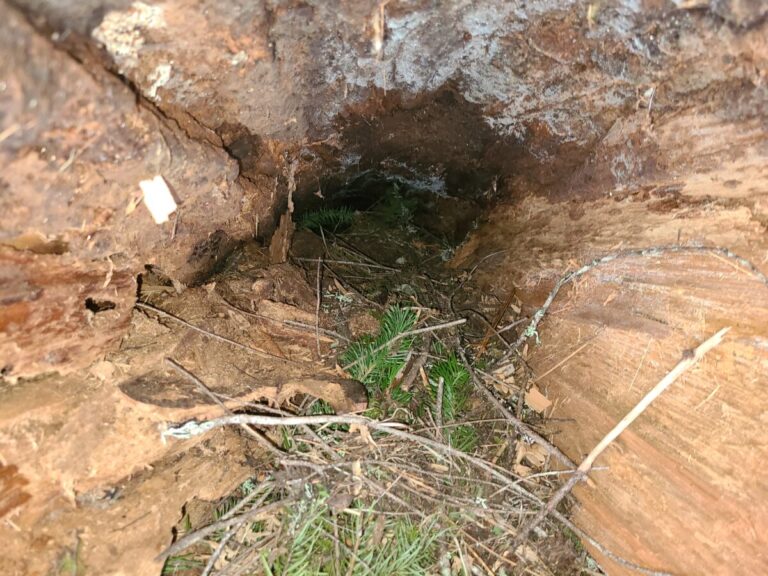
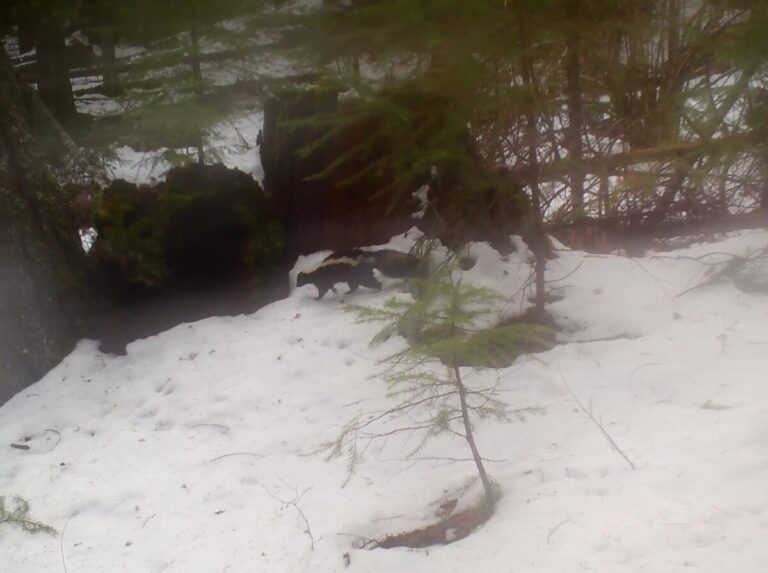
This adaptable species occurs at least up to the western edges of the High Cascades, but may be absent at higher elevations. They typically travel in a lope. I have not yet seen them or their tracks near the lodges at Lemolo or Diamond Lakes, but wouldn’t be surprised to find them there. A trailcam watching a hollow log a couple miles from Toketee Lake revealed that a Striped Skunk was denning there. I wouldn’t be surprised to find Western Spotted Skunks in the area but have not found their tracks yet.
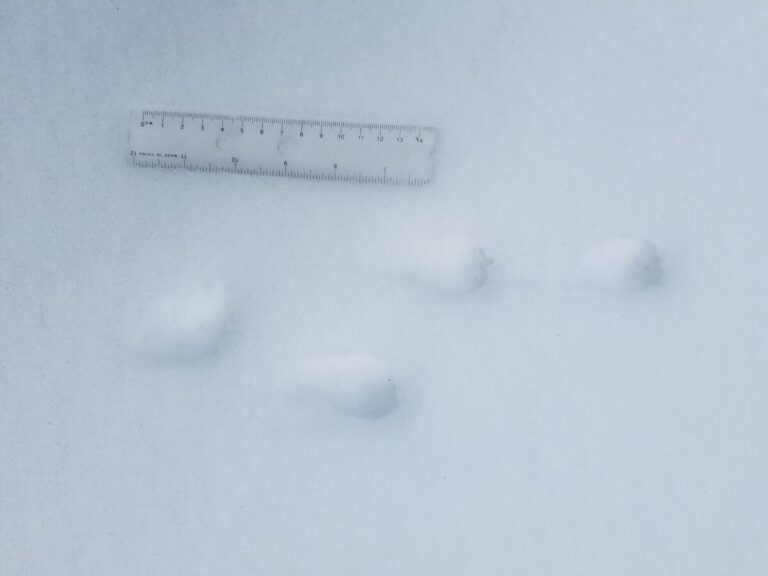
Lope gait of Striped Skunk
Lope gait of Striped Skunk
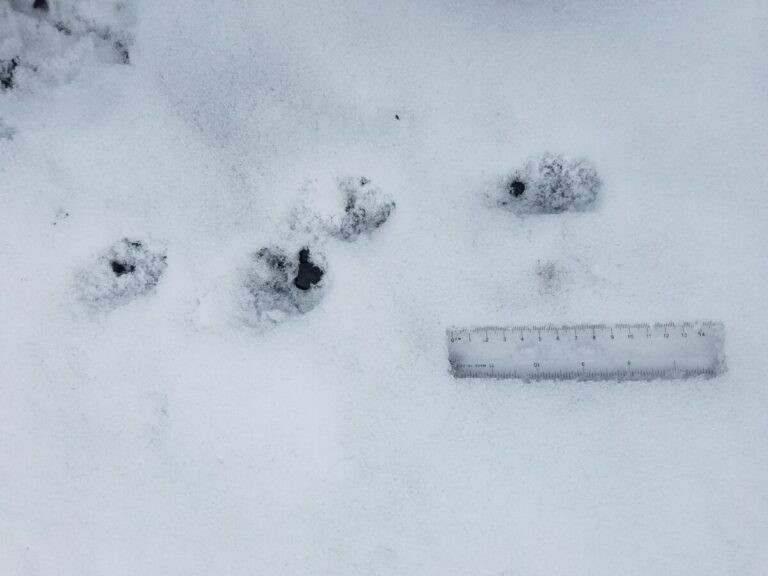
I'm not sure what's going on here, but this was part of one of the other trails shown here.
Lope gait of Striped Skunk
Hollow log used as a den by a Striped Skunk, confirmed by camera trap.
Inside view of the hollow log used as a den by a Striped Skunk, confirmed by camera trap.
Striped Skunk heading to its den in the hollow log.
Lope track set of a Striped Skunk.
Lope track set of a Striped Skunk.
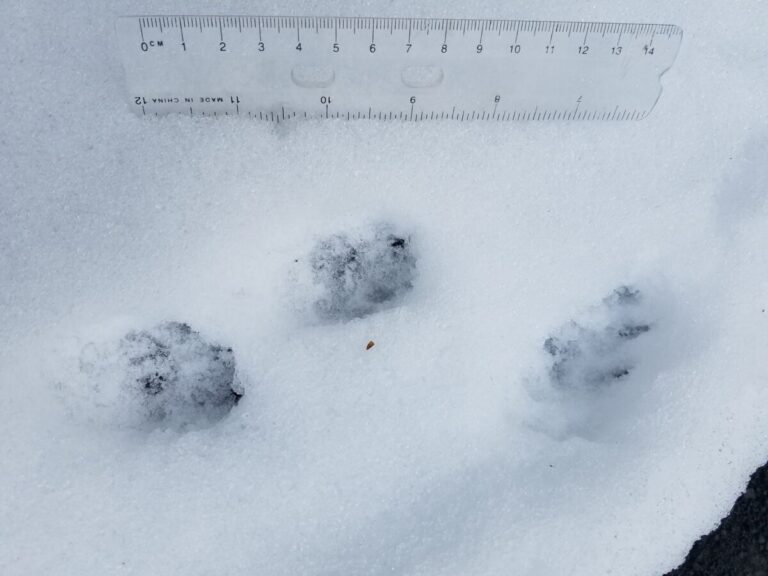
Close-up of some Striped Skunk tracks in the loping trail.
Close-up of some Striped Skunk tracks in the loping trail.
Close-up of some Striped Skunk tracks in the loping trail.
Snowshoe Hare
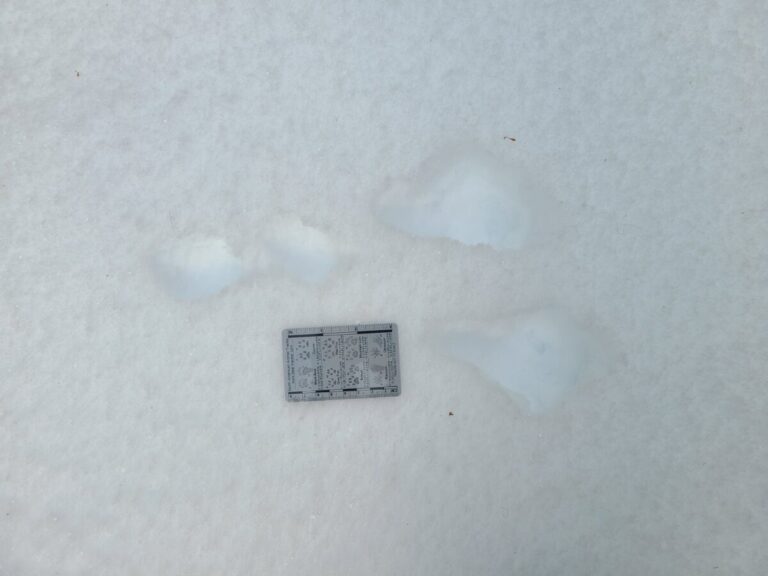
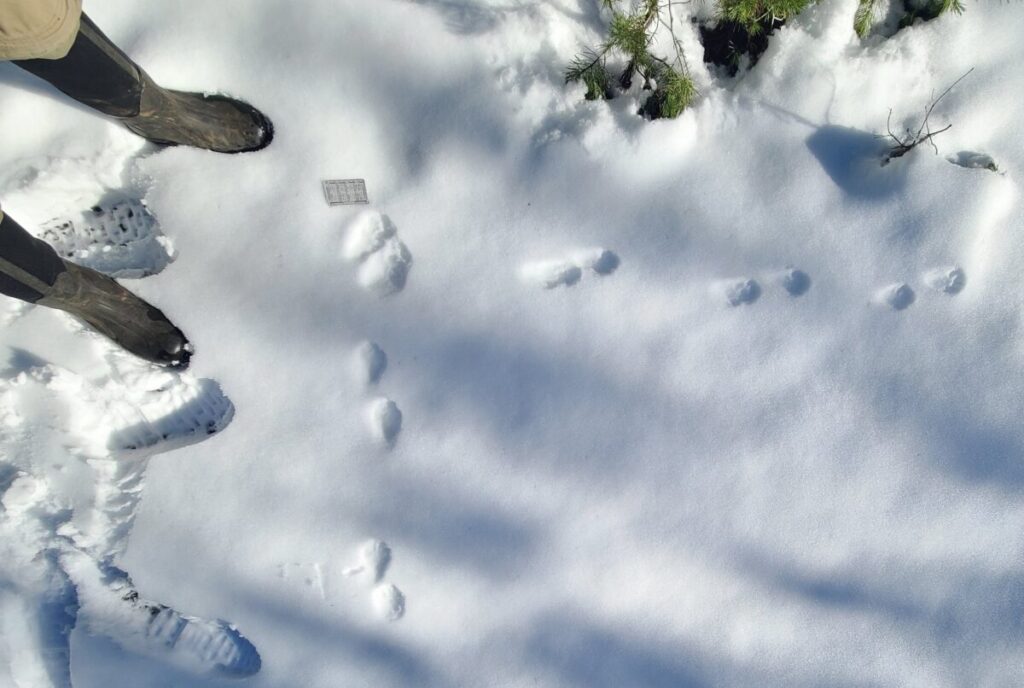
Second only to Douglas’s Squirrel, Snowshoe Hare tracks are one of the most commonly encountered snow tracks in eastern Douglas County. In some areas they are more common than Douglas’s Squirrel tracks. They are quite distinctive in their typical bounding pattern, with two smaller front feet landing offset from one another and then the larger hind feet swinging past and landing even with each other in a wider placement. The arrangement of the four feet as well as the noticeably different sized front and rear feet make for a very recognizable track set. There are exceptions of course, depending on substrate, but that’s par for the course.
Snowshoe Hare slow bound, going right, with moderate track definition.
Snowshoe Hare slow bound, going left, with good track definition.
Snowshoe Hare slow bound, going left, with good track definition.
Snowshoe Hare slow bound, going left, with poor track definition. Crossing Douglas's Squirrel trail which goes from upper left to lower right.
Snowshoe Hare slow bound, going right, with poor track definition.
Snowshoe Hare bound and paused movement, mostly traveling right.
Snowshoe Hare slow bound, going right, with moderate track definition.
Snowshoe Hare slow bound, going left, with good track definition.
Snowshoe Hare slow bound, going right, with fairly good track definition.
Pacific Marten
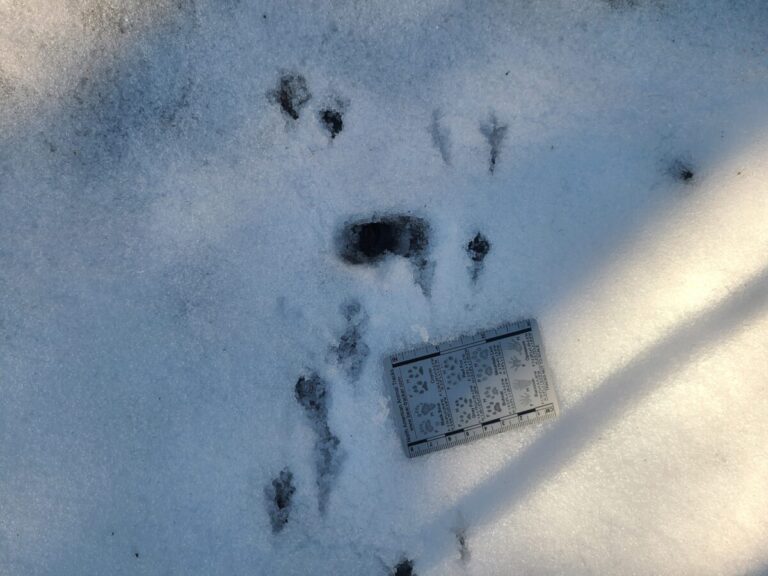
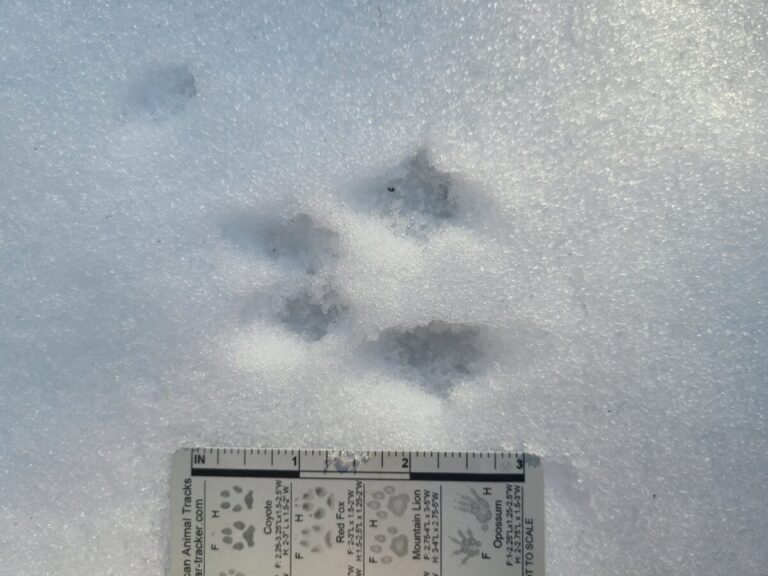
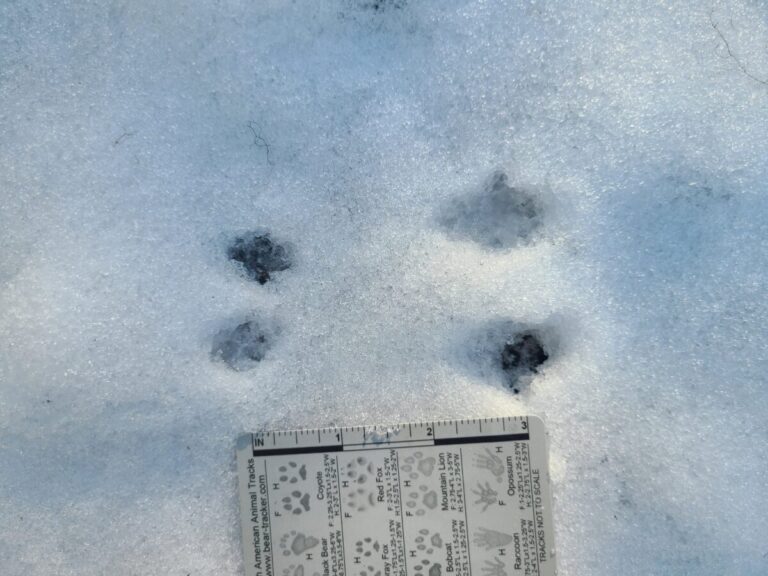
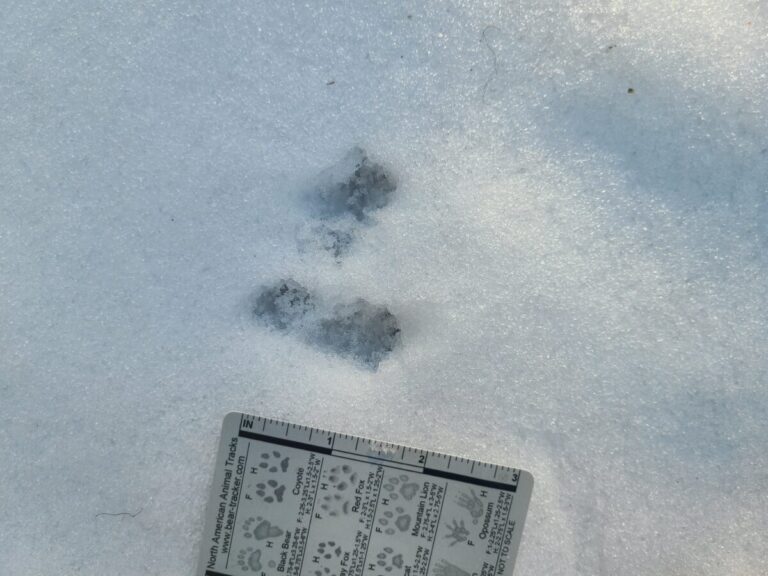
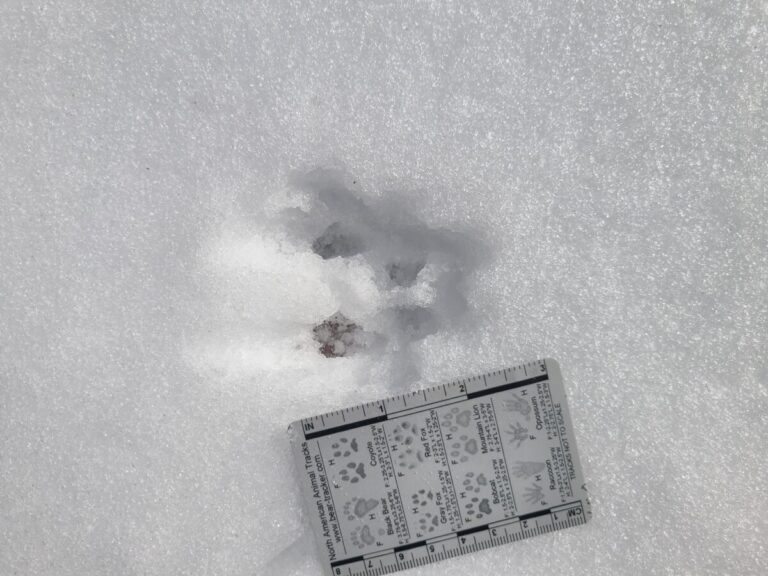
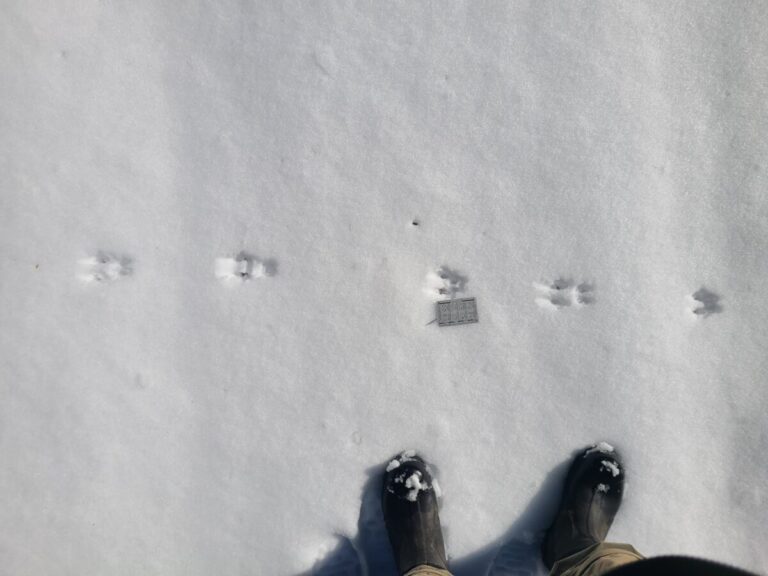
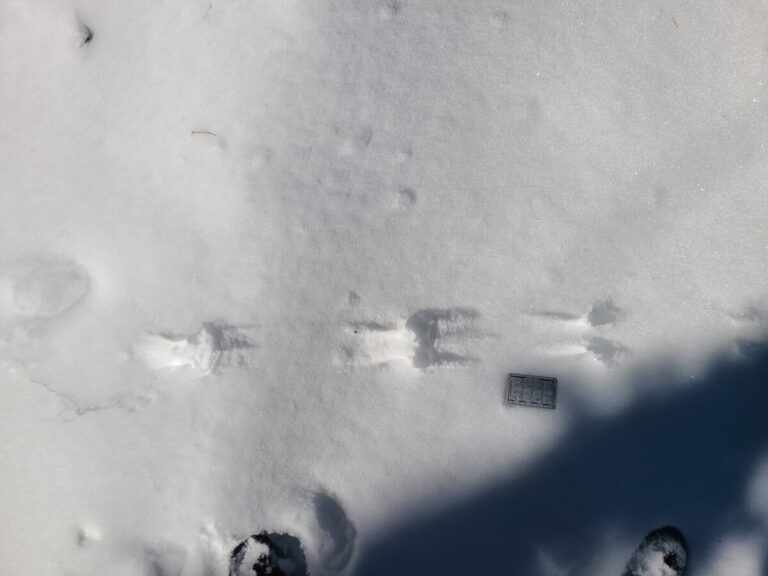
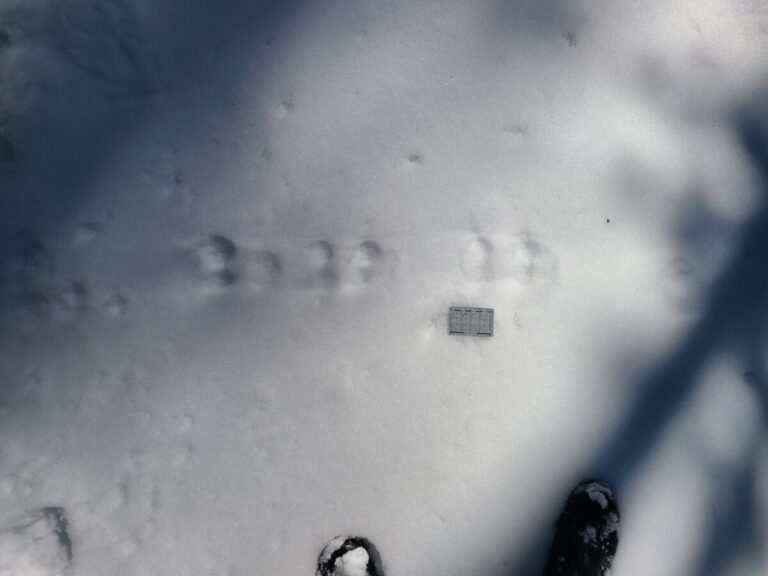
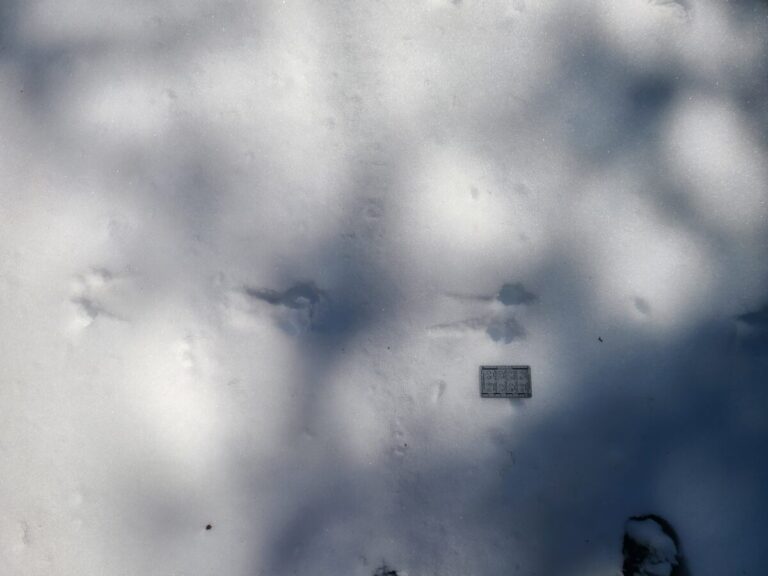
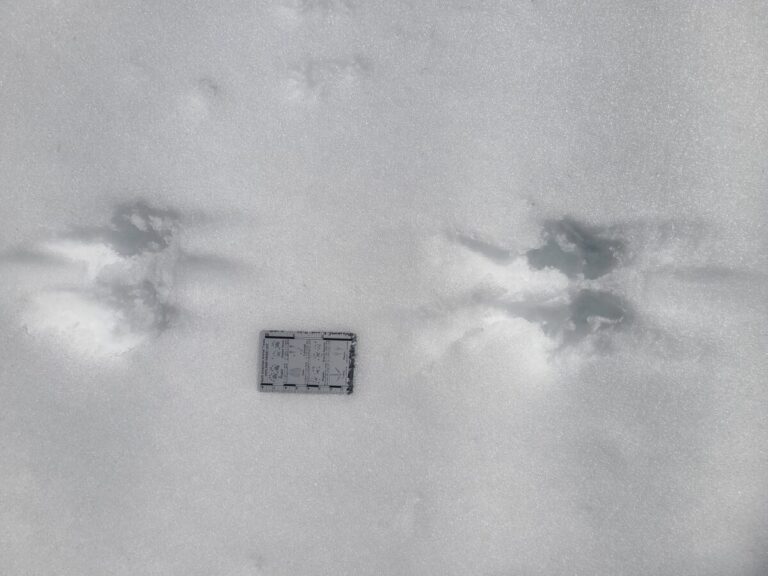
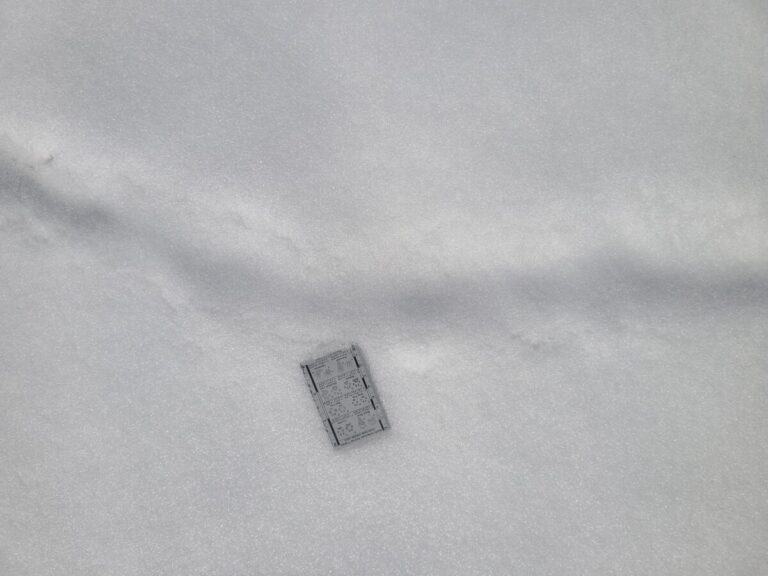
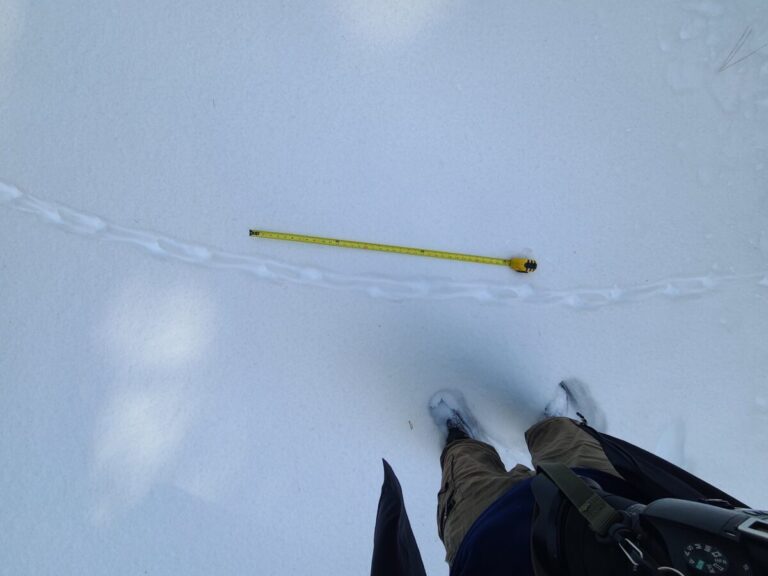
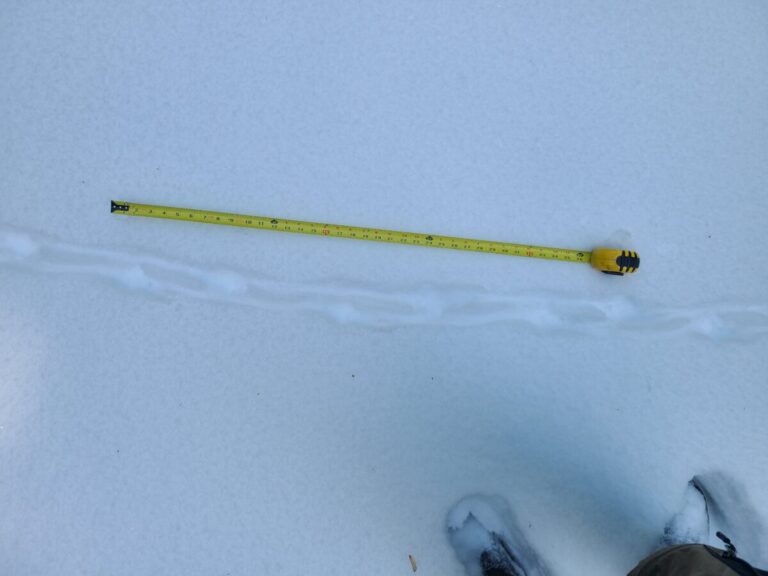
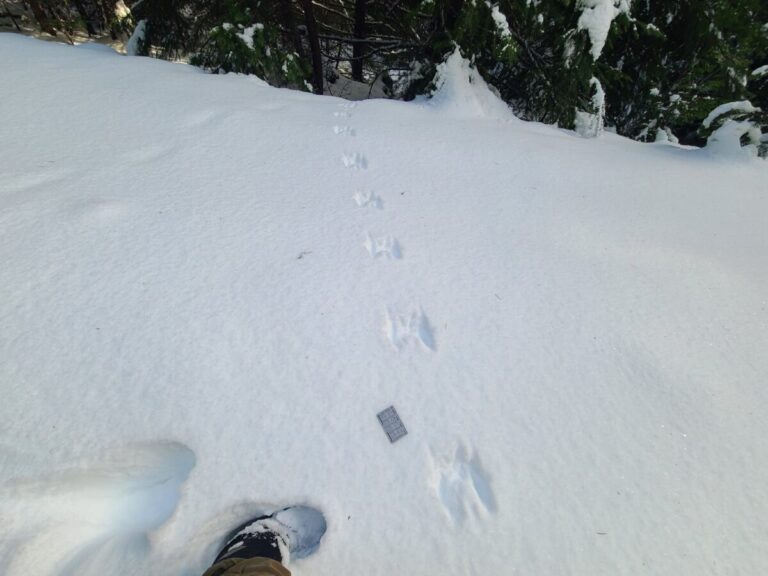
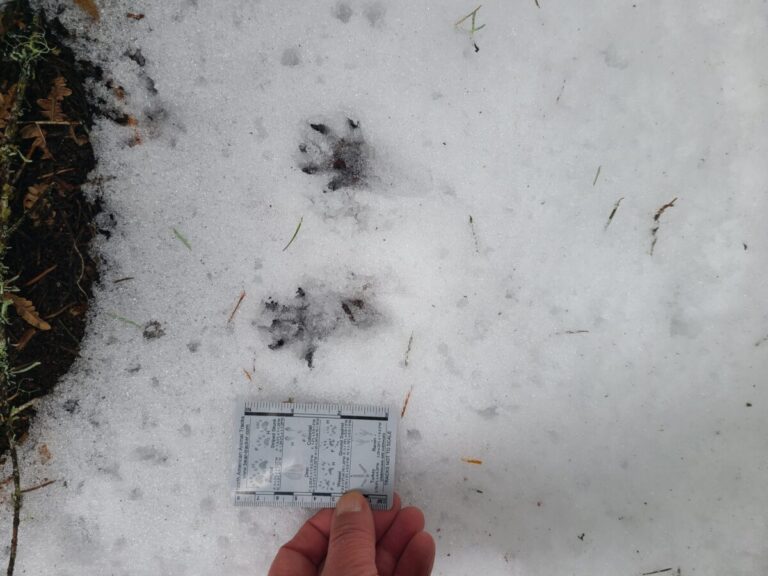
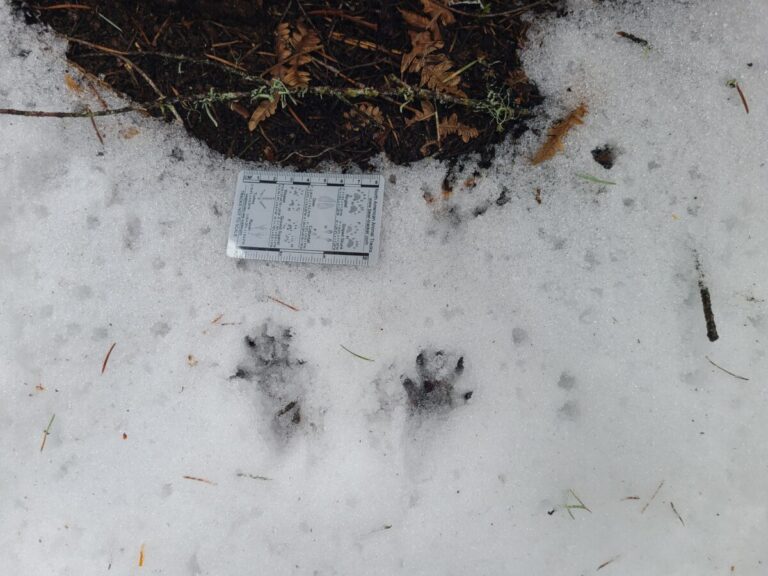
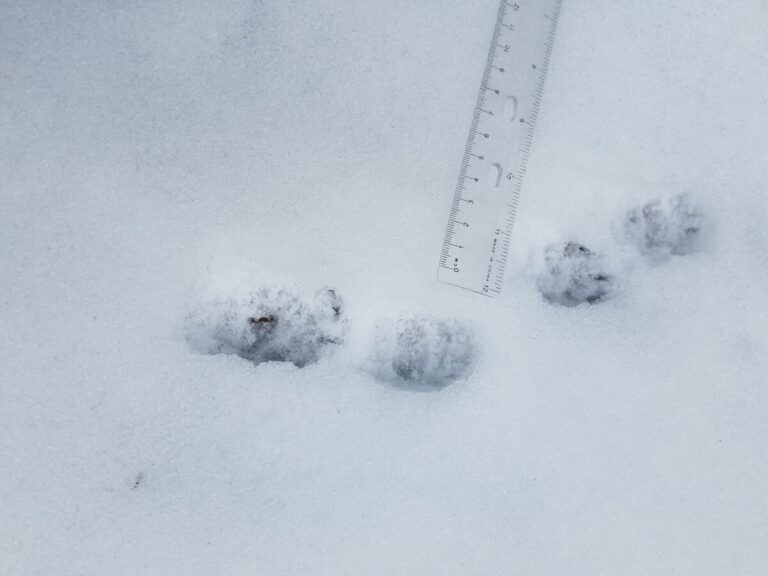
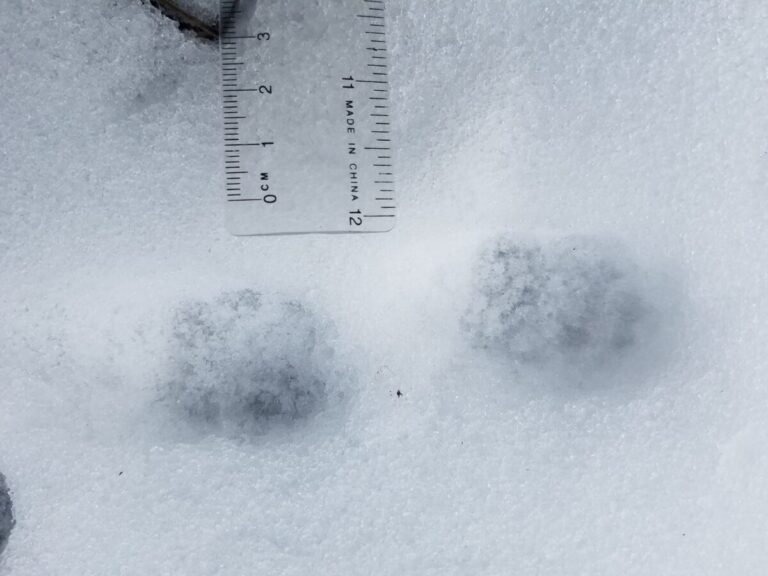
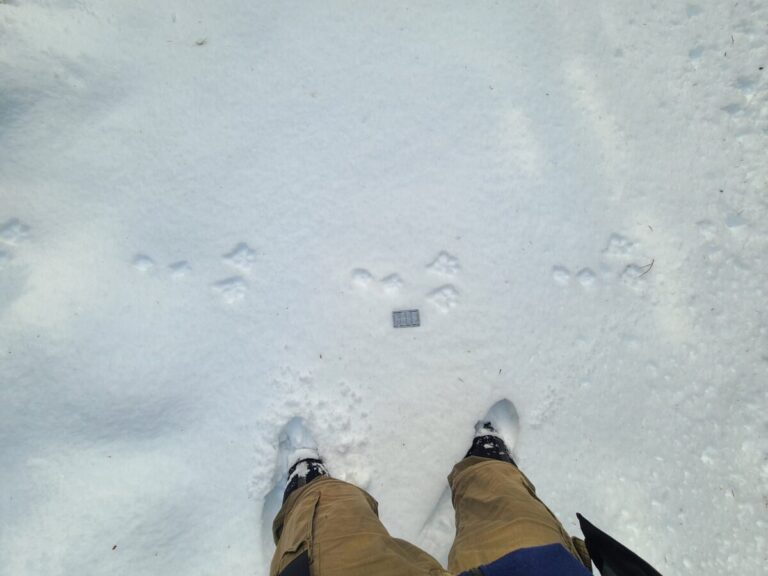
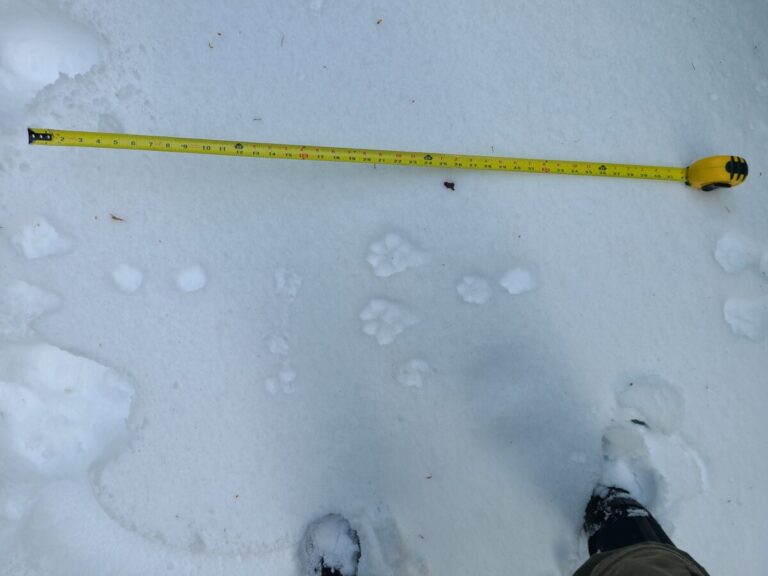
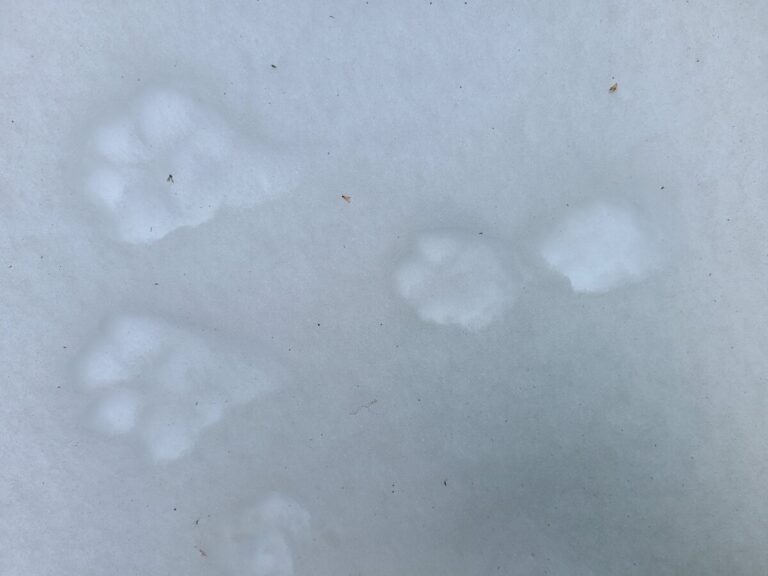
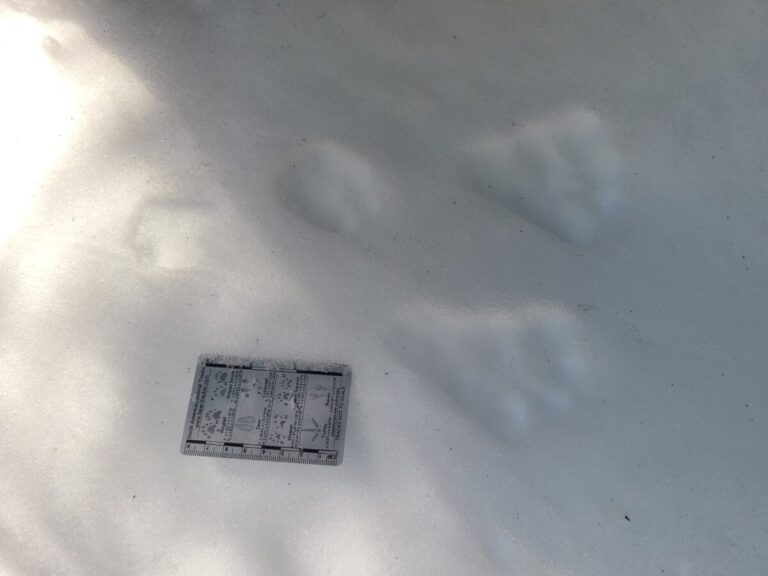
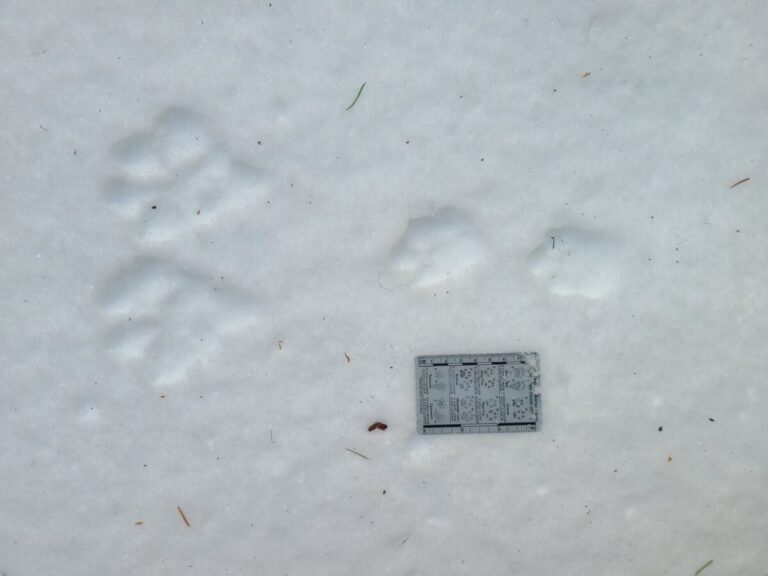
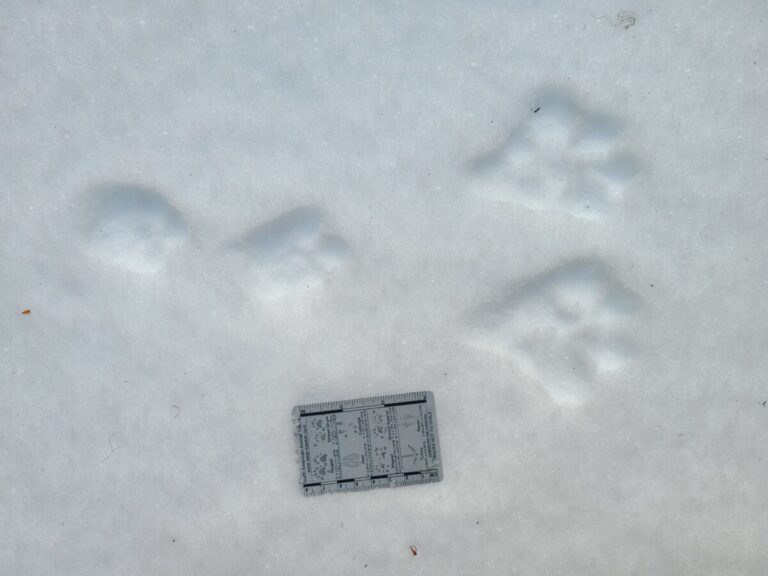
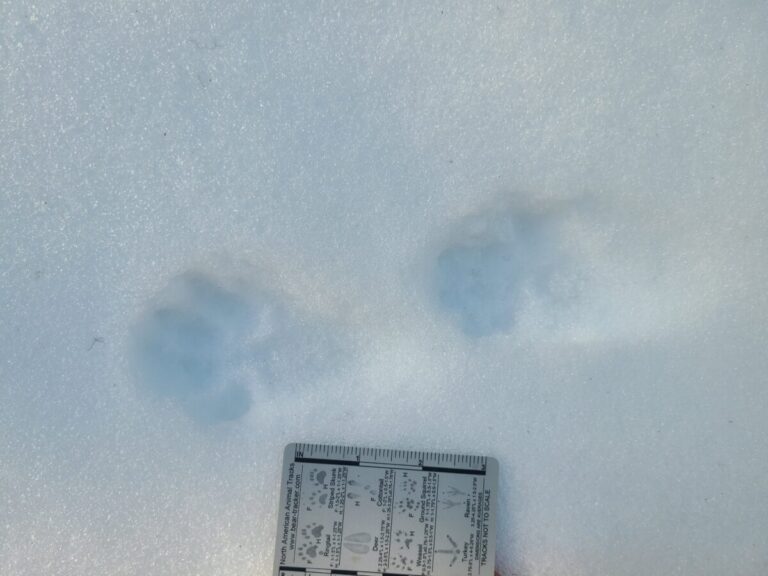
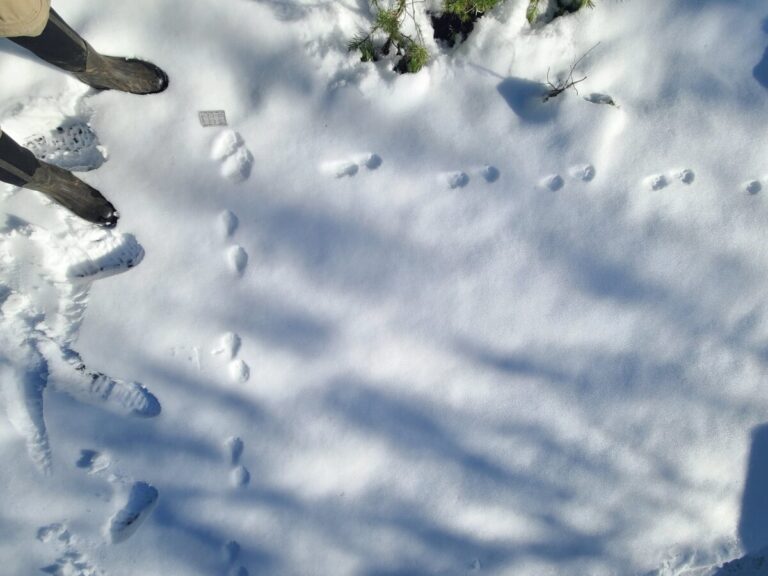
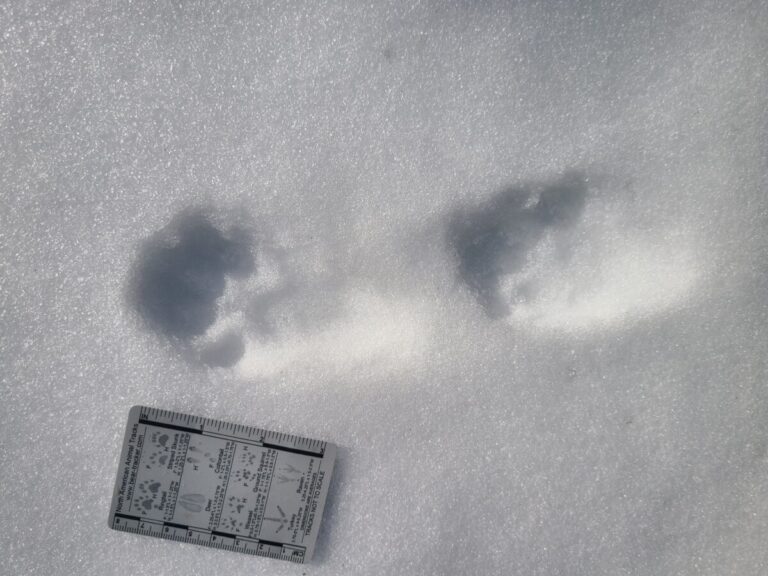
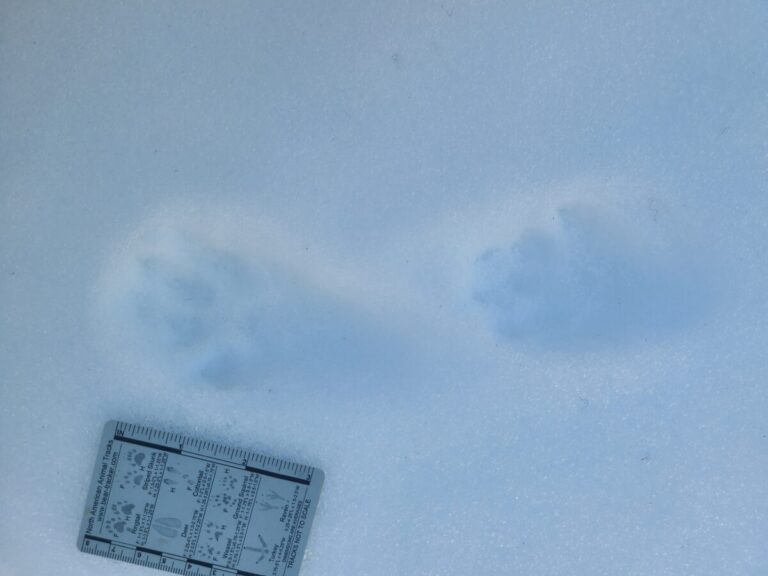
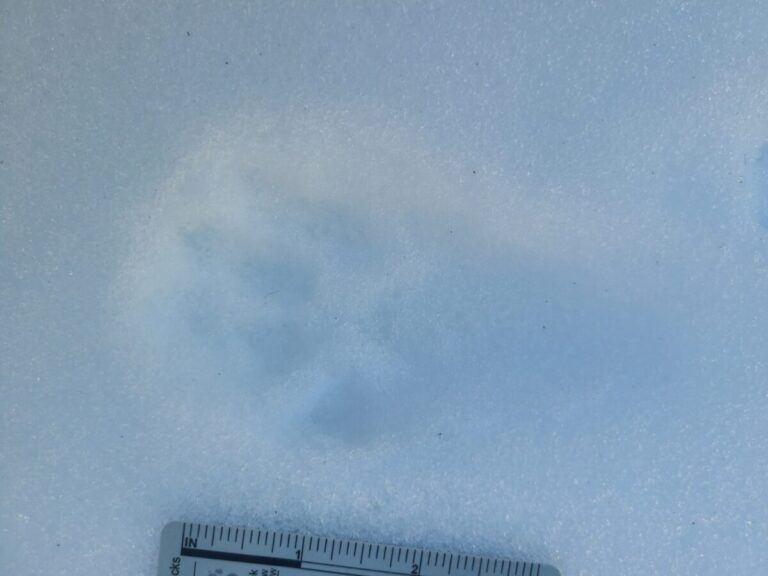
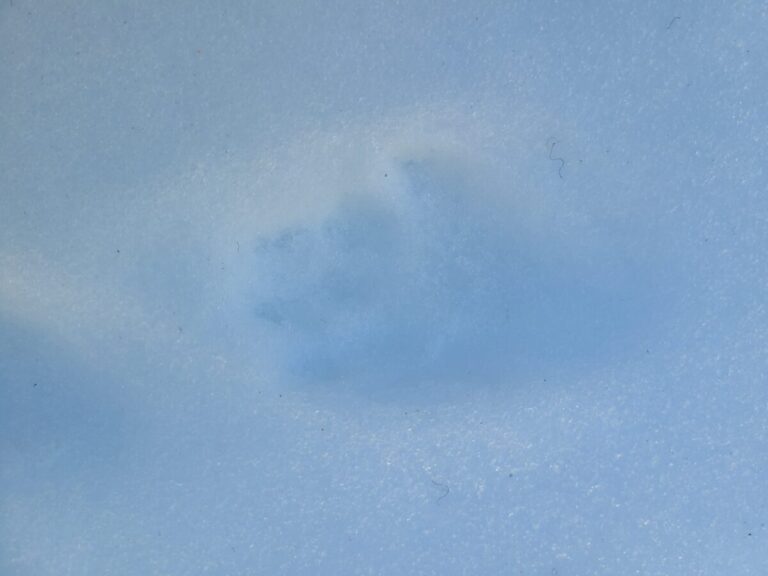
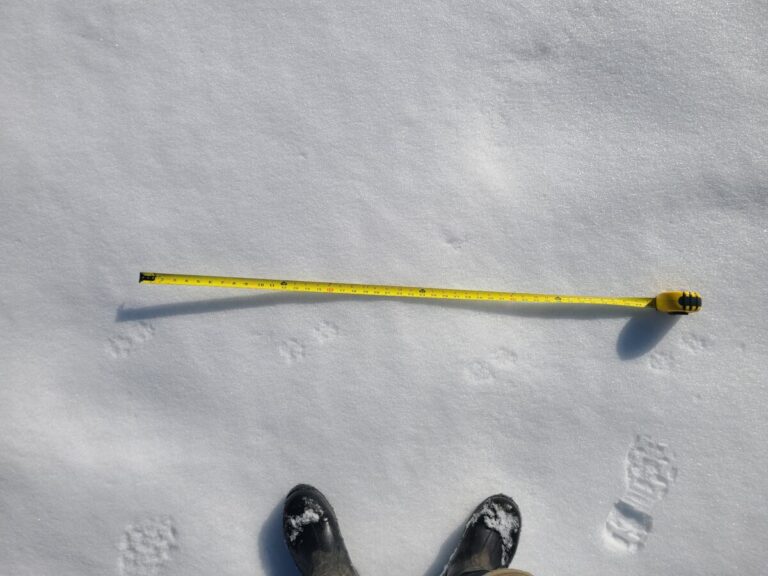
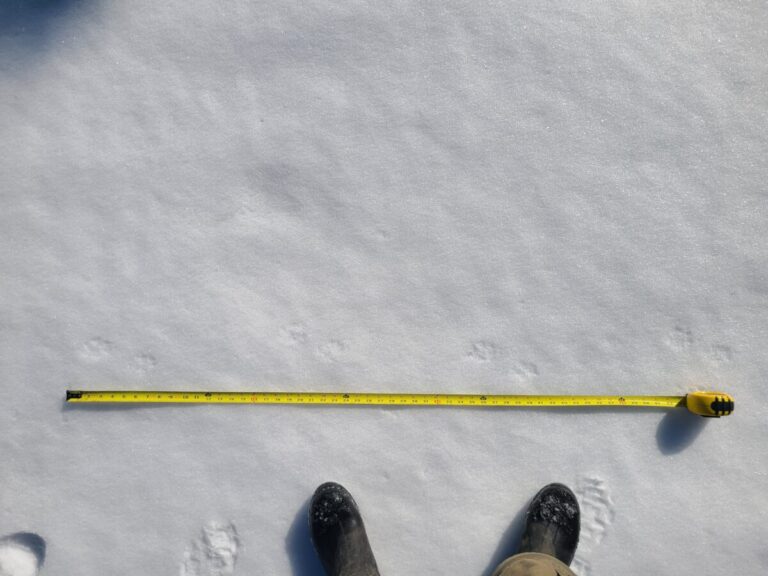
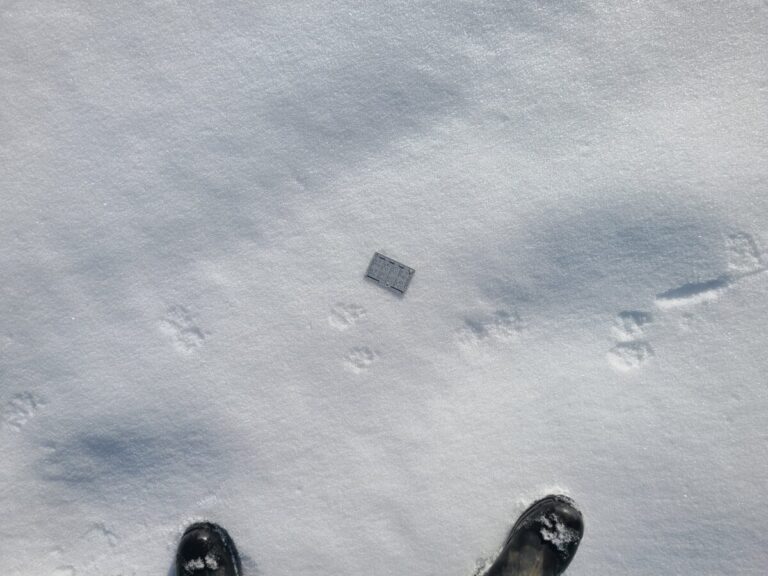
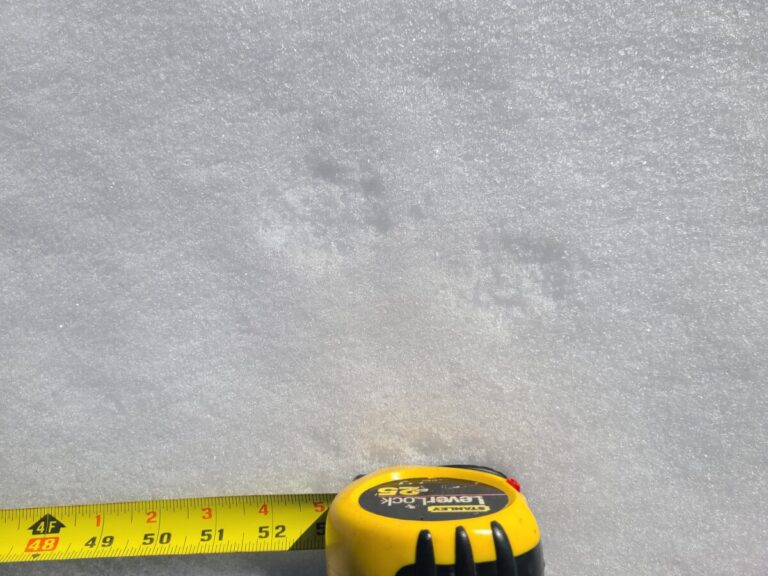
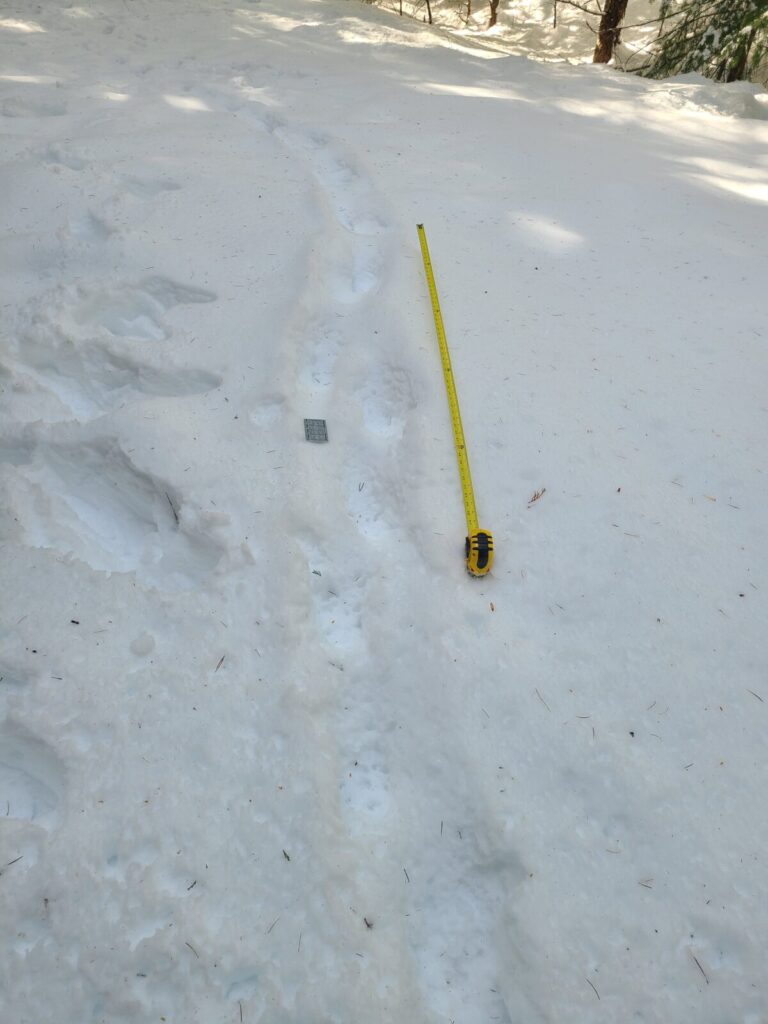
This is the largest of the relatively common mustelids (“weasels”) in the area. As with many species the gait and resulting track pattern of this species changes with changing snow conditions. On a hard crust, the marten travels with a 3×4 lope, as do other mustelids. In most common snow conditions, however, the marten travels in a 2×2 lope, where the hind feet land in the depressions of the front feet, thus making what looks like only two diagonally oriented tracks repeated at intervals. In the deepest and softest snow the marten, like many species, resorts to bounding or jumping to get anywhere and sometimes will even push under the snow in such conditions. Martens also climb trees and run along logs so look for those behaviors in the snow.
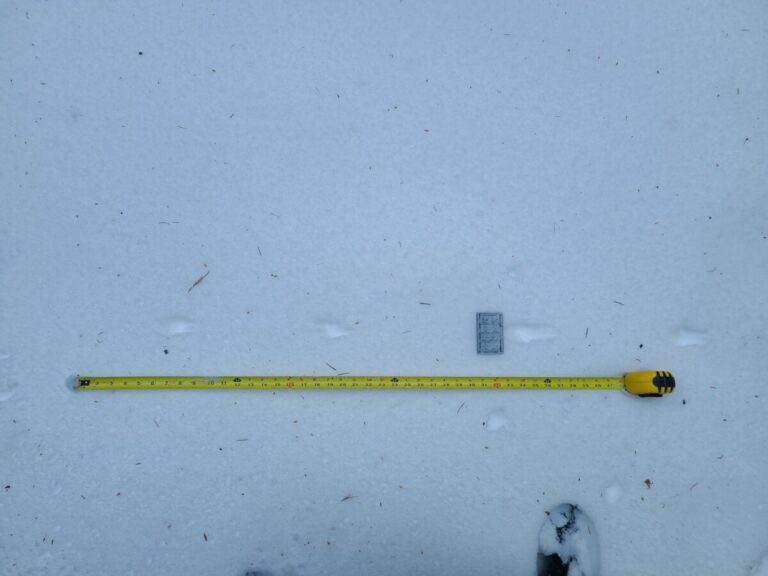
Paired tracks of a Pacific Marten in a 2x2 lope.
Paired tracks of a Pacific Marten in a 2x2 lope.
2x2 lope of a Pacific Marten.
Paired tracks of a Pacific Marten in a 2x2 lope.
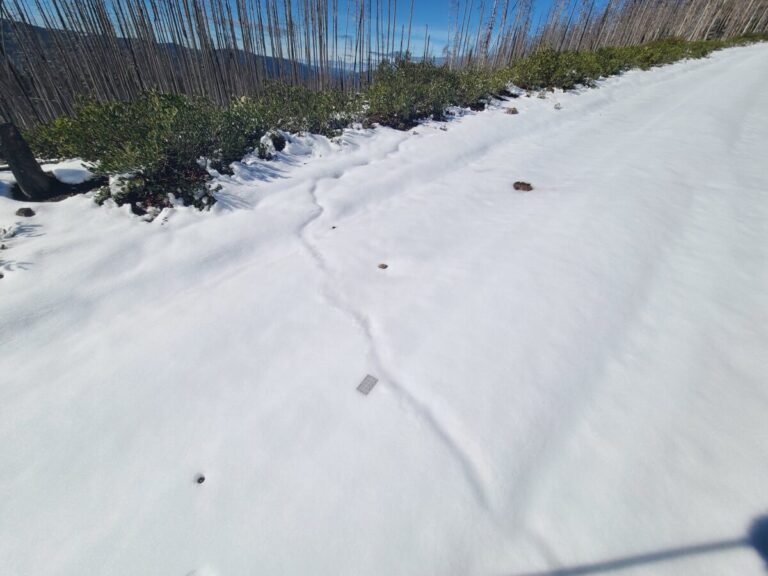
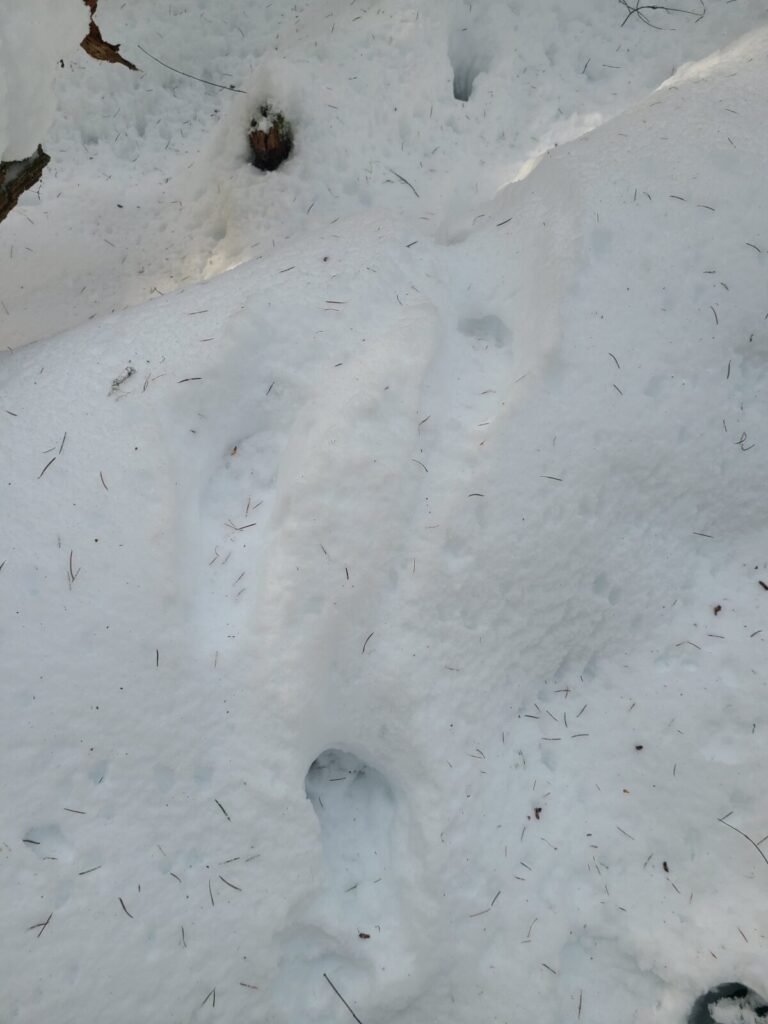
2x2 lope of a Pacific Marten that abruptly changes direction.
Paired tracks of a Pacific Marten in a 2x2 lope.
Paired tracks of a Pacific Marten in a 2x2 lope.
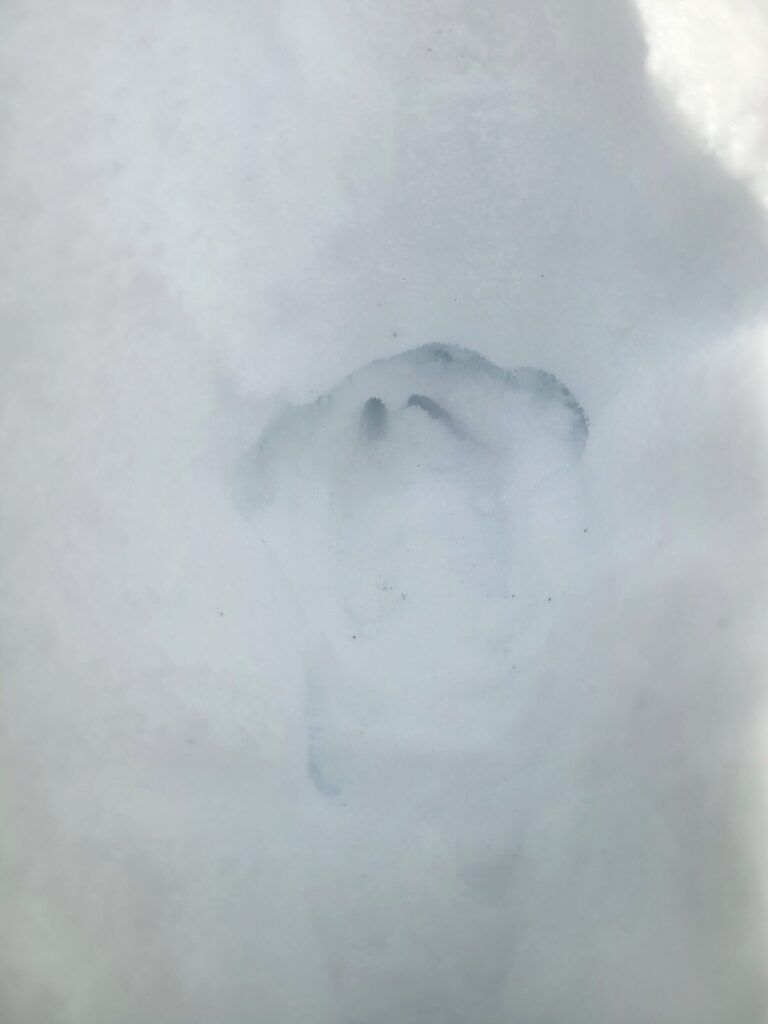
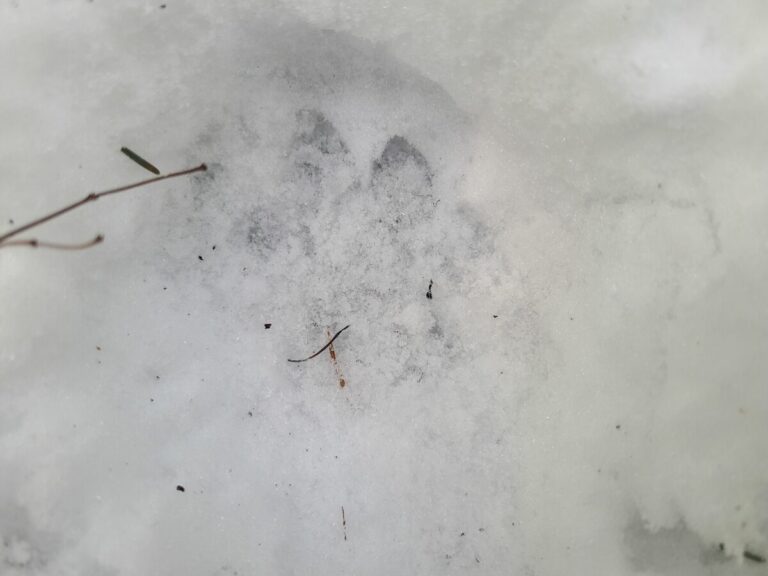
Single Pacific Marten track within a 2x2 lope.
Single Pacific Marten track within a 2x2 lope.
Single Pacific Marten track within a 2x2 lope.
Red Fox
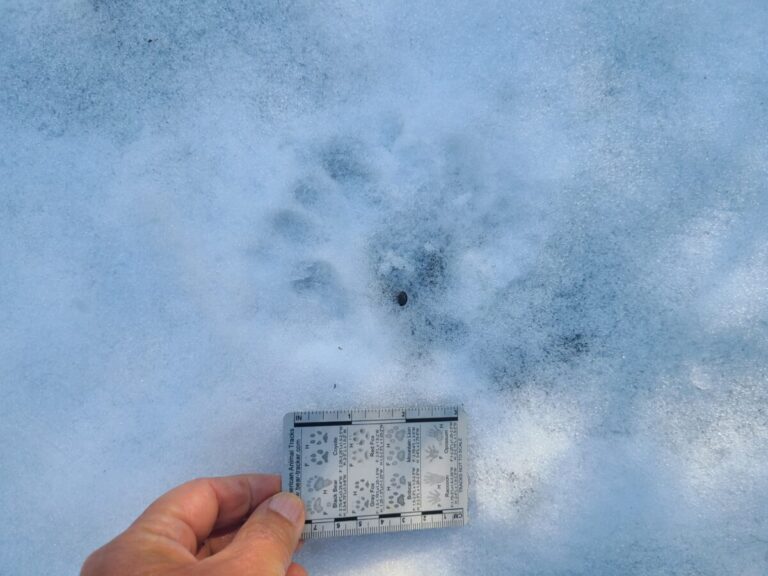
Red Foxes occur throughout much of the area. Their general track patterns and shape are similar to Coyote but smaller and usually with less definition due to their heavily furred feet. An ongoing study of the Sierra Nevada Red Fox in the Oregon Cascades continues to document their presence and examine their genetics. Genetic mixing has been documented between the “pure” Sierra Nevada Red Fox and the historically introduced (from Europe) fur trade foxes present at lower elevations. Gray Fox could conceivably occur here, but in general I think they don’t occur at these higher elevations.
Somewhat melted out tracks in what I think is a direct-register trot.
A somewhat melted out track at this point showing approximately maximum size for fox.
More melted out tracks, with little detail left within each track. I am calling these fox versus coyote mostly by size (taking melt into account) and stride length.
Somewhat melted out track.
More melted out tracks.
Somewhat melted out track, but not as much as others in this series. Small and bar-like meta pad visible, making somewhat of an "arrowhead" shape.
Somewhat melted out track, but not as much as others in this series. Small and bar-like meta pad visible, making somewhat of an "arrowhead" shape.
Side trot on a thin layer of fresh snow over an ice crust, thus the toes register even less than in slightly deeper snow. If you look closely you can see that the upper (left side of the trail) tracks are smaller and with only a dot of a meta pad whereas the lower prints (right side of trail) are larger with a more significant bar-shaped meta pad. These represent the hind and front feet respectively. Traveling right.
Side trot on a thin layer of fresh snow over an ice crust, thus the toes register even less than in slightly deeper snow. If you look closely you can see that the upper (left side of the trail) tracks are smaller and with only a dot of a meta pad whereas the lower prints (right side of trail) are larger with a more significant bar-shaped meta pad. These represent the hind and front feet respectively. Traveling right.
Side trot with some transitions on a thin layer of fresh snow over an ice crust, thus the toes register even less than in slightly deeper snow. Probably due to the gait change the already fuzzy details in these tracks are even less visible here.
As we zoom in to some of these tracks, one might wonder which end is which? Here the upper/front foot shows a couple of the front toes an a subtle carpal bar, while the lower/hind foot barely shows the front toes and really not much other definition.
Zoomed in we can see the subtle differences between the hind (upper right) and front (lower left) tracks on this fox.
Some of these prints seem to show a slight nail drag in front of the print.
A small dig and pee spot associated with some of the above tracks.
Bobcat
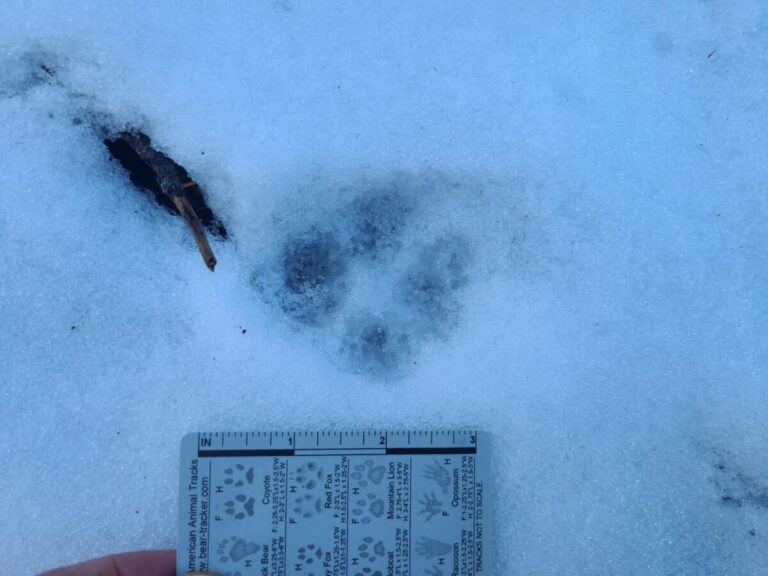
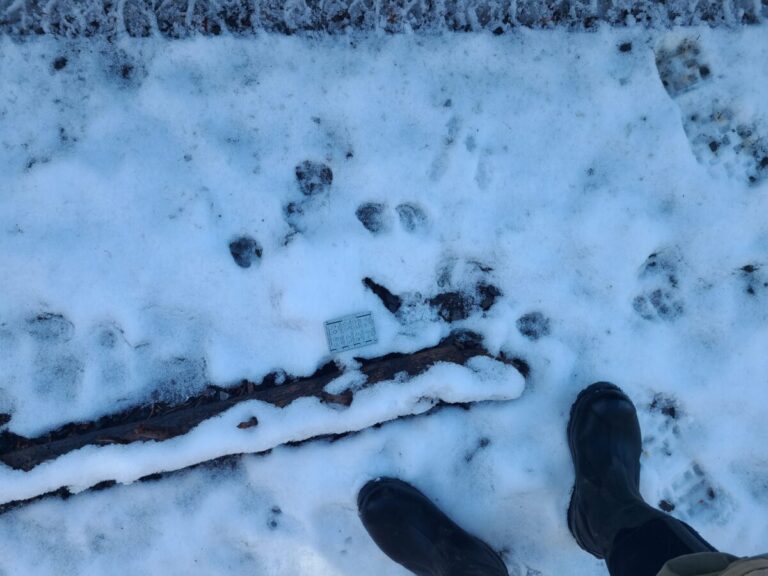
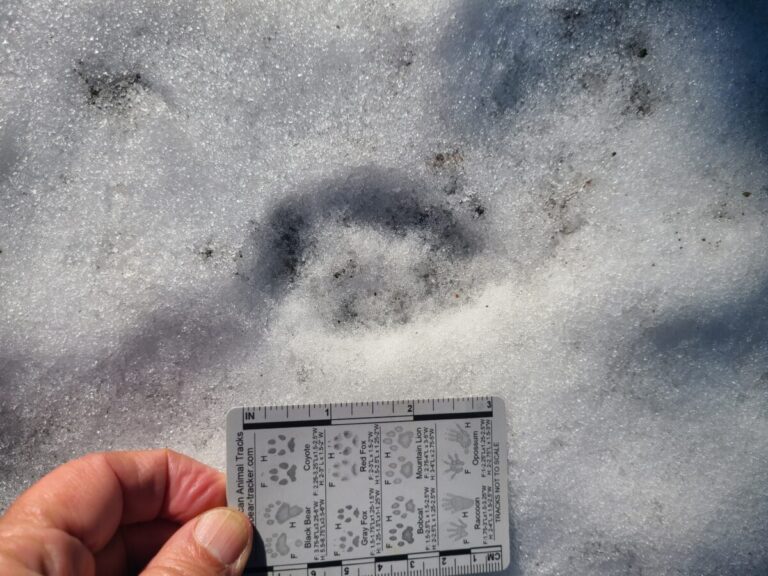
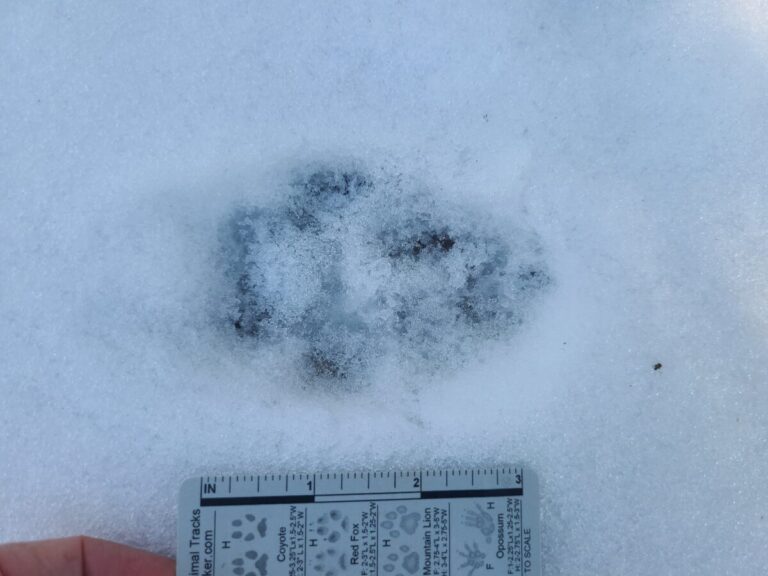
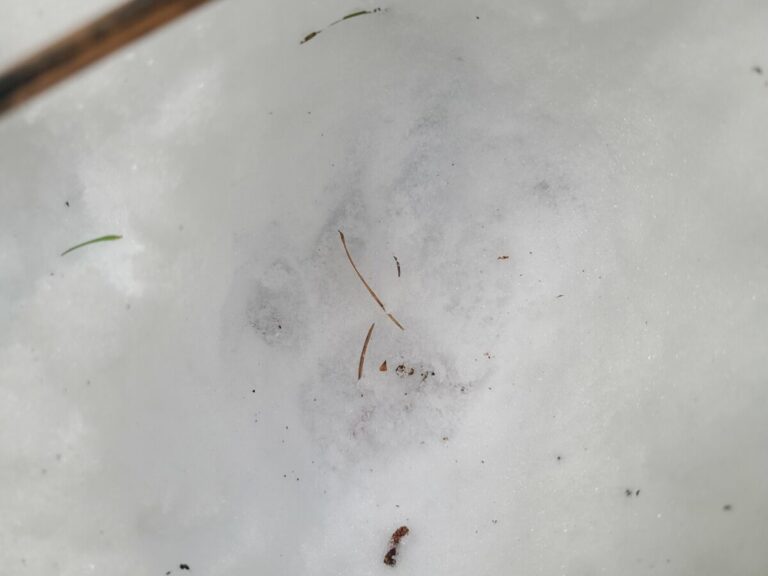
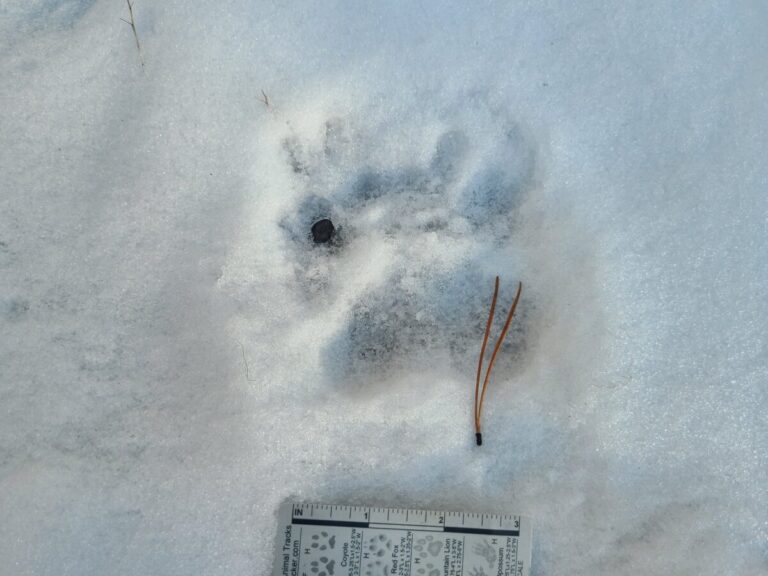
Sometimes I wonder if there is anywhere that Bobcats don’t exist. While they are very stealthy and rarely seen, they are quite widespread in the Pacific Northwest. As with their larger relative, the Mountain Lion, they typically travel in a casual walking gait. On hard ground or snow crust they may walk with a slight overstep but in even small amounts of snow they resort to a direct register where the rear feet are placed exactly over the print of the front foot. Their prints in general are more round versus the oval of a fox or coyote. Again, like the Mountain Lion, clear Bobcat prints show an asymmetrical toe arrangement with a leading toe, and a relatively large palm pad with three lobes on the back. In the event you are tracking in the vicinity of a lot of people or dwellings where house cats might be present, adult Bobcat tracks have a pad that is wider than one inch whereas domestic cats have pads distinctly less than 1 inch wide.
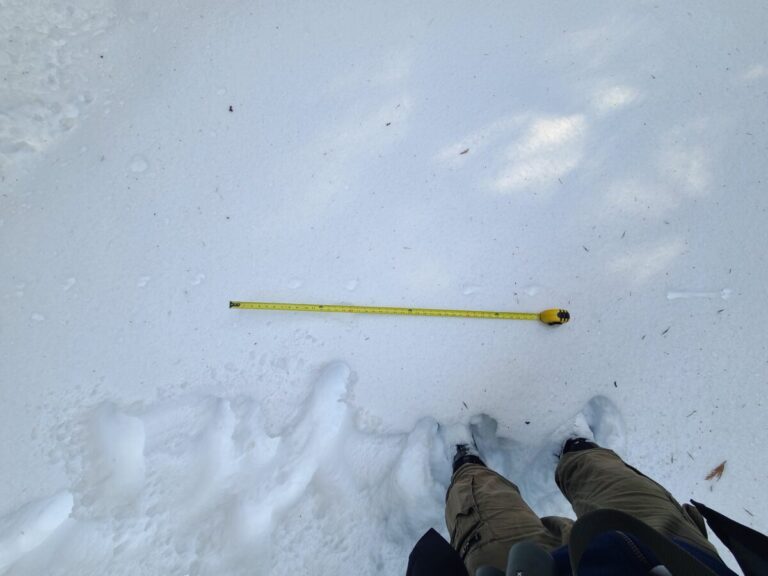
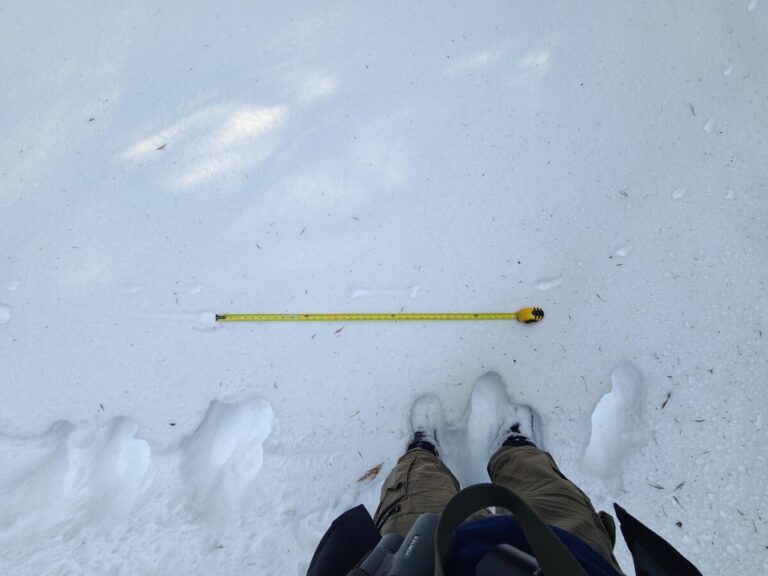
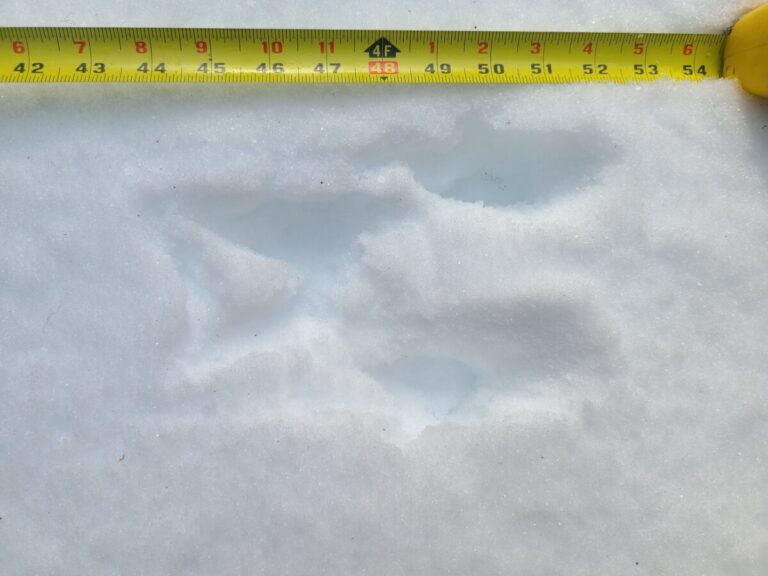
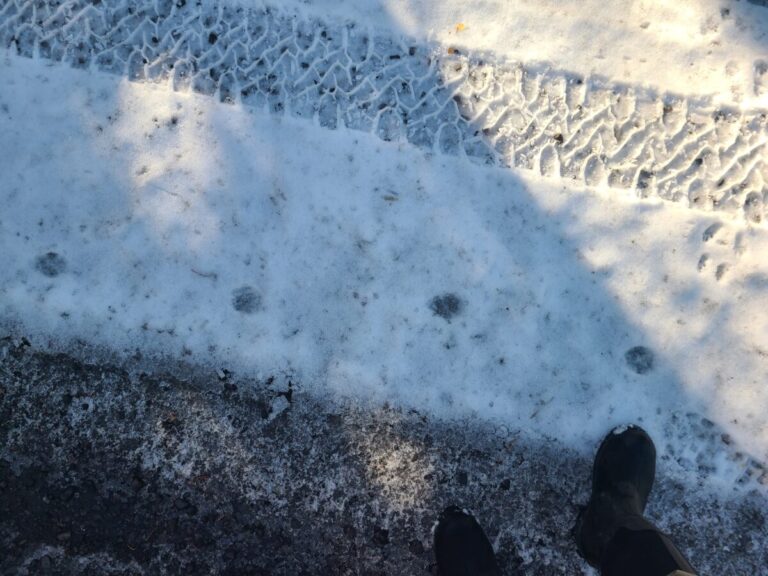
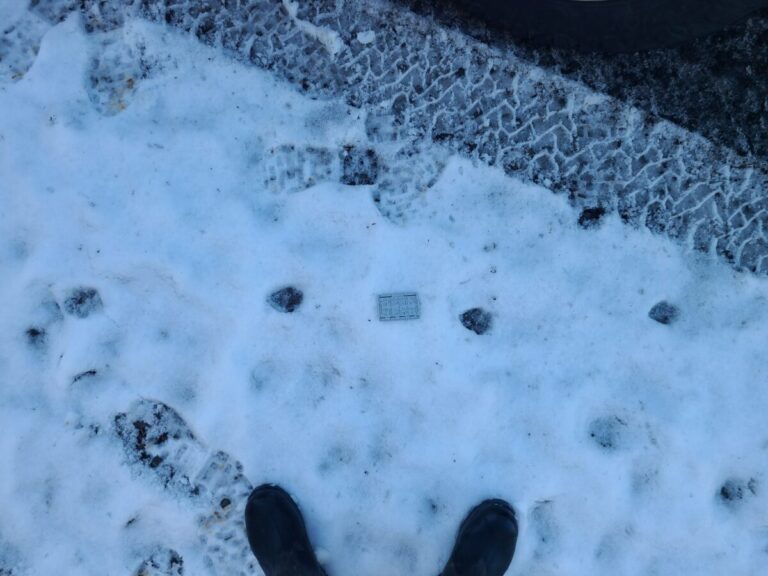
A direct register walk of a Bobcat in snow, walking down a snow-covered road. Note that the trail width is proportionately wider than is usual for fox or coyote. In other words the zigzag in the prints is more pronounced.
A closeer view of just two prints in the Bobcat trail.
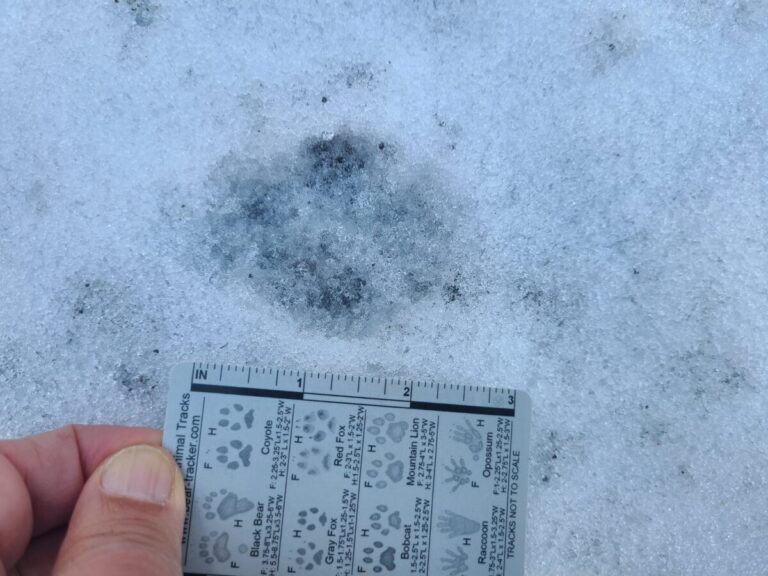
Close up showing a hind over front direct register, making it look as if it has 5 or more toes, which is quite common. Asymmetry and three rear lobes visible.
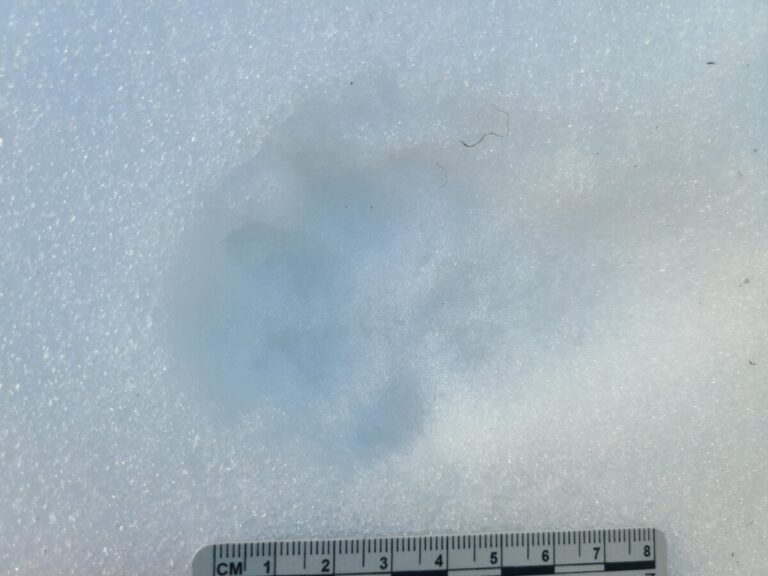
Hind over front track of a Bobcat showing asymmetry and three-lobed back edge of meta pad.
Coyote
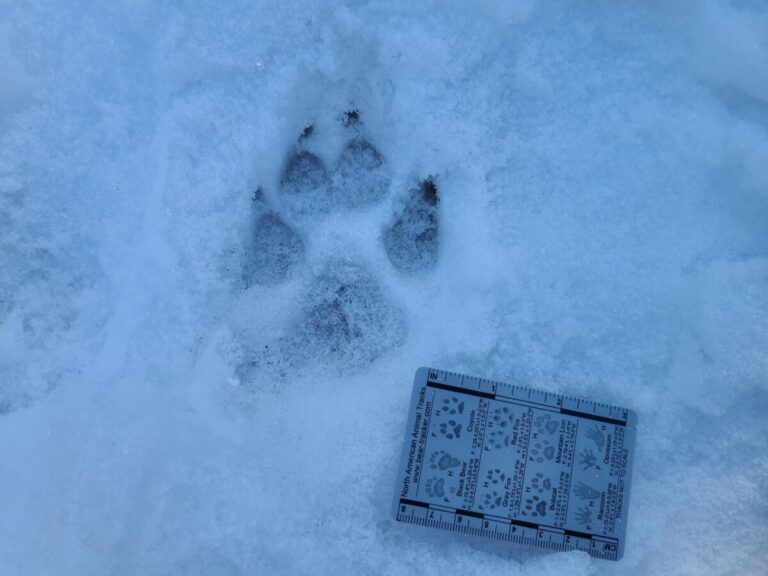
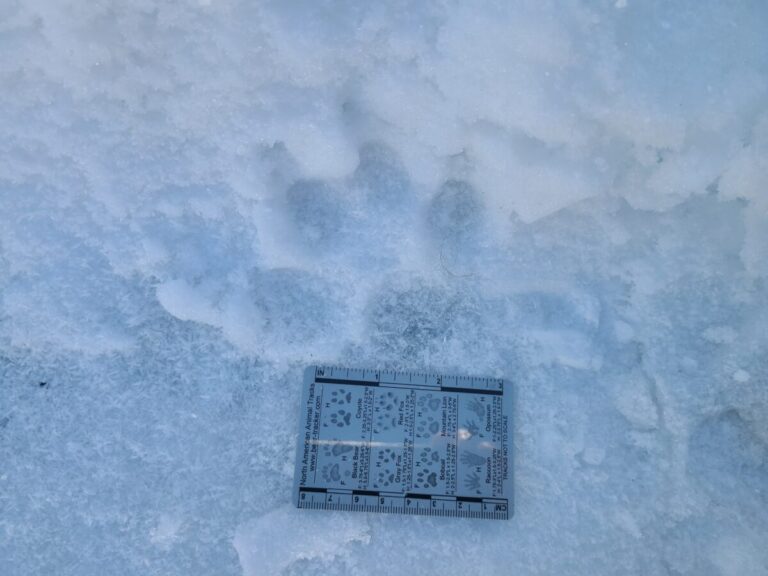
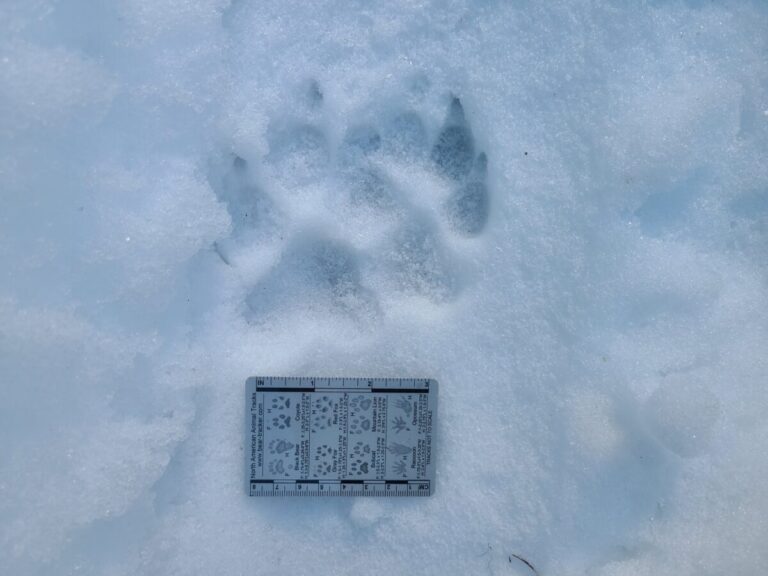
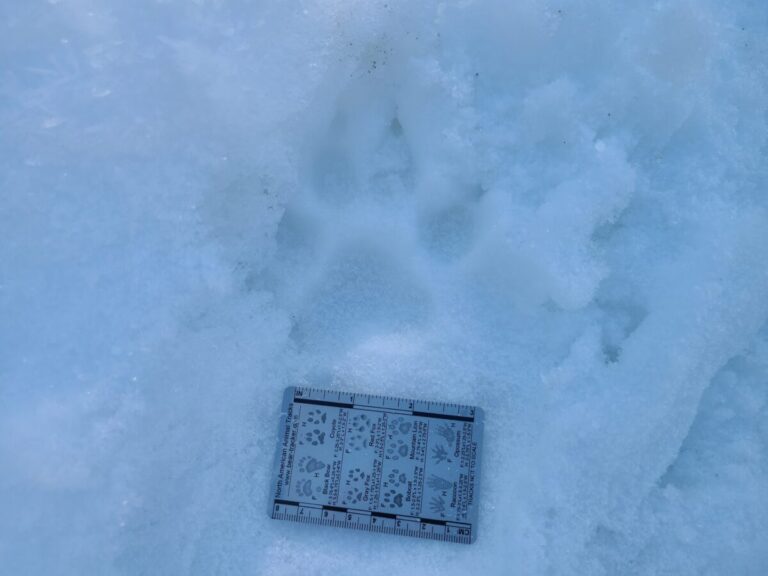
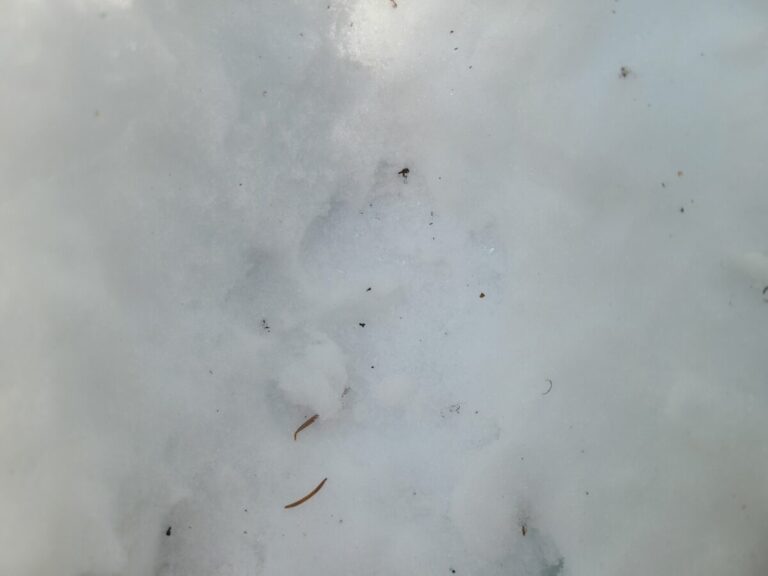
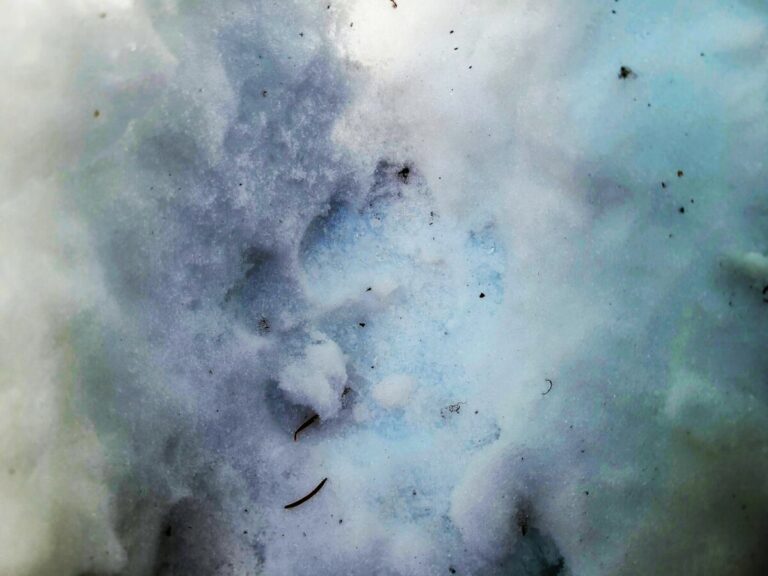
Coyotes occur in most or all habitats in Oregon, including these high elevation landscapes. They are such adaptable animals. Similar species at these high elevations include Red Fox and domestic dog. We’ve already looked at some Red Fox tracks, so perhaps you can already see the similarities and differences. One of the first things I notice at a coarse scale is it seems that Coyotes sink deeper in the snow than foxes in the same snow condition. This makes sense, given the greater weight of the Coyote. Next is the greater definition in the prints. As you can see in the images below, the toes, claws, and meta pad are are quite well defined. Other things to notice is that the toes look larger or more full, probably because they have less fur (though they can have substantial fur) among their toes. I have also noticed a great range of sizes in both Red Foxes and Coyotes, both in direct sightings of the animals as well as in prints. There is definitely overlap in print size, with 2.5 inches being the approximate center of overlap in this area and the overlap zone commonly being 0.25 inches either side.
Regarding domestic dogs, some breeds do come rather close to matching a Coyote, however, some consistent differences are that domestic dogs usually have thicker nails, wider placement of toes and rounder meta pads. Also, in my experience domestic dogs are not as consistent to direct register in the snow, but again there are more efficient breeds and more “goofy” breeds (my technical term).
Direct register walk or trot of a Coyote.
Direct register walk or trot of a Coyote.
Note clear presentation of toes and claws.
Note clear presentation of toes, claws, and long meta pad.
This print is in the overlap zone of about 2.5 inches or a little more.
Domestic Dog
It surprises many people that domestic dogs and/or their tracks can be found in very remote areas and thus when one sees canine tracks domestic dog cannot be eliminated by location alone. Other features such as the tightness and orientation of the toes, thickness and orientation of nails, and sometimes the trail pattern can be used to eliminate domestic dog. In general wild canines have a tighter configuration of toes that point more forward than domestic dog. Nails are generally thinner and point forward or even inward. Finally, wild canines when traveling tend to have a relatively consistent gait appropriate for the terrain and substrate. The trouble is, wild canine tracks and trails sometimes sometimes exhibit characteristics more typical of domestic dogs and some domestic dogs sometimes exhibit characteristics of wild canines. It is most useful to put together all clues to make an assessment. I am not going to delve into further detail on discerning wild and domestic canines in this post as a complete treatise would require a post on its own. Some example domestic dog prints are below. Looking through my photos I discovered I have not taken photographs of domestic dog trails, so I will have to add that at some future date.
Domestic Dog track at a parking area. Looks somewhat like a Gray Wolf track--robust, not very splayed--but not as large. Too large and stocky for a Coyote. Nails look somewhat sharp except for the right toe. Palm pad rather large for a Coyote.
Quite splayed toes. Quite common in domestic dogs, less common in Gray Wolves and Coyotes. Nails seem rather prominent in this messy track. Domestic dog.
Again, rather small for a Gray Wolf and large for a Coyote. Heavy nails.
Rather small for Gray Wolf and large for Coyote. Outer toes pointed outward, common for domestic dog, less common for Gray Wolf or Coyote.
American Beaver
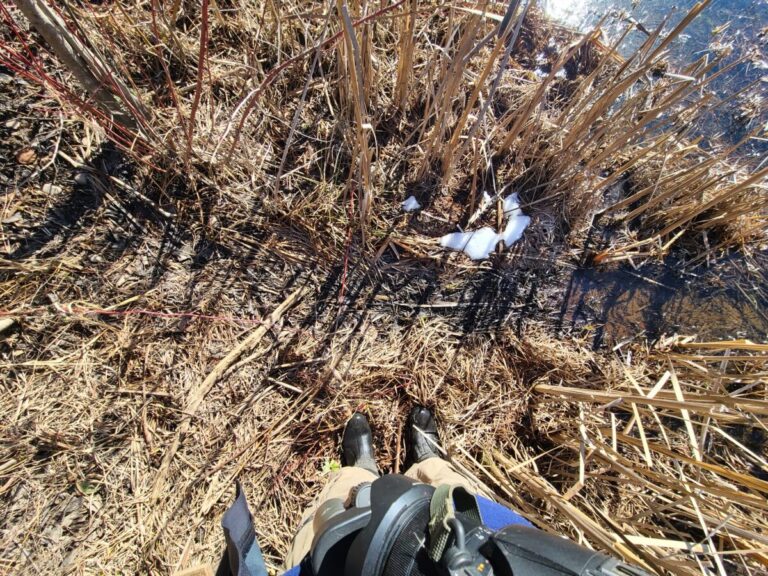
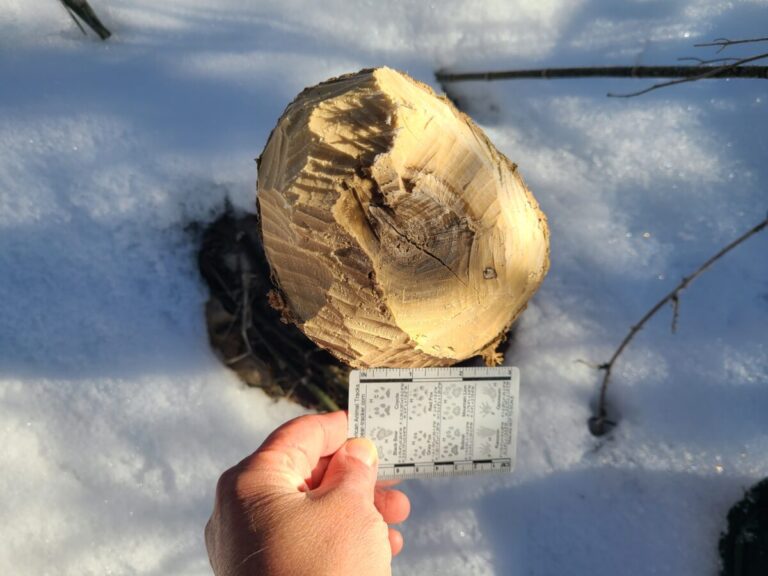
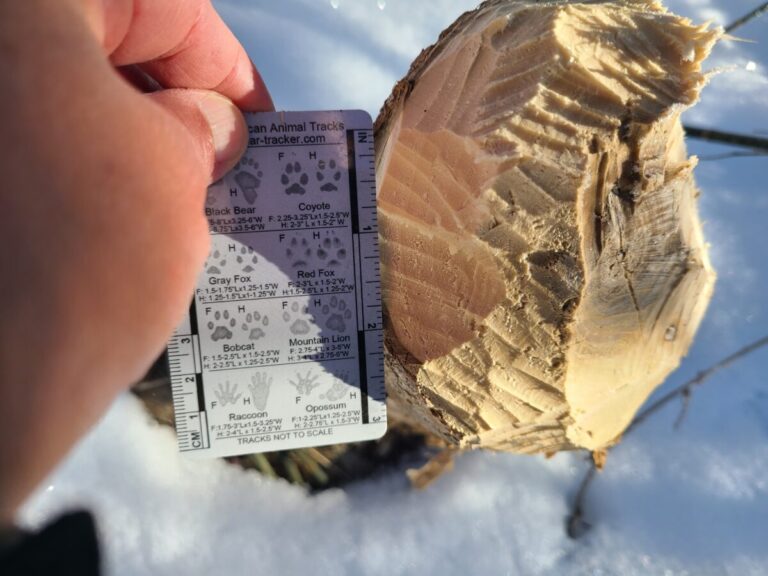
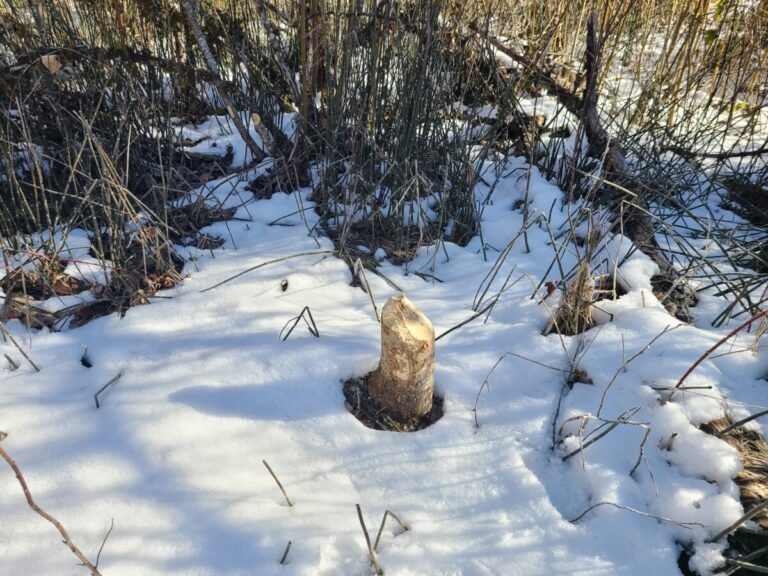
I haven’t yet run across beaver tracks in the snow in this area–it’s all a matter of timing–but I have run across some beaver chews and trails in a snowy area. One of these days I’ll hit the timing right.
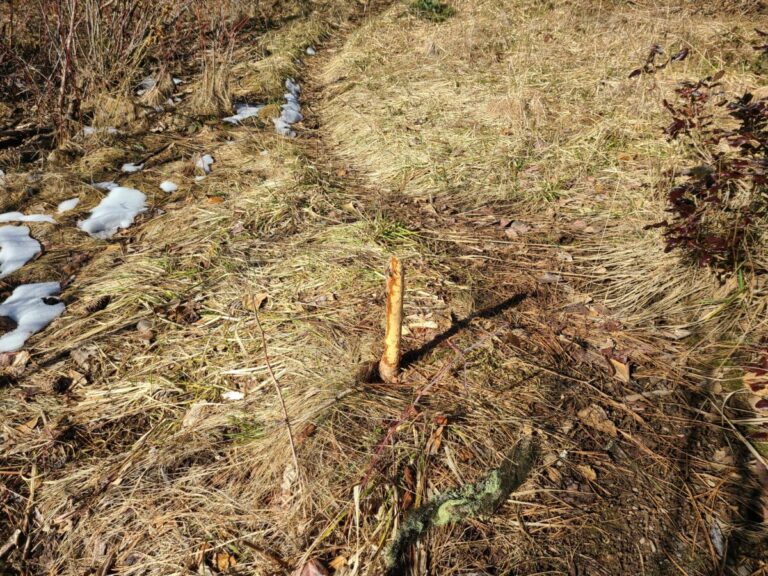
An American Beaver haul or travel path.
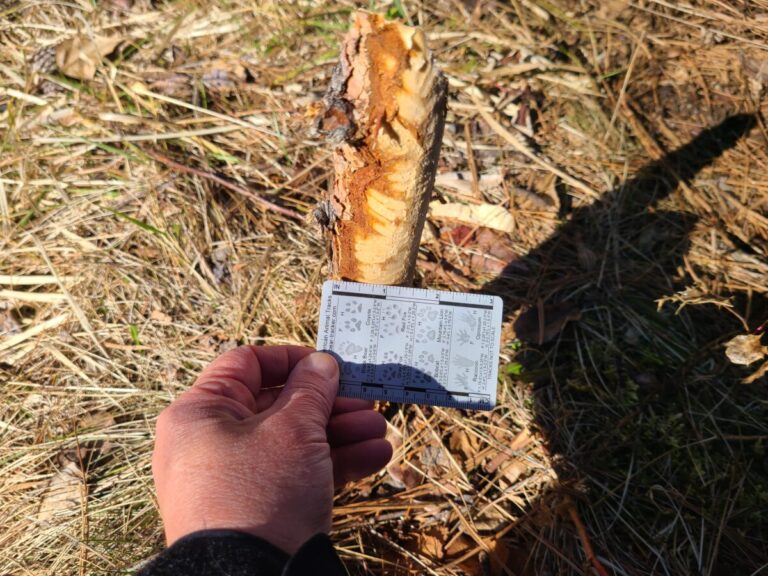
Beaver tree felling work.
Beaver tree felling work.
Beaver tree felling work.
A smaller stem cut off and gnawed upon by a beaver. Beaver trail visible as well.
A smaller stem cut off and gnawed upon by a beaver.
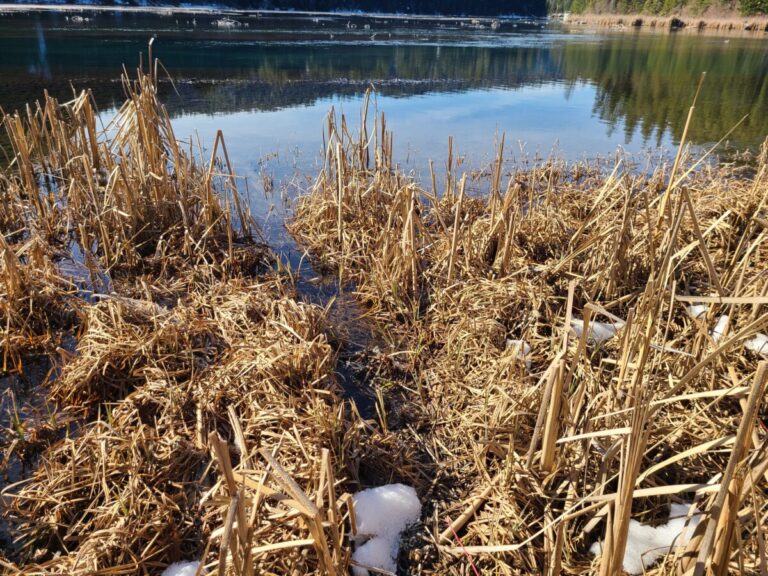
A beaver travel way.
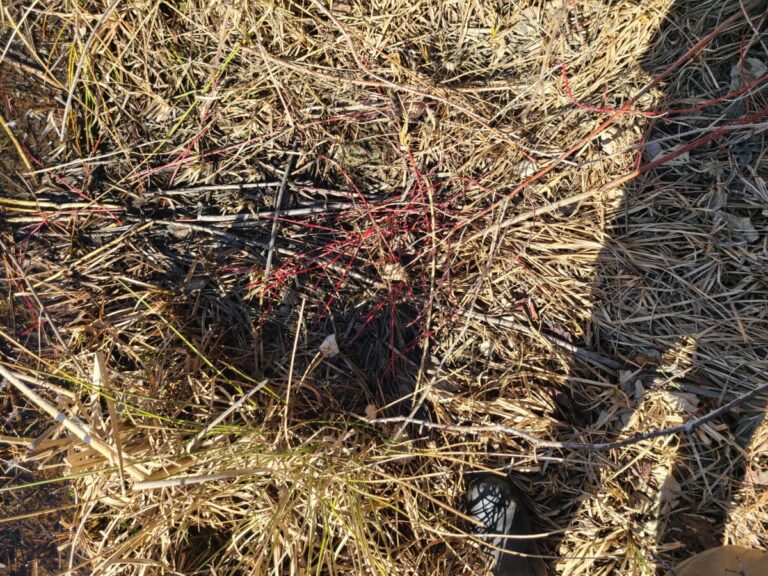
A small stash of small fresh red twigs, seemingly stashed here for a later snack, but I'm not sure.
Deer
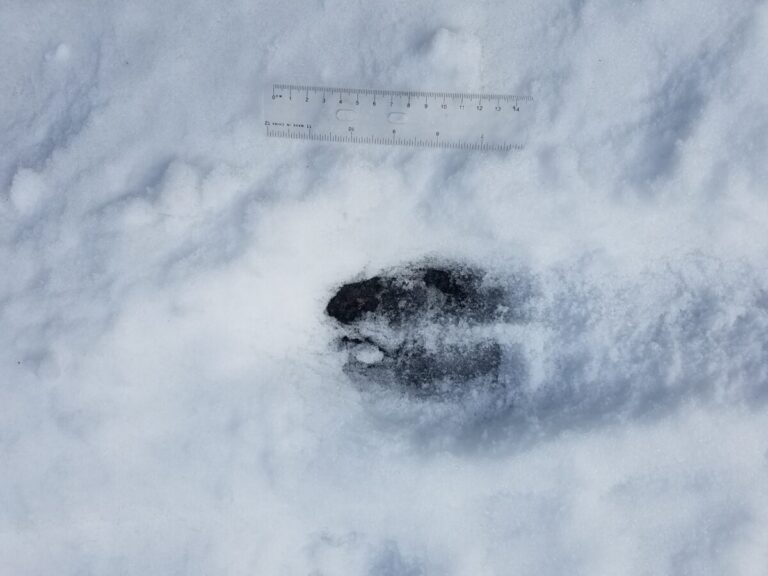
Deer generally move to lower elevations as the snow deepens at high elevations so they are able to find food to eat in areas of shallow or intermittent snow. Sometimes they are also able to find food in areas with tall, heavy conifer canopy which intercepts more snow and provides downfall of lichen-covered branches. This is the same with elk, but elk are able to manage in somewhat deeper snow. Deer sign can include tracks, scat, nipped buds or leaves and pawing the ground to access food items. All the deer at high elevations here are Columbian Black-tailed Deer (Odocoileus hemionus columbianus). I have seen Rocky Mountain Mule Deer (Odocoileus hemionus hemionus) in this area in summer, but not yet in winter.
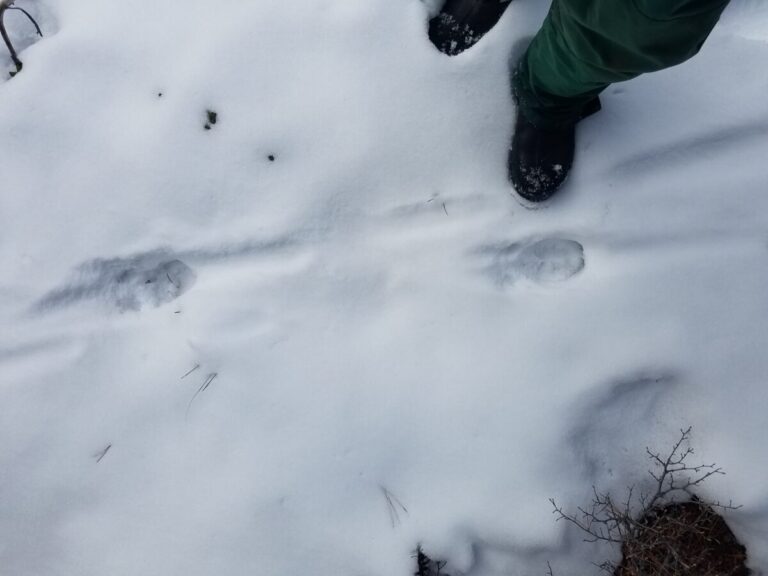
Deer walking in snow showing foot drag marks.
Deer scat.
Deer scat.
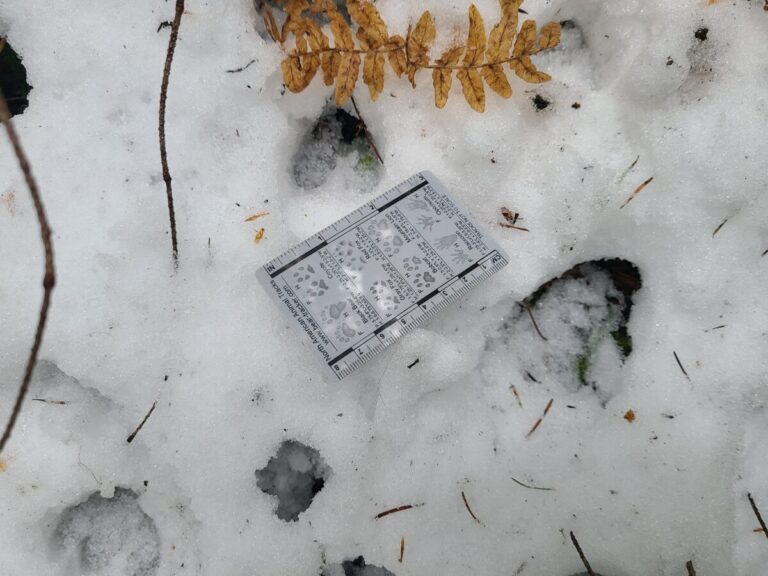
Deer tracks.
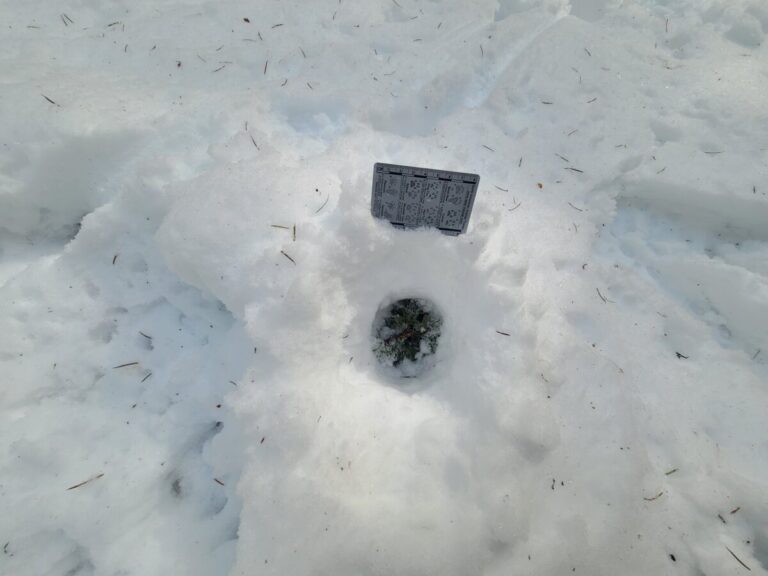
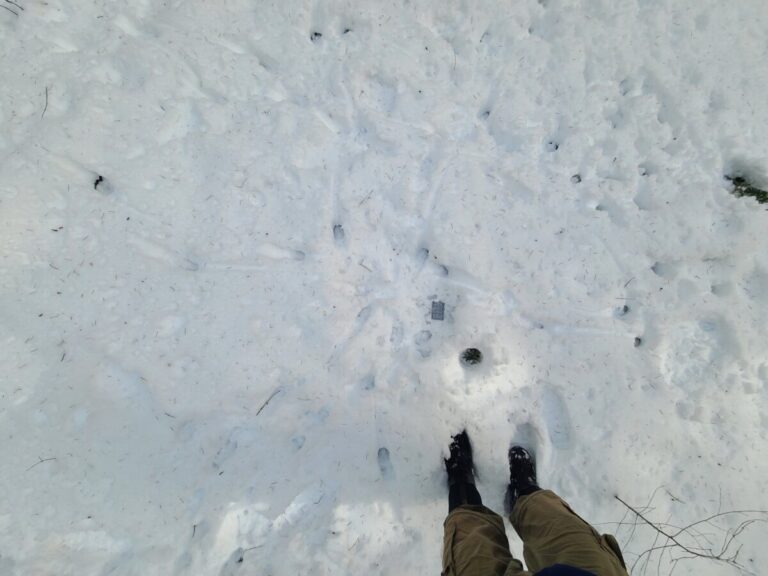
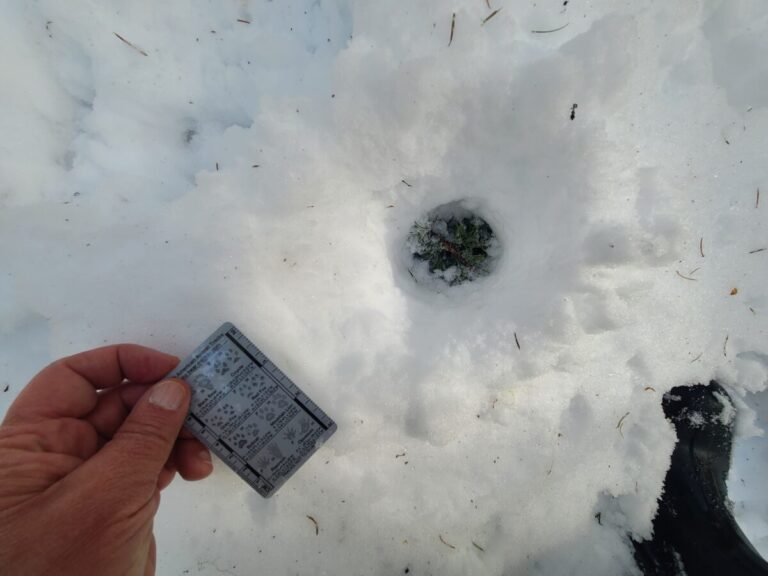
I included several photos of this interesting little hole where it appears deer have repeatedly stuffed their nose and created this hole. Is it a scent station?
I included several photos of this interesting little hole where it appears deer have repeatedly stuffed their nose and created this hole. I also found it interesting that tracks converge from all directions on this spot. Is it a scent station?
I included several photos of this interesting little hole where it appears deer have repeatedly stuffed their nose and created this hole. Is it a scent station?
Deer tracks.
Deer pawing at ground, possibly foraging.
Deer pawing at ground, possibly foraging.
Deer pawing at ground, possibly foraging.
Mountain Lion
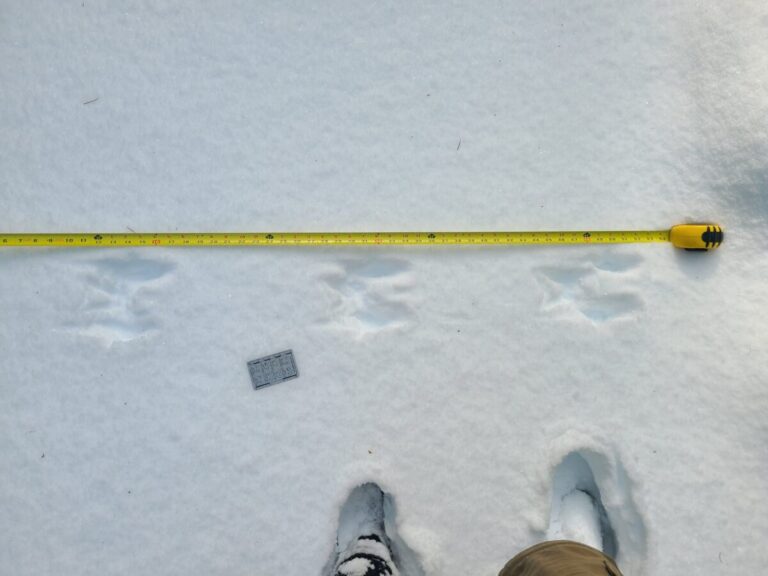
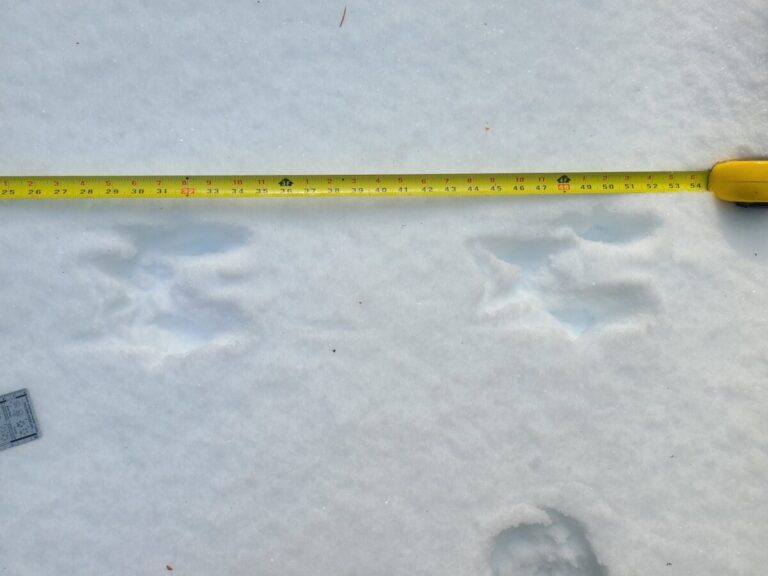
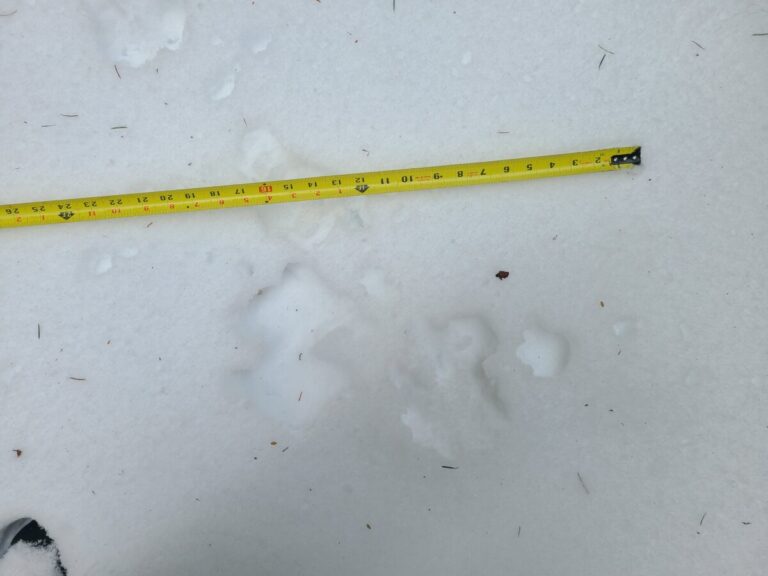
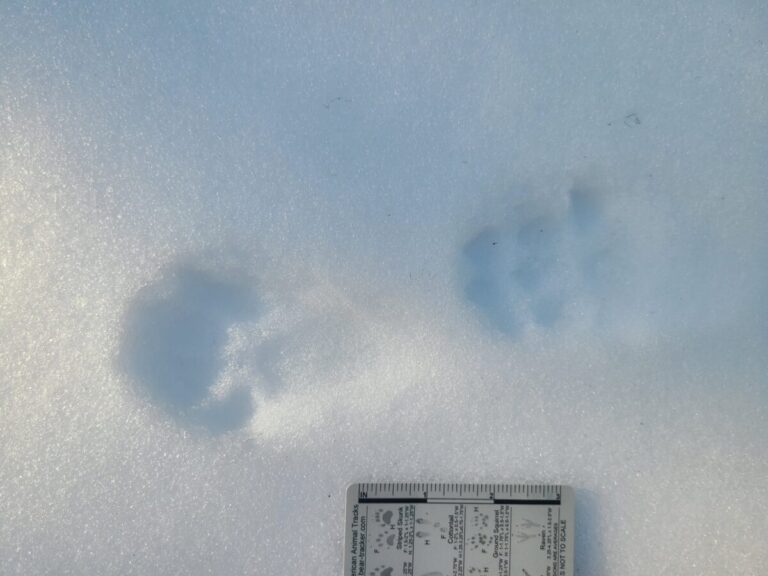
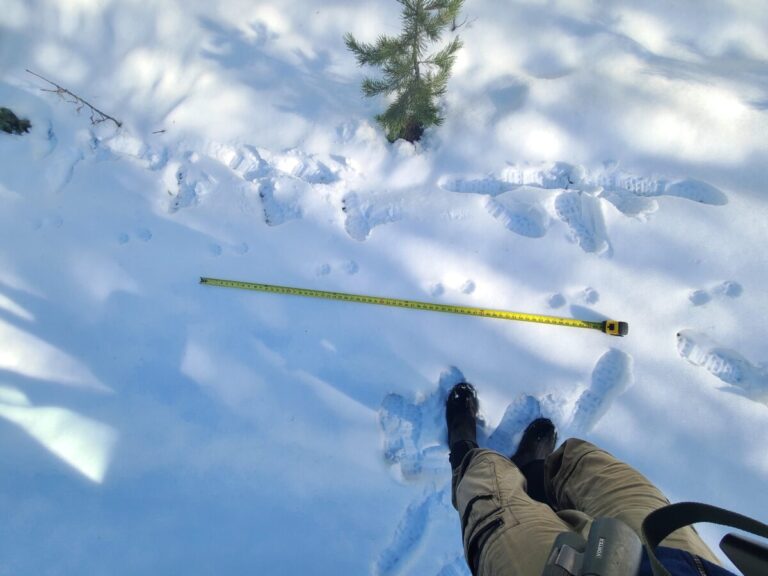
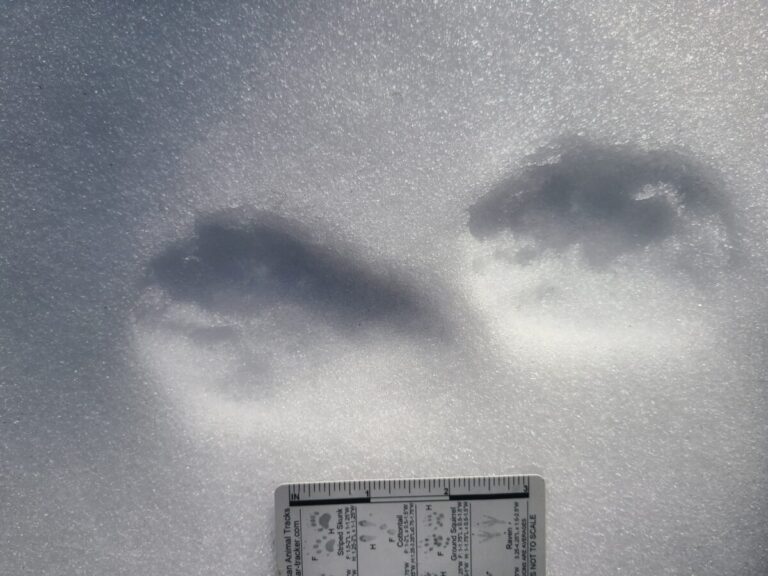
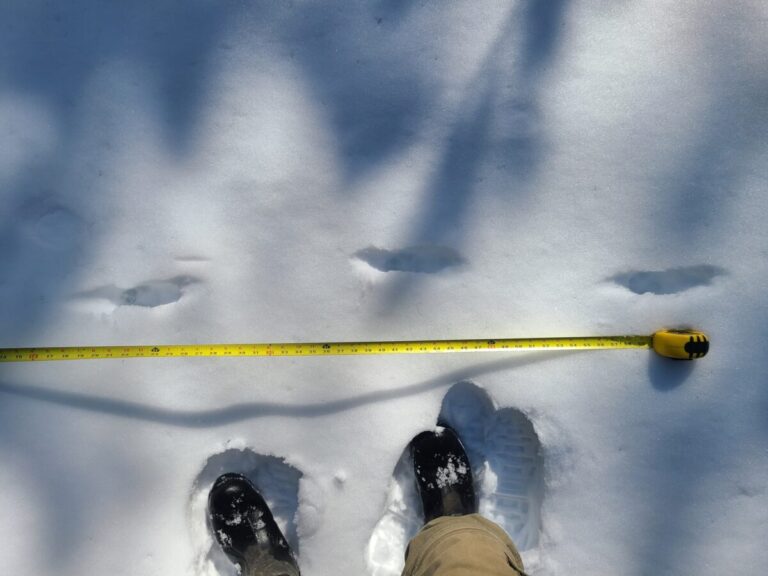
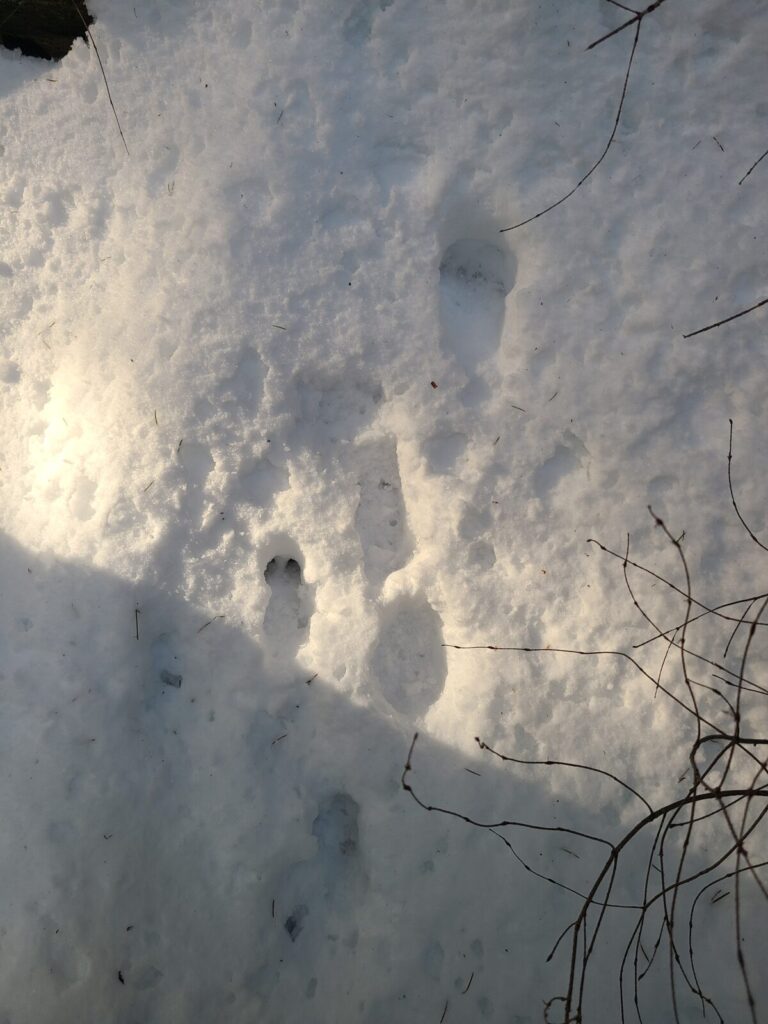
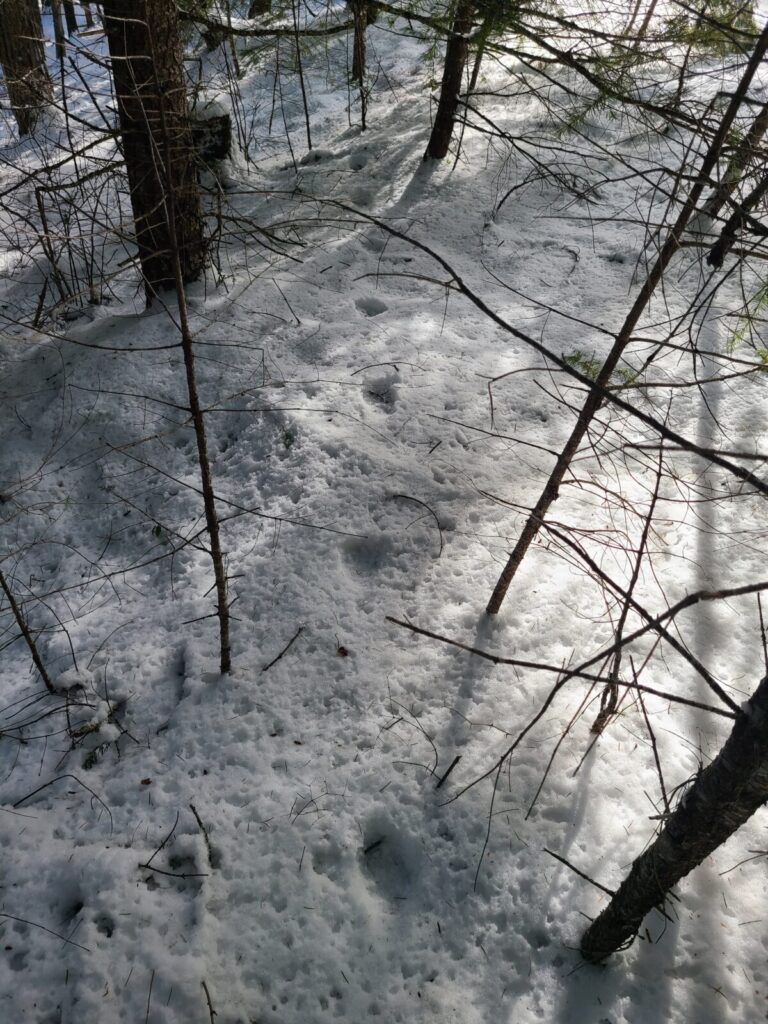
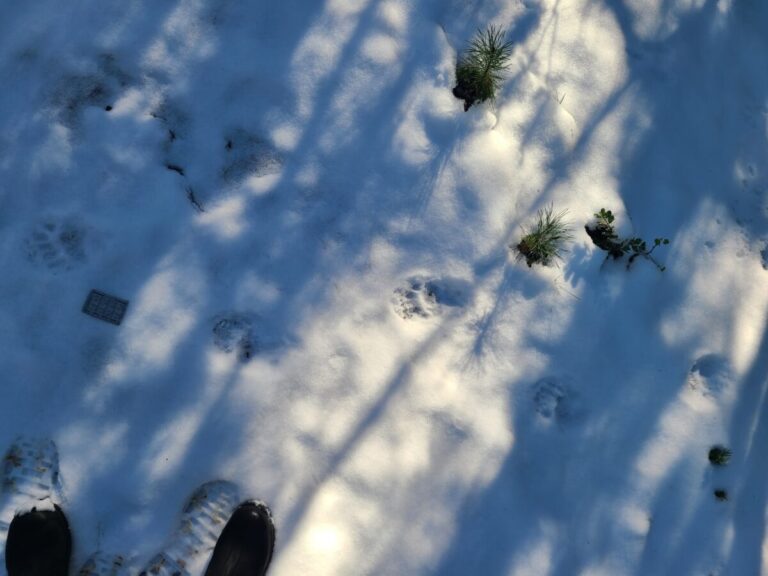
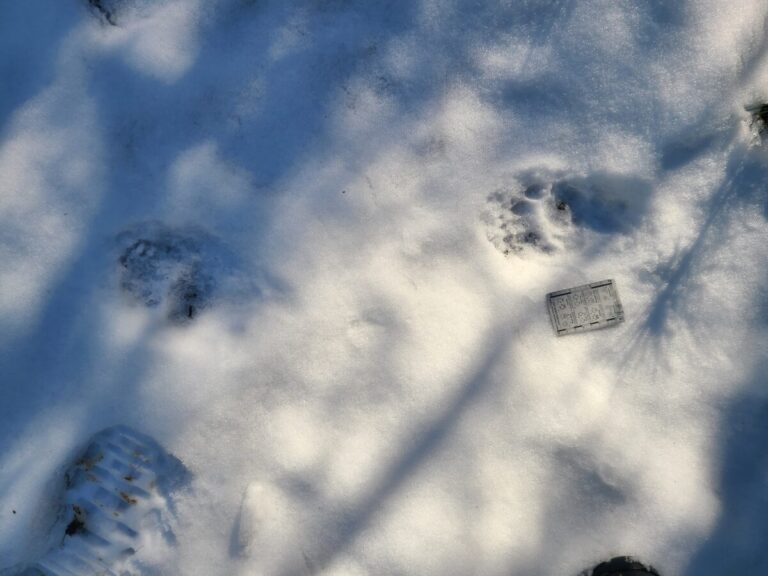
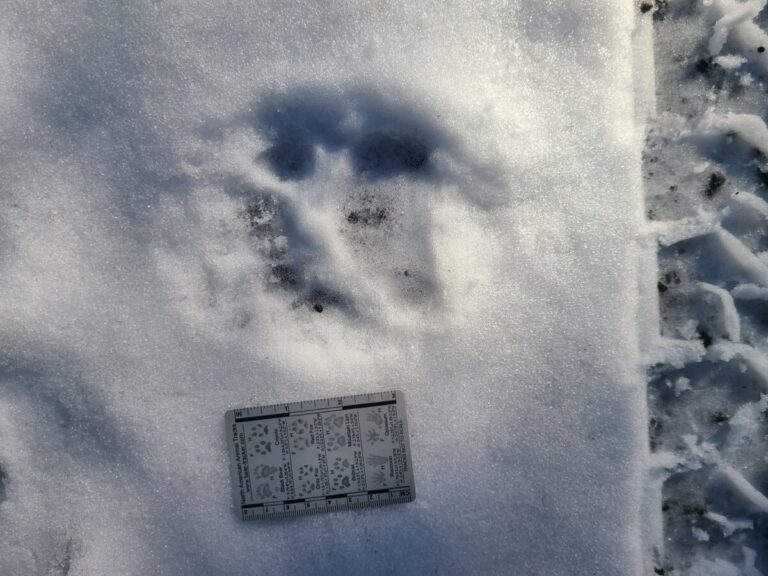
This largest cat of North America occurs throughout this area, though I suspect it is relatively sparse at the highest elevations in winter where deer are sparse or absent. Keeping an eye out in areas with clear deer sign is probably the best way to locate lion tracks in the snow. Their usual gait is a steady walk, with spacing not much different than deer in the snow, but the feet of the lion of course make large round impressions versus the narrow holes of deer. In fact, it is not uncommon to find lions following deer trails and in the photos below I included one that shows a lion impression over a deer print. I have included two sets of images. The first set is primarily of lion trails without closeup views of individual prints. They all show a pretty consistent direct register walking gait, which is what would be expected in this depth of snow. Distance from one foot hole to the next is approximately 20-24 inches most of the time, which is common for a large adult Mountain Lion. The second set of images focuses on a few footprints that were discernible in the snow.
Somewhat old Mountain Lion tracks under the tree canopy (note rough snow surface)
Mountain Lion trail with deer trail.
Either two Mountain Lions or the same lion crossing its own trail.
Closer view of the crossed trail.
Mountain Lion trail through woods.
Mountain Lion trail through woods.
Mountain Lion trail through the smooth deep snow on a forest road with relatively open canopy.
Mountain Lion trail along the edge of a forest road.
Mountain Lion trail along the edge of a forest road.
Mountain Lion stepping up onto a log to cross it.
Mountain Lion traveling in deeper snow.
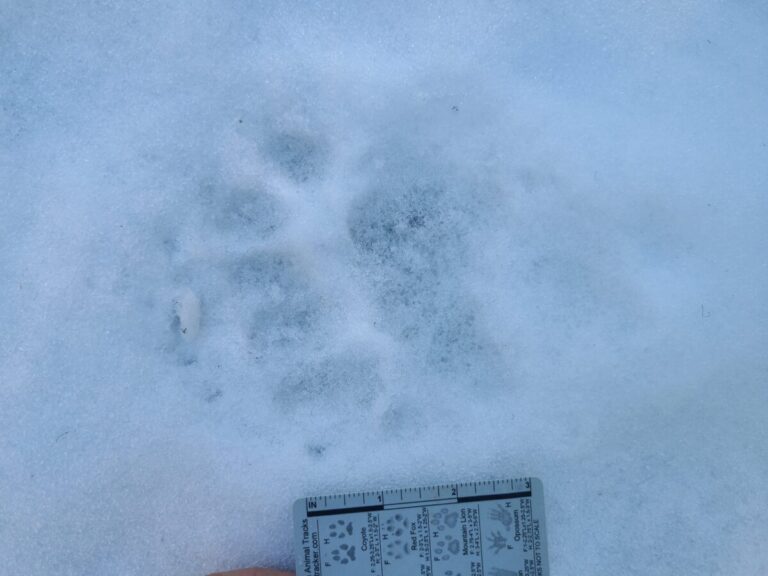
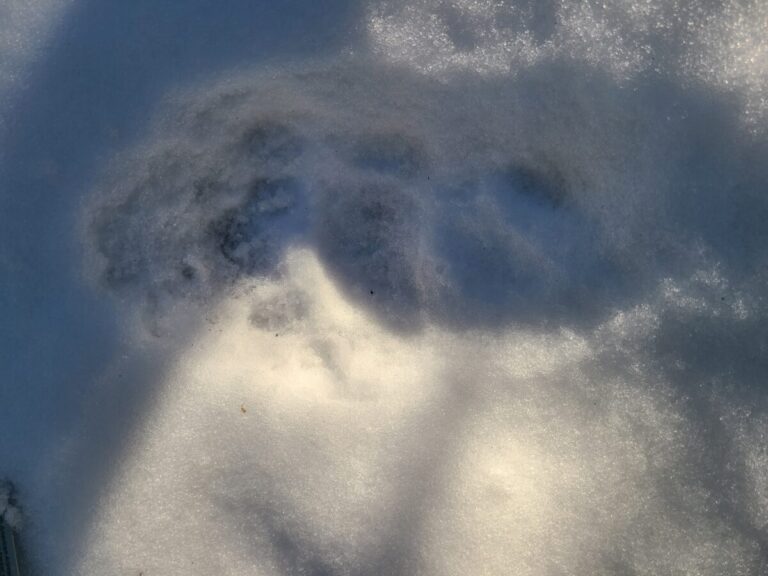
This next set of photos show a few Mountain Lion footprints in the snow. None were very recent or clear, but on some of them I think you will be able to see key features such as asymmetrical toe arrangement and large meta pad.
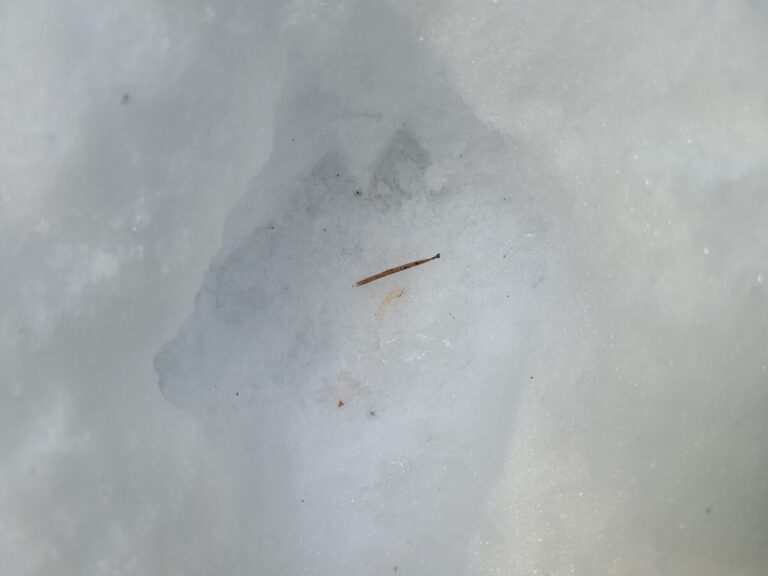
Mountain Lion foot impression over a deer track. In this part of the trail the Mountain Lion was putting its feet into the foot holes made by the deer.
Mountain Lion right-side print.
Mountain Lion left-side print.
Mountain Lion left-side print.
Mountain Lion left-side print, enhanced to better reveal details.
Mountain Lion left-side print.
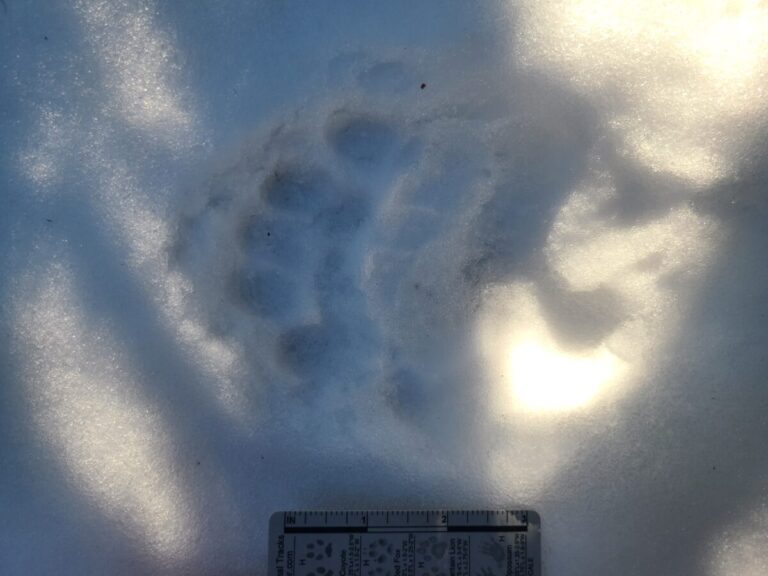
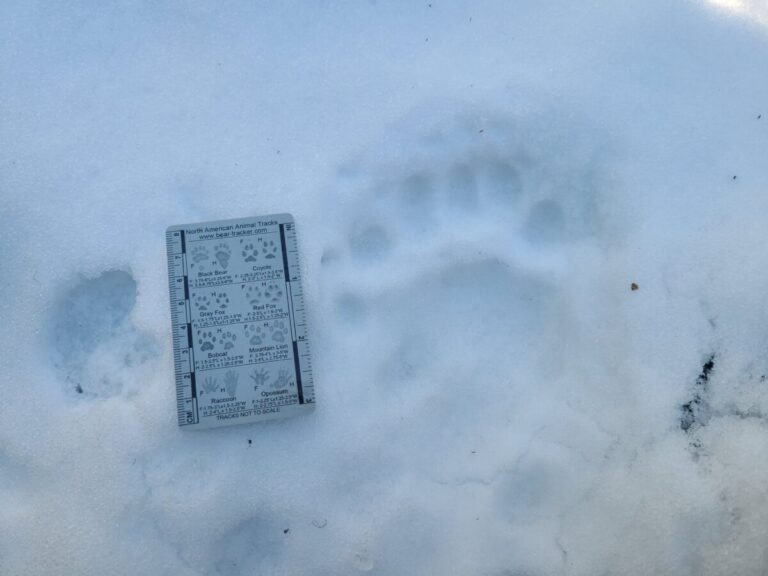
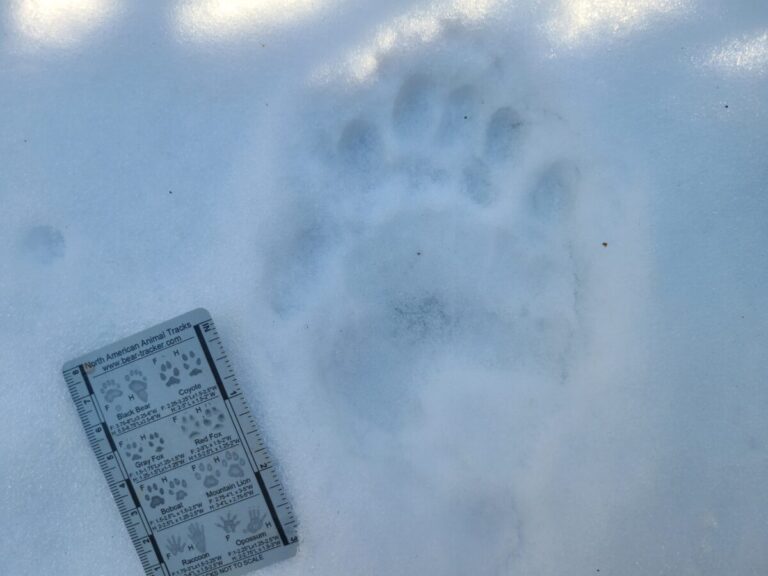
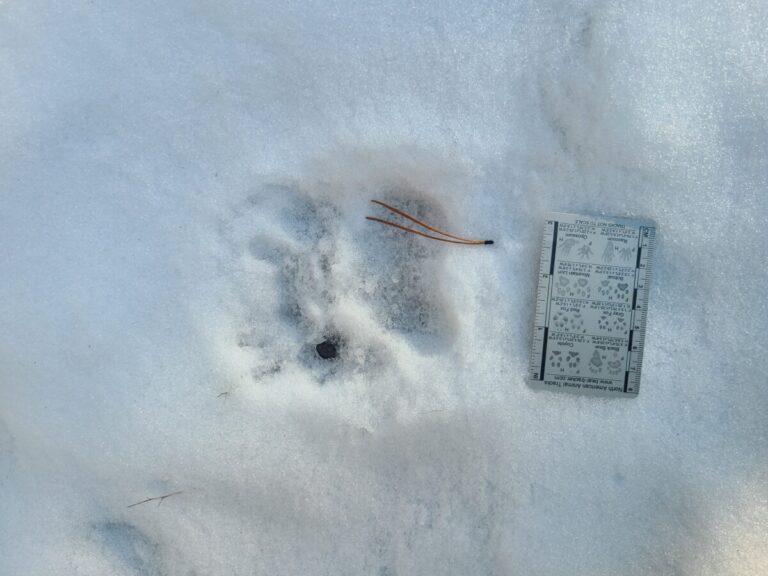
Black Bear
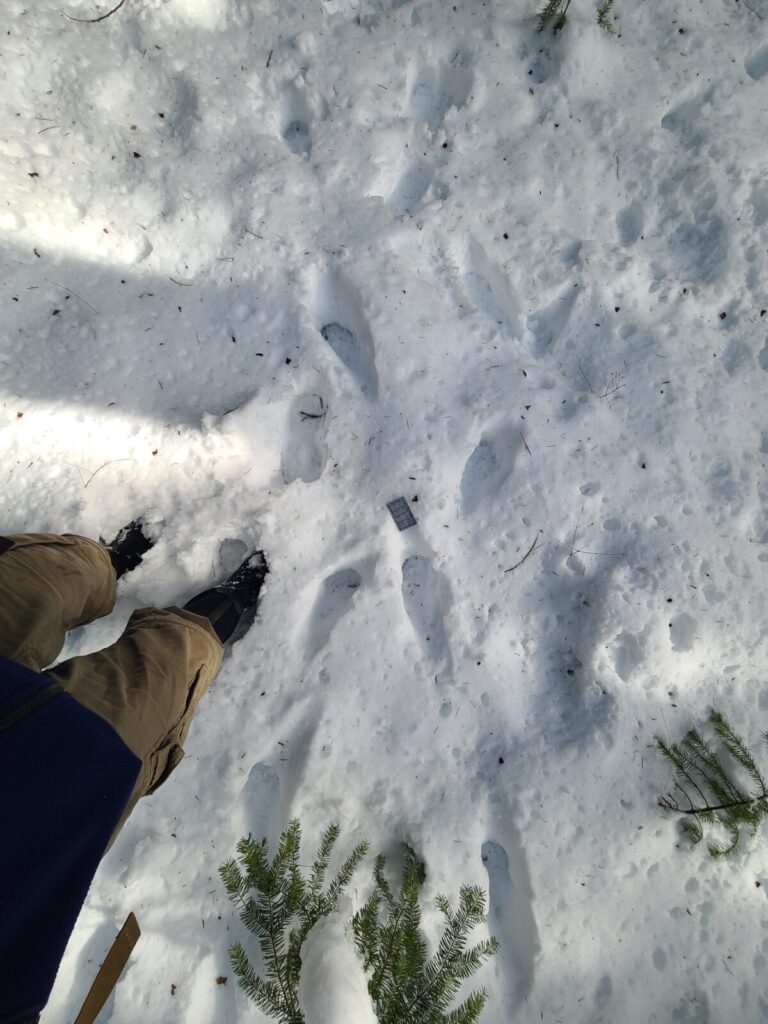
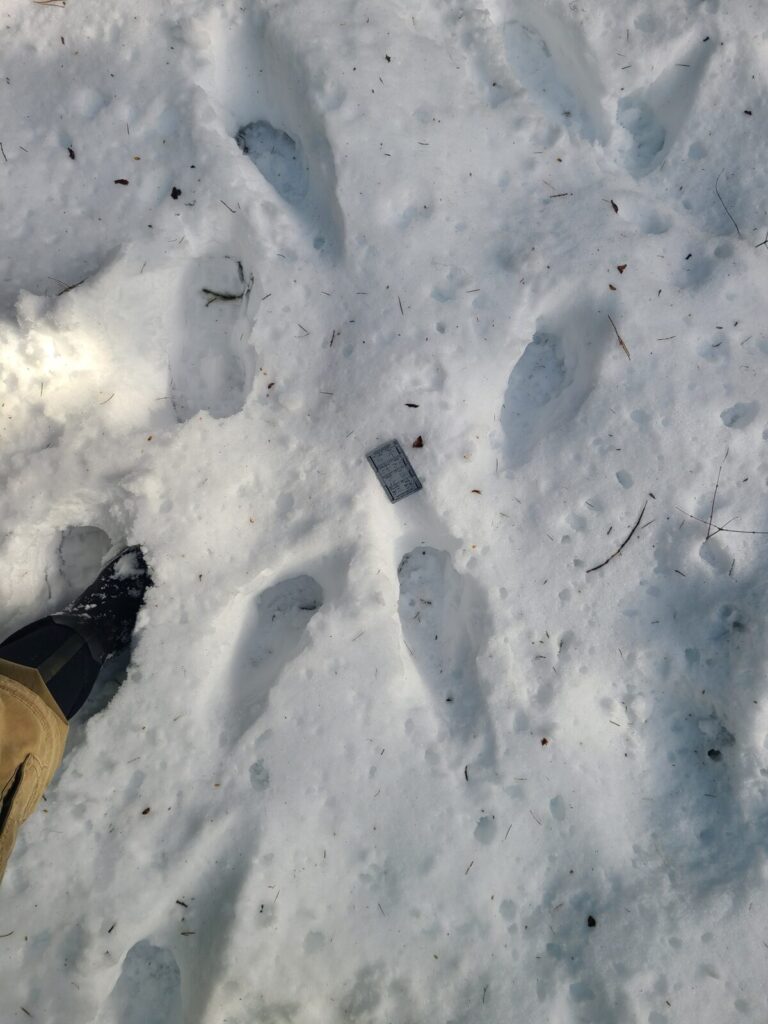
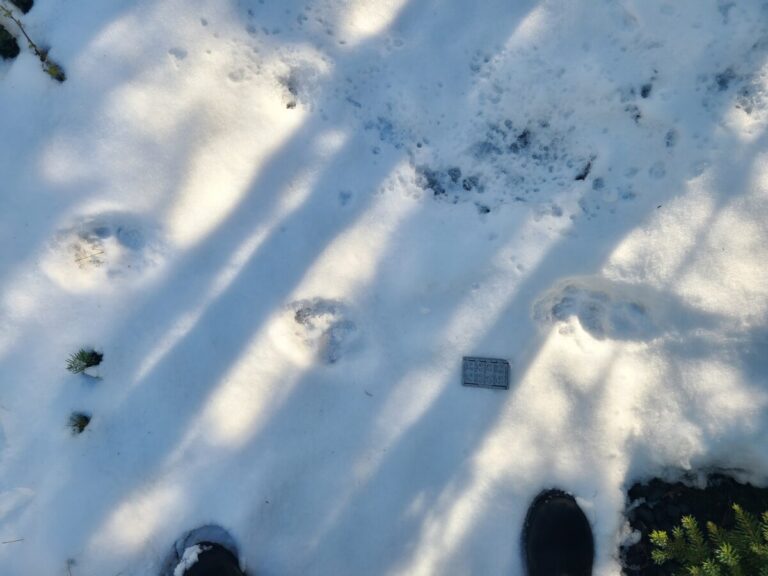
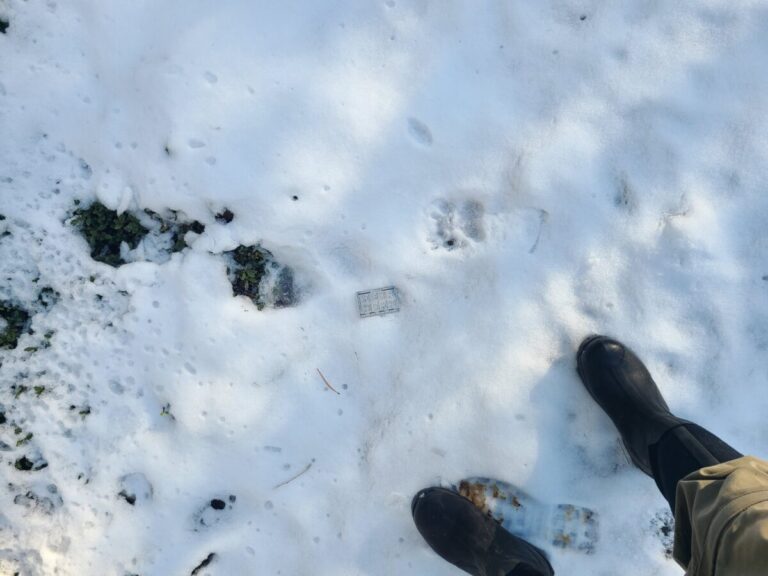
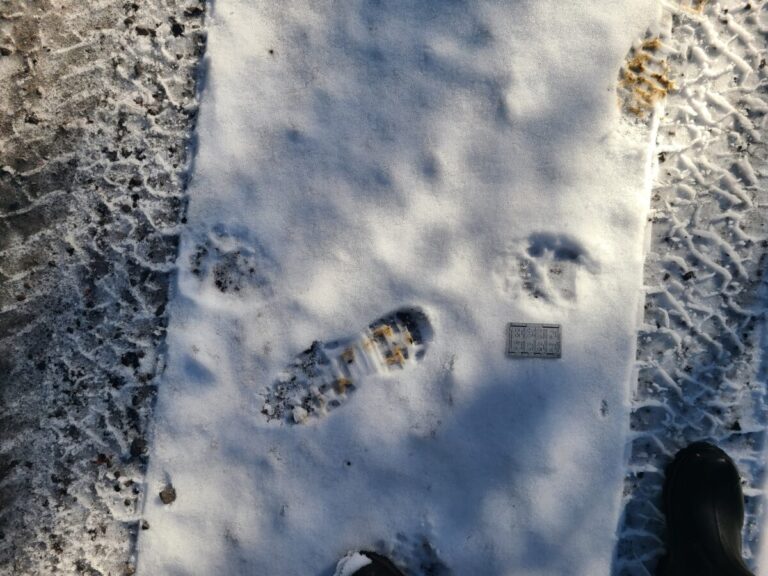
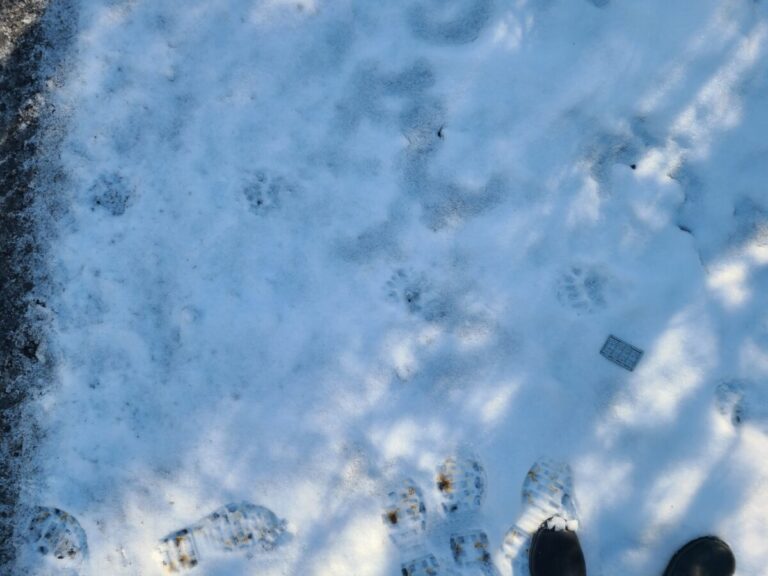
Black Bears at high elevations likely den and become dormant for several of the coldest months when the snow is deepest, but early and late snows will show their presence. When foot holes in the snow are the only thing visible (e.g. no detailed prints) bear trails can look something like a Mountain Lion trail or even a human walking trail because of the larger foot holes and zig zag of the steps. However, an average-sized bear usually makes walking holes/impressions that are between lions and humans in size.
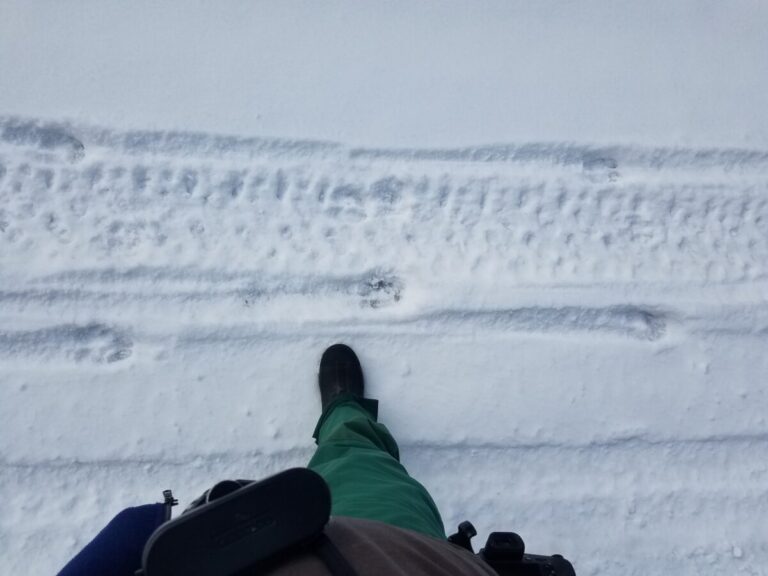
Black Bear trail crossing road, traveling right to left, in a direct register, even though the snow is only an inch or two deep.
Black Bear trail crossing road, traveling right to left, in a direct register, even though the snow is only an inch or two deep.
Black Bear trail crossing road, traveling right to left, in a direct register, even though the snow is only an inch or two deep.
Black Bear trail crossing road, traveling right to left, in a direct register, even though the snow is only an inch or two deep.
Black Bear trail crossing road, traveling right to left, in a direct register, even though the snow is only an inch or two deep.
Black Bear trail crossing road, traveling right to left, in a direct register, even though the snow is only an inch or two deep.
Black Bear showing extra toes from double register, right side based on the wider right edge of the meta pad.
Black Bear double register, right side based on widest part of meta pad on right side.
Black Bear double register, left side because of wider part of metapad on left and lowest toe on right.
Black Bear showing extra toe due to double register, right side because meta pad widest on right.
Black Bear double register, left side because of wider left side of meta pad and lowest toe on right.
Black Bear double register, right side because meta pad widest on right and lowest toe on left.
Black Bear double register, right side because meta pad widest on right.
Black Bear double register, right side because meta pad widest on right and lowest toe on left.
Black Bear double register, left side because outer toe slightly out of line with rest of toes, meta pad shape difficult to discern.
Roosevelt Elk
As with deer, elk tend to move to lower elevations or areas with a denser tree canopy to find food, but are able to survive in deeper snow than deer. In years of little snowfall, elk and deer may be present more throughout the area. Elk tend to travel in groups more than the Columbian Black-tailed Deer present on the west side of the Cascades, so sometimes when elk tracks are found there are tracks from a number of animals. The tracks are of course much larger than those of deer and make strong impressions in the snow.
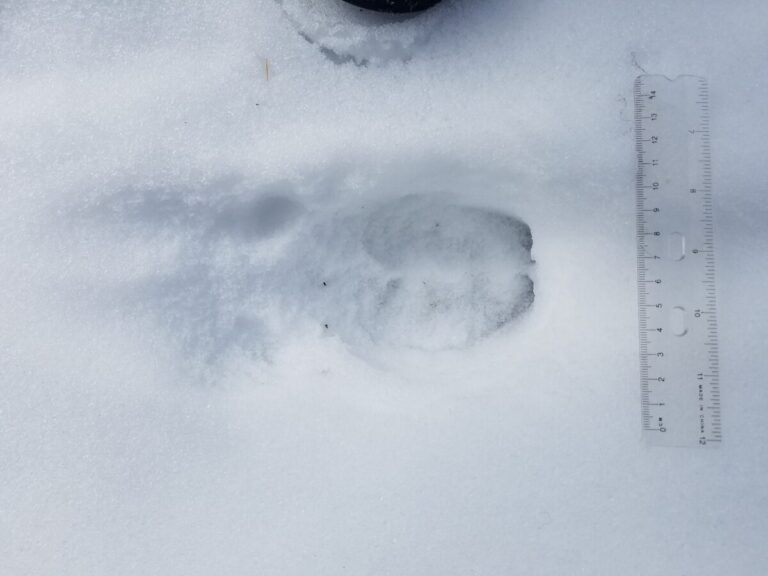
A single elk track, traveling right to left based on greater thickness to the right of center.
Elk trail moving left to right based on presence of dew claws behind hooves.
Single elk track moving left to right, showing dew claws on left behind hoof and narrowest part of cleaves facing right.
Short view of an elk trail moving left to right. Note dew claws to left of hoof.
ADDITIONAL SPECIES
There are over a dozen species whose tracks one might encounter in the snow in the High Cascades but whose tracks or sign I have not yet encountered in the snow in this area. Some I have encountered outside of the snow season. Others I have not detected at all but should be present. The hibernating species I would only expect early or late in the season, if at all. Tracks and sign of the others I hope to encounter at some point.
Shrews (at least two species present in area) Jumping Mice (hibernator) Several bird species (especially hawks, owls, jays, and woodpeckers) Coast Mole (possible but unlikely or rare in area) Humbolt’s Flying Squirrel (detected in area outside of snow season) Belding’s Ground Squirrel (hibernator) Golden-mantled Ground Squirrel (hibernator) Western Spotted Skunk (likely present at lower elevations) Douglas’s Ground Squirrel (hibernator and edge of range) Muskrat (possible, though I’m not aware of observations in the area) Porcupine (I would expect them to be present but no records) Yellow-bellied Marmot (hibernator and edge of range) Virginia Opossum (detected outside of snow season, rare in area) Badger (rare, documented near Diamond Lake in snow) North American River Otter (present in area) Wolverine (likely present at least occasionally) Gray Wolf (this area is the home range of the Indigo pack; I have camera trap images and probable scat)
I hope this gives you some ideas of what to look for the next time you are up in the snow in the Cascades of eastern Douglas County and elsewhere. Most of these observations were made in the vicinity of Toketee Lake, Lemolo Lake, Cinnamon Butte Road, or Diamond Lake, all accessible from the North Umpqua Highway (Hwy 138). Let me know if you have any questions or would like to join me for some tracking or other outdoor adventures. For more wildlife images, fieldnotes and tracking content see my Umpqua Basin Wildlife facebook page and other blog posts. Enjoy!–Matt
Very interesting stuff, Matt! Your work really pushes me to want to be more inquisitive myself about the natural world, and not just pass by without closer examination. Last month Mary signed us up for a mushroom hunt. Olivia joined us too and we had a great time exploring and learning about fascinating phenomenon and facets of nature that I have rarely given any attention to before. Because it has always been difficult for my mind to recall exact names and facts, I have mostly settled with a very general understanding of things. I.E.: large animal tracks verse small animal tracks. In fact, it doesn’t even enter my mind to think about what a particular animal may have been accomplishing while moving through the snow, or digging holes, or chewing on a tree branch. That’s just what they do! But life is truly more spectacular when you get down to brass tacks and appreciate the interplay and patterns of God’s creation, even when the only thing before our eyes is clues from the past, or tracks in the snow.
I did recognize the slightly smaller snow shoe size difference of a Lisa. 😉 Perhaps I can coaxs my bride to join me in exploring in the snow this winter as well. 🙂
Not being familiar with winter tracking (or any tracking), the first thing that came to my mind was “Boy! It must be REALLY COLD!”
Even being unfamiliar with tracking of all types, I am impressed at how you can guess the animal/bird that made those tracks.
Good Job Matt!
I am really impressed!!!
Not being familiar with wildlife tracking, (I live in a very warm climate) the first thing I thought of was “My! it must be REALLY COLD!!! ”
I can only imagine what those birds and animals look like. and how they must labor on a daily basis just to find something to eat and to continue living!
Amazing amount of information. My only suggestion would be to add an index or a search function so a person would be able to seek out a specific plant or animal with out looking through the whole post
Hey Jim! Good to hear from you! Yes, it is a LOT of information, isn’t it!? For me it is more like a reference piece versus a short blog post. To search, from a computer browser menu, go to Edit, then Find in page. The shortcut for this is usually CTRL+F. I haven’t tried to do this from a cell phone.
Hi Dick! I have not seen GHOW tracks or plunges in the snow in person. I’ve just seen others’ photographs. I’m looking forward to the experience! I have seen GHOW tracks in mud.
Matt,
Thanks for this. It’s super-informative and fun. It just snowed here in La Grande, so tomorrow I can go out to the feeders and check out some bird prints. well-done!
This Post Has 12 Comments
Very interesting stuff, Matt! Your work really pushes me to want to be more inquisitive myself about the natural world, and not just pass by without closer examination. Last month Mary signed us up for a mushroom hunt. Olivia joined us too and we had a great time exploring and learning about fascinating phenomenon and facets of nature that I have rarely given any attention to before. Because it has always been difficult for my mind to recall exact names and facts, I have mostly settled with a very general understanding of things. I.E.: large animal tracks verse small animal tracks. In fact, it doesn’t even enter my mind to think about what a particular animal may have been accomplishing while moving through the snow, or digging holes, or chewing on a tree branch. That’s just what they do! But life is truly more spectacular when you get down to brass tacks and appreciate the interplay and patterns of God’s creation, even when the only thing before our eyes is clues from the past, or tracks in the snow.
I did recognize the slightly smaller snow shoe size difference of a Lisa. 😉 Perhaps I can coaxs my bride to join me in exploring in the snow this winter as well. 🙂
Not being familiar with winter tracking (or any tracking), the first thing that came to my mind was “Boy! It must be REALLY COLD!”
Even being unfamiliar with tracking of all types, I am impressed at how you can guess the animal/bird that made those tracks.
Good Job Matt!
I am really impressed!!!
It takes a lot of experience to become familiar with their tracks an habits and you’ll notice that I have a LOT of questions!!! 🙂 🙂 🙂
Not being familiar with wildlife tracking, (I live in a very warm climate) the first thing I thought of was “My! it must be REALLY COLD!!! ”
I can only imagine what those birds and animals look like. and how they must labor on a daily basis just to find something to eat and to continue living!
GOOD JOB MATT!!
Thanks Matt! I will be taking more photos of tracks next time I get in the snow! What fun and really interesting!
Amazing amount of information. My only suggestion would be to add an index or a search function so a person would be able to seek out a specific plant or animal with out looking through the whole post
Hey Jim! Good to hear from you! Yes, it is a LOT of information, isn’t it!? For me it is more like a reference piece versus a short blog post. To search, from a computer browser menu, go to Edit, then Find in page. The shortcut for this is usually CTRL+F. I haven’t tried to do this from a cell phone.
This is great work Matt! Have you ever seen great horned owl tracks (and wing marks) in the snow?
Hi Dick! I have not seen GHOW tracks or plunges in the snow in person. I’ve just seen others’ photographs. I’m looking forward to the experience! I have seen GHOW tracks in mud.
Matt your powers of observation are phenomenal! Thank you for sharing this info with us.
Matt,
Thanks for this. It’s super-informative and fun. It just snowed here in La Grande, so tomorrow I can go out to the feeders and check out some bird prints. well-done!
Very interesting.